
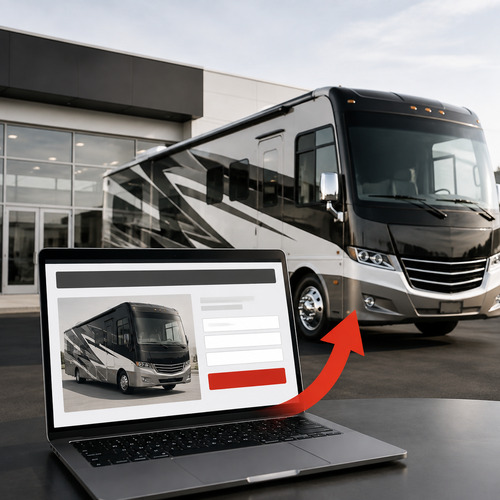
What Landing Page CRO Practices Boost RV Motorhome Lead Conversion?
Landing page CRO boosts RV motorhome lead conversion by cutting form fields, speeding up load times, and matching page content to the exact ad that drove the click. The median landing page converts at 6.6%, but three-field forms convert nearly three times better than nine-field forms, and RV dealers who fix both routinely land in the 10%+ range.
TL;DR
This guide covers the specific landing page changes that move the needle for RV motorhome dealers: form length, page speed, message match, and mobile design. It breaks down real conversion rate benchmarks, what a bloated lead form actually costs you, and how page speed alone can swing conversion rate by 3x. You’ll get a realistic CRO budget and timeline for a single dealership versus a regional group, how to measure whether a redesign actually worked, and how landing page CRO compares to just running more ad spend. Plus a Monday-morning punch list and answers to the five questions RV marketers ask most about cost, timeline, measurement, and what actually moves conversion rate.
AI Summary: Landing page CRO (conversion rate optimization) for RV motorhome dealers is a strategy that systematically tests and improves landing page elements — form length, page speed, headline match, and mobile layout — to convert more paid traffic into leads without increasing ad spend. It works by isolating one variable at a time (form fields, load speed, CTA placement) and measuring the conversion rate impact before rolling out a winning change site-wide. RV dealerships use it because paid media budgets are wasted the moment a qualified click lands on a slow or confusing page. Propellant Media builds and tests landing pages for RV motorhome brands, pairing CRO work with geofencing and programmatic display so every paid click has the best possible chance of converting.
Table of Contents
- What Is Landing Page CRO and How Does It Work for RV Dealers?
- Why Does Landing Page CRO Matter for RV Motorhome Lead Generation?
- How Many Form Fields Should an RV Landing Page Have?
- How Much Does Page Speed Affect RV Landing Page Conversion?
- How Much Does Landing Page CRO Cost for RV Dealers?
- How Do You Measure Whether a Landing Page Redesign Worked?
- How Does Landing Page CRO Compare to Increasing Ad Spend?
- Frequently Asked Questions About Landing Page CRO for RV Dealers
[VISUAL PLACEMENT: Before/after graphic — “RV Motorhome Landing Page Redesign: Before vs After CRO” — alt text: “RV motorhome landing page before and after CRO redesign comparison”]
What Is Landing Page CRO and How Does It Work for RV Dealers?
Landing page CRO (conversion rate optimization) is the systematic testing of page elements — headlines, forms, images, load speed — to increase the percentage of visitors who convert into leads. RV dealers use it to get more value out of paid clicks they’re already paying for, rather than buying more traffic.
Conversion rate optimization is a testing discipline that isolates one page variable at a time. It works by changing a single element — form length, CTA button color, headline copy — and measuring the resulting conversion rate against a control version before rolling the winner out permanently. RV motorhome dealers use CRO to systematically fix the page elements bleeding the most leads, rather than guessing at a full redesign.
The median landing page conversion rate sits at 6.6% across industries, based on Unbounce’s analysis of 464 million visits across 41,000 landing pages, according to Digital Applied’s 2026 landing page statistics report. Top-performing pages reach 10% or higher, with best-in-class pages hitting 15-20% under optimal conditions.
- 6.6% median landing page conversion rate across industries (Unbounce data)
- 10%+ conversion rate for top-performing pages
- 15-20% conversion rate for best-in-class pages under optimal conditions
- RV motorhome dealers with unoptimized pages often sit well below the 6.6% median
Landing Page Conversion Rate Tiers
2-3%
Unoptimized
6.6%
Median
15-20%
Best-in-class
Source: Unbounce data, via Digital Applied 2026 report
Why Does Landing Page CRO Matter for RV Motorhome Lead Generation?
Landing page CRO matters because a slow or overcomplicated page destroys the value of every dollar spent on geofencing, DOOH, or paid search before a shopper ever becomes a lead. Fixing the page is almost always cheaper than buying more traffic to compensate.
Every 1-second delay in page load costs roughly 7% in conversions, and pages loading in 1 second convert nearly 3x higher than pages loading in 5 seconds — 9.6% versus 3.3% — according to SHNO’s 2026 landing page conversion statistics roundup. 47% of users expect a page to load in 2 seconds or less, and pages with poor Core Web Vitals can pay 22% more per click than a faster competitor bidding the same keywords.
In our experience managing landing pages for RV and outdoor recreation clients, the single biggest conversion killer isn’t creative or copy — it’s a form asking for more information than the shopper is willing to give up on a first visit.
How Many Form Fields Should an RV Landing Page Have?
An RV landing page should ask for no more than three fields — typically name, phone or email, and one qualifying field like ZIP code or unit type of interest — since three-field forms convert at 10.1% compared to just 3.6% for nine-field forms.
Form abandonment is the point at which a visitor starts filling out a form but leaves before submitting. It works against RV dealers specifically because 81% of visitors abandon forms after starting, and 67% never return to finish, per the same SHNO data. On mobile, 62% of form abandonments cite form complexity as the direct cause — a meaningful number given how much RV research happens on phones during commutes and evenings.
- 3-field forms: convert at 10.1%
- 9-field forms: convert at only 3.6% — a 64% drop
- 81% of visitors abandon a form after starting it
- 62% of mobile abandonments cite form complexity as the reason
How Much Does Page Speed Affect RV Landing Page Conversion?
Page speed affects RV landing page conversion directly and severely — a page loading in 1 second converts at roughly 9.6%, while the same page loading in 5 seconds converts at only 3.3%, a nearly 3x difference with no other changes made.
Mobile performance matters even more for this audience. The average mobile landing page converts at 2.8% compared to 4.8% on desktop, per HubSpot’s 2026 landing page report — and since RV shoppers are disproportionately likely to click a geofencing or DOOH-driven ad from their phone, a slow mobile experience is actively working against every other channel investment.
| Load Time | Conversion Rate | Relative Impact |
|---|---|---|
| 1 second | 9.6% | Baseline |
| 3 seconds | ~6% | Roughly 37% lower |
| 5 seconds | 3.3% | Roughly 66% lower |
How Much Does Landing Page CRO Cost for RV Dealers?
Landing page CRO for a single RV dealership typically runs $1,500 to $3,500 as a one-time build or redesign project, with ongoing testing and iteration priced at $500 to $1,500 per month. Regional dealer groups running multiple location-specific pages often spend $5,000 to $12,000 for the initial build across locations.
The practical starting point for a dealer with a limited budget is auditing the existing page for form length and load speed first — the two highest-impact, lowest-cost fixes — before investing in a full visual redesign.
- Single-page redesign: $1,500–$3,500 one-time
- Ongoing testing/iteration: $500–$1,500/month
- Multi-location build: $5,000–$12,000 for a regional group
- Fastest wins: cut form fields to 3, fix load speed, before a full redesign
How Do You Measure Whether a Landing Page Redesign Worked?
A landing page redesign worked if conversion rate improves against the same traffic sources and season, measured through an A/B test or a clean before/after comparison over at least 200 conversions per version to avoid drawing conclusions from noise.
Track conversion rate by traffic source separately — a redesign that helps paid search traffic may not help geofencing-driven traffic the same way, since visitor intent differs by channel. Watch cost-per-lead alongside raw conversion rate, since a higher-converting page with lower lead quality isn’t actually a win.
How Does Landing Page CRO Compare to Increasing Ad Spend?
Landing page CRO is almost always cheaper per incremental lead than increasing ad spend, since it improves the conversion rate on traffic you’re already paying for instead of buying more traffic at the same conversion rate.
A dealer spending $5,000/month on geofencing marketing at a 3% landing page conversion rate generates roughly the same lead volume as increasing spend to $8,300/month at that same 3% rate — or simply fixing the page to convert at 6.6% and keeping the original $5,000 budget. Most RV dealerships get the best return by doing both: a one-time CRO investment first, then scaling programmatic display advertising spend once the page is actually converting well.
What Creative and Copy Practices Support Higher Conversion?
The RV landing pages that convert best match the exact headline and image from the ad that drove the click, load in under 2 seconds, and place the form above the fold on mobile without requiring a scroll to find it.
- Message match: headline and hero image mirror the ad creative exactly
- Above-the-fold form: no scrolling required on mobile to see the form
- Single clear CTA: one action per page, not competing offers
- Trust signals: dealership reviews, years in business, inventory count near the form
[VISUAL PLACEMENT: Screenshot mockup — “High-Converting RV Motorhome Landing Page Layout Example” — alt text: “RV motorhome landing page layout example with three-field form above the fold”]
Frequently Asked Questions About Landing Page CRO for RV Dealers
How much does landing page CRO cost for an RV dealership?
A single RV dealership can expect to spend $1,500 to $3,500 on a one-time landing page redesign, with ongoing testing and iteration priced at $500 to $1,500 per month.
Regional dealer groups building multiple location-specific pages typically spend $5,000 to $12,000 for the initial multi-page build. Dealers with limited budgets should start with the two highest-impact, lowest-cost fixes — cutting form fields to three and improving page load speed — before investing in a full visual redesign, since those two changes alone can move conversion rate significantly.
How long does a landing page CRO project take?
A single landing page redesign typically takes 2 to 4 weeks from audit to launch, while a proper A/B test needs to run for at least 2 to 4 weeks afterward to collect enough conversions for a reliable result.
The timeline breaks down as: 3 to 5 days for a conversion audit, 5 to 10 days for design and build, 2 to 3 days for QA and speed optimization, then an ongoing 2 to 4 week testing window. Dealers wanting results before a specific show or season should start the process at least 6 weeks ahead of peak traffic.
How do I know if my landing page redesign is actually working?
A working redesign shows a measurably higher conversion rate against the same traffic sources over at least 200 conversions per version, not just a handful of leads that could be random variation.
Track conversion rate by traffic source separately, since a redesign that helps paid search may not help geofencing-driven traffic the same way. Also track cost-per-lead and lead quality alongside raw conversion rate — a page that converts more visitors into low-quality leads isn’t actually a win. Give any test at least 2 to 4 weeks before declaring a winner.
Is landing page CRO better than just increasing ad spend?
Landing page CRO is almost always more cost-efficient than increasing ad spend, because it improves how much value you get from traffic you’re already paying for instead of buying more traffic at the same conversion rate.
A page converting at 3% needs roughly 66% more traffic (and budget) to match the lead volume of the same page converting at 6.6% after a CRO fix. Most RV dealerships get the best return doing both in sequence: fix the landing page first, then scale ad spend once the page is proven to convert well, rather than scaling spend into a page that’s still leaking leads.
Are there compliance considerations for RV landing page forms?
Yes — RV landing pages collecting phone numbers need TCPA-compliant consent language for any follow-up calls or texts, and any financing or pricing information displayed must match dealership disclosure requirements.
Include clear opt-in language above the submit button, not buried in fine print, and make sure any “starting at” pricing includes required disclosures. Most CRM and landing page platforms include compliant consent checkboxes by default, but always confirm with your dealership’s compliance process before launching a new form, especially one collecting phone numbers for SMS follow-up.
Key Takeaways
- Cut landing page forms to 3 fields — 9-field forms convert 64% worse than 3-field forms.
- Fix page load speed to under 2 seconds — a 1-second page converts nearly 3x higher than a 5-second page.
- Median landing page conversion rate is 6.6%; top performers hit 10-20%.
- Budget $1,500-$3,500 for a single-page redesign, $5,000-$12,000 for a multi-location build.
- Match landing page headlines and images exactly to the ad creative that drove the click.
- Test one variable at a time and wait for at least 200 conversions per version before declaring a winner.
- Fix the page before scaling ad spend — it’s almost always the cheaper way to generate more leads.
Ready to Fix Your RV Dealership’s Landing Page?
Propellant Media builds and tests landing pages specifically for RV motorhome dealers, paired with geofencing and programmatic display so every paid click has the best chance of converting. Talk to our team about a CRO audit for your current landing page.
Justin Croxton, CEO of Propellant Media
Published: July 21, 2026