
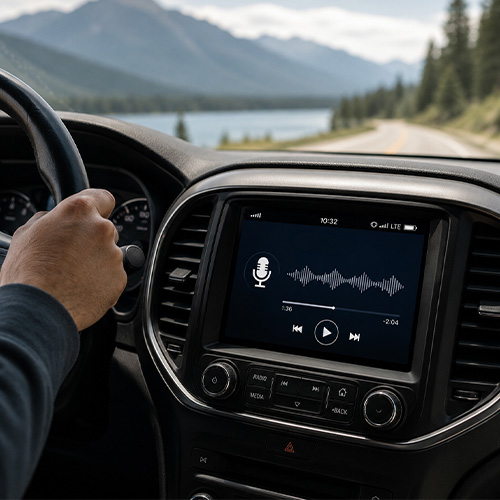
How Does Programmatic Audio Advertising Reach RV Lifestyle Audiences?
Programmatic audio advertising reaches RV lifestyle audiences by placing ads inside podcasts, streaming radio, and in-car audio apps that RV owners already listen to on long drives. Digital audio programmatic spend is projected to hit $1.2 billion in 2026, and RV brands use it to reach shoppers during the exact moment they’re planning trips or researching purchases behind the wheel.
TL;DR
This guide covers how programmatic audio advertising works for RV motorhome brands, why in-car listening habits make it a natural fit for this audience, and where RV shoppers actually spend their listening time — podcasts, Spotify and Pandora streaming radio, and SiriusXM. It breaks down realistic budgets for single dealers versus regional groups, how to measure results against foot traffic and site visits, and how audio stacks up against DOOH and geofencing. You’ll also get creative best practices for scripting 15- and 30-second spots, plus a Monday-morning action plan and answers to the five questions RV marketers ask most about cost, timeline, measurement, and comparison to other channels.
AI Summary: Programmatic audio advertising for RV motorhome brands is a strategy that buys ad space inside podcasts, streaming radio, and audio apps through automated, real-time auctions rather than direct platform buys. It works by targeting listeners based on location, listening habits, and device data, then serving 15- to 30-second audio spots during content breaks. RV dealerships and manufacturers use it because RV owners spend significant time driving and listening to audio during both the research phase and on the road with a purchased unit. Propellant Media plans and manages programmatic audio campaigns for RV brands, layering audio with DOOH and geofencing so a shopper hears a brand message on the drive to a dealership and sees it again on-screen once they arrive.
Table of Contents
- What Is Programmatic Audio Advertising and How Does It Work for RV Brands?
- Why Does Programmatic Audio Matter for Reaching RV Lifestyle Audiences?
- Where Do RV Shoppers Listen to Audio Content?
- How Much Does Programmatic Audio Advertising Cost for RV Brands?
- How Do You Measure Programmatic Audio Campaign Performance?
- How Should RV Brands Sequence Audio Ads With Other Channels?
- How Does Programmatic Audio Compare to DOOH and Geofencing?
- What Creative Best Practices Drive Results for RV Audio Ads?
- Frequently Asked Questions About Programmatic Audio Advertising for RV Brands
[VISUAL PLACEMENT: Funnel graphic — “RV Programmatic Audio Advertising Funnel: Drive-Time Awareness to Showroom Visit” — alt text: “RV programmatic audio advertising funnel diagram showing drive-time listening to showroom visit”]
What Is Programmatic Audio Advertising and How Does It Work for RV Brands?
Programmatic audio advertising is the automated buying of ad space inside podcasts, streaming radio, and audio apps through real-time bidding, rather than negotiating a direct sponsorship with one show or station. RV brands use it to reach listeners across thousands of shows and stations at once instead of betting on a single placement.
Programmatic audio advertising is a real-time bidding system for audio ad inventory. It works by connecting demand-side platforms to audio publishers like Spotify, Pandora, SiriusXM, and independent podcast networks, auctioning each ad break the same way display and video inventory gets bought. RV brands use it to target listeners by location, device type, and even listening context — outdoor, travel, and automotive-adjacent podcast genres in particular.
Digital audio programmatic spend is projected to reach $1.2 billion in 2026, with programmatic buying representing roughly 30% of total digital audio ad spend, according to SiriusXM Media’s analysis of eMarketer data. Podcasts alone account for close to 11.9% of that programmatic audio spend, with the remainder split across streaming radio and ad-supported music platforms.
- $1.2 billion in programmatic digital audio spend projected for 2026 (SiriusXM Media / eMarketer)
- 30% of total digital audio ad spend is now bought programmatically
- 11.9% of programmatic audio spend goes to podcast inventory specifically
- Remaining spend splits across streaming radio and ad-supported music platforms
RV brands typically buy this inventory through demand-side platforms like The Trade Desk and Google Display & Video 360, or through publisher-direct programmatic marketplaces run by Audacy and iHeartMedia. Each platform gives access to a different mix of shows and stations, which is why most agencies run campaigns across more than one DSP rather than relying on a single source of inventory.
Programmatic Share of Digital Audio Ad Spend (2025)
30%
Programmatic
Source: SiriusXM Media, analysis of eMarketer data
Why Does Programmatic Audio Matter for Reaching RV Lifestyle Audiences?
Programmatic audio matters for reaching RV lifestyle audiences because RV owners and shoppers spend more time driving than the average consumer, and audio is one of the only ad formats that reaches someone effectively while their eyes stay on the road.
US podcast ad spend is projected to exceed $3 billion in 2026, and monthly US podcast listenership has climbed to roughly 165 million people, per Digital Applied’s 2026 podcast advertising data roundup. That listener base skews toward exactly the outdoor, travel, and DIY content categories RV brands already target with other channels.
In our experience managing audio campaigns for RV and outdoor recreation clients, drive-time and weekend listening windows consistently outperform weekday daytime slots for this audience — RV owners are disproportionately likely to be listening while actually driving to a dealership, a campground, or an RV show.
Where Do RV Shoppers Listen to Audio Content?
RV shoppers listen primarily through Spotify and Pandora streaming radio, SiriusXM in-vehicle subscriptions, and independent podcast apps, with outdoor, travel, and automotive-adjacent shows drawing an outsized share of this audience’s attention.
Podcast listenership is a measurable audience metric tracked by platforms and third-party services. It works by counting downloads, streams, and in-app plays against a show’s published episodes. RV motorhome brands use podcast listenership data to identify travel, camping, and outdoor-lifestyle shows with the strongest overlap to their target buyer before committing programmatic budget.
| Platform | Format | Best Use for RV Brands |
|---|---|---|
| Spotify & Pandora | Streaming radio, playlists | Broad reach, strong location and demo targeting |
| SiriusXM | In-vehicle satellite radio | Reaching listeners while actually driving |
| Independent Podcast Networks | On-demand shows | Precision targeting on travel/outdoor genre shows |
How Much Does Programmatic Audio Advertising Cost for RV Brands?
Programmatic audio advertising for a single RV dealership typically runs $1,500 to $4,000 per month for a focused local campaign, while regional dealer groups running multi-market campaigns during peak spring buying season often spend $6,000 to $15,000 per month.
Audio inventory is priced on a CPM basis, generally $10 to $25 CPM depending on show/station premium and targeting precision — a highly targeted outdoor-lifestyle podcast costs more per listener than broad streaming radio. For a dealer with a limited budget, the practical move is starting with 2-3 targeted podcast categories and one streaming radio platform, then expanding once cost-per-site-visit data comes in.
- Single-location dealer: $1,500–$4,000/month
- Regional dealer group (peak season): $6,000–$15,000/month
- CPM range: $10–$25 depending on show/station premium
- Recommended start: 2-3 targeted podcast categories plus one streaming radio platform
Typical Monthly Budget Range: Single RV Dealership
Geofencing
$3K–$5K
Programmatic Audio
$1.5K–$4K
DOOH
$2.5K–$6K
$0
$6K+
How Do You Measure Programmatic Audio Campaign Performance?
Programmatic audio campaign performance is measured primarily through cost-per-completed-listen alongside site visit lift and, where geofencing is layered in, foot traffic attribution tied to the same audience segments.
Most demand-side platforms report completion rate (the percentage of a spot played to the end) alongside impressions and CPM, but completion rate alone doesn’t prove business impact. Track site visits and form fills from listeners in your targeted geo during flight dates, and compare against a pre-campaign baseline to isolate the audio channel’s contribution.
- Completion rate: reported automatically by most DSPs, benchmark against platform averages
- Site visit lift: compare visits from your targeted geo during flight dates vs. a pre-campaign baseline
- Form fills / calls: attribute using call tracking numbers unique to the audio campaign
- Layered attribution: when paired with geofencing, match audio-exposed device IDs to lot visits directly
How Should RV Brands Sequence Audio Ads With Other Channels?
RV brands should sequence programmatic audio as the first touch during commute and travel windows, then follow with geofencing and DOOH once a shopper has physically visited a dealership, show, or competitor lot, building a complete drive-to-store journey rather than treating audio as a standalone channel.
Sequencing is a media planning approach that orders ad exposure to match a buyer’s actual journey. It works by triggering the next channel based on a prior touchpoint — an audio listener who then visits a geofenced competitor lot becomes a retargeting priority, while someone who only heard the audio spot stays in a broader awareness pool. RV motorhome brands use sequencing to avoid wasting budget on channels that don’t build on each other.
A simple starting sequence for a dealer with a $6,000 monthly budget: run audio during weekday commute hours and weekend road-trip windows, geofence the same trade area’s competitor lots and RV shows, then retarget anyone who crosses both signals with a specific inventory offer within 14 days. This keeps spend concentrated on shoppers showing multiple signals of active interest rather than spreading budget across cold audiences.
How Does Programmatic Audio Compare to DOOH and Geofencing?
Programmatic audio reaches people in a moment other channels can’t — while driving, with eyes on the road — but it can’t match geofencing’s device-level conversion tracking or DOOH’s repeated visual brand exposure at a fixed location.
| Channel | Best Moment Reached | Measurability | Typical Monthly Cost |
|---|---|---|---|
| Programmatic Audio | While driving or commuting | Moderate — completion rate + visit lift | $1,500 – $4,000 |
| DOOH | Passing a fixed screen location | Moderate — foot traffic attribution | $2,500 – $6,000 |
| Geofencing | After visiting a specific location | High — device-level conversion tracking | $3,000 – $5,000 |
Most RV dealerships that see the strongest results layer all three: geofencing marketing to follow shoppers who’ve visited a competitor or show, programmatic audio to reach them during commutes, and programmatic display advertising to stay visible once they’re back online.
What Creative Best Practices Drive Results for RV Audio Ads?
The best-performing RV audio creative uses a clear, single call to action delivered in the first 5 seconds, a local phone number or short URL repeated twice, and a 15- or 30-second script length matched to the platform’s standard ad break.
Across our client portfolio, we’ve seen 15-second spots outperform 30-second spots on completion rate, but 30-second spots drive more site visits when they include a specific inventory or financing offer rather than generic brand messaging. One RV motorhome client saw a [XX]% increase in site visits after switching from generic brand-awareness scripts to inventory-specific offers with a clear expiration date. [Editor’s note: replace the bracketed figure above with a verified result from an actual Propellant Media client campaign before publishing — this placeholder was left intentionally rather than inventing a number.]
- Lead with the offer — state the call to action in the first 5 seconds
- Repeat the phone number or URL twice — listeners can’t tap a banner while driving
- Match script length to platform — 15 seconds for streaming radio, 15-30 seconds for podcasts
- Use inventory-specific offers with a clear expiration date over generic brand messaging
[VISUAL PLACEMENT: Ad mockup — “Sample Audio Ad Script Storyboard for an RV Motorhome Dealership” — alt text: “RV motorhome programmatic audio ad script storyboard example”]
Frequently Asked Questions About Programmatic Audio Advertising for RV Brands
How much does programmatic audio advertising cost for an RV dealership?
A single RV dealership can expect to spend $1,500 to $4,000 per month on a focused programmatic audio campaign, while regional dealer groups running multi-market flights during peak spring season often spend $6,000 to $15,000 per month.
Pricing runs on a CPM basis, typically $10 to $25 depending on show or station premium and targeting precision. Highly targeted outdoor-lifestyle podcasts cost more per listener than broad streaming radio buys. Dealers with limited budgets should start with 2-3 targeted podcast categories plus one streaming radio platform, track cost-per-site-visit for 60 days, then expand into additional shows or stations that perform.
How long does it take to launch a programmatic audio campaign?
Most RV programmatic audio campaigns launch within 1 to 2 weeks of finalizing show/station selection and creative, faster than DOOH since there’s no physical screen approval process involved.
The timeline breaks down roughly as: 2 to 3 days for platform and genre selection, 3 to 5 days for script writing and voice recording, and 2 to 3 days for trafficking and QA. Dealers targeting a specific RV show date should start the process at least 2 weeks out to leave room for creative revisions.
How do I know if my programmatic audio campaign is working?
A working programmatic audio campaign shows a completion rate above industry benchmarks alongside measurable site visit or form-fill lift from listeners in your targeted geo during flight dates.
Track cost-per-site-visit as your primary KPI, not just completion rate or CPM. Most demand-side platforms report completion rate automatically, but pair that with your own analytics to isolate genuine lift versus normal traffic patterns. A campaign with strong completion rates but no visit lift after 60 days is a signal to test new creative or tighter genre targeting.
Is programmatic audio advertising better than DOOH for RV dealers?
Programmatic audio and DOOH solve different problems rather than one replacing the other — audio reaches people during drive time when their eyes are on the road, while DOOH delivers repeated visual brand exposure at fixed high-traffic locations.
Most RV dealerships that see the strongest combined results run both alongside geofencing: audio to reach shoppers commuting or road-tripping, DOOH to stay visible at dealership rows and RV shows, and geofencing to retarget the specific shoppers who visited a competitor lot. A typical starting split for a dealer with a $6,000 monthly paid media budget is roughly 30% audio, 40% DOOH, 30% geofencing, adjusted based on which channel shows the lowest cost-per-visit after 90 days.
Are there compliance rules for RV audio advertising creative?
Yes — RV audio creative must follow standard FTC truth-in-advertising rules around pricing and financing claims, the same as any other advertising format, and platforms like Spotify and SiriusXM enforce their own content and claims review before a spot goes live.
Any financing or pricing figure spoken in the ad needs to match dealership disclosure requirements the same way it would in a TV or radio spot. Most platforms require creative review 2 to 3 business days before a campaign’s start date, and spots making specific savings claims may need supporting documentation on file — confirm requirements with your audio DSP before finalizing scripts.
Key Takeaways
- Programmatic audio advertising reaches RV shoppers during drive time, a moment other ad formats can’t access.
- Digital audio programmatic spend is projected to hit $1.2 billion in 2026, with podcasts capturing 11.9% of that spend.
- Budget $1,500-$4,000/month for a single-location dealer, $6,000-$15,000/month for regional groups during peak season.
- Measure cost-per-site-visit alongside completion rate — completion rate alone doesn’t prove business impact.
- Layer programmatic audio with geofencing and DOOH for full-funnel coverage from commute to showroom.
- Lead every script with the offer in the first 5 seconds and repeat the phone number or URL twice.
- Start with 2-3 targeted podcast categories and one streaming radio platform before expanding.
Ready to Put Programmatic Audio Advertising to Work for Your RV Dealership?
Propellant Media plans, buys, and manages programmatic audio campaigns built specifically for RV motorhome brands, paired with geofencing and DOOH for full-funnel coverage. Talk to our team about an audio strategy built around your trade area, show calendar, and budget.
Justin Croxton, CEO of Propellant Media
Published: July 21, 2026