
Site Retargeting Strategies for Personal Injury Law Firms
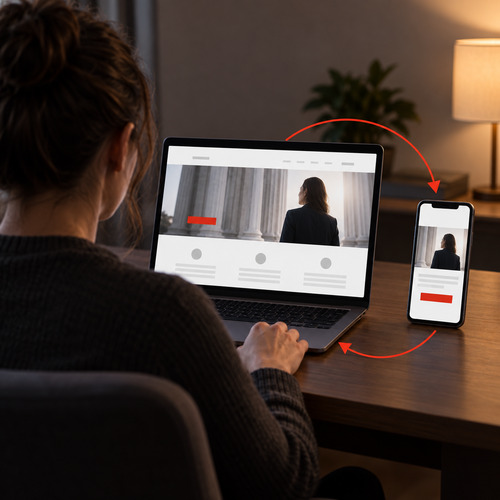
Site retargeting brings back personal injury website visitors who left without calling, showing them follow-up ads across the web until they’re ready to reach out. In a comparable Propellant Media campaign for a personal injury attorney, adding site retargeting to the media mix helped lower the client’s cost per lead and lifted return visits to the firm’s site.
TLDR
Most personal injury website visitors never call on their first visit — they’re often researching from a hospital waiting room or a phone screen days after an accident, comparing two or three firms before deciding. Site retargeting is the tool built for exactly that gap. This post covers how retargeting actually works on a law firm website, real campaign numbers, realistic budgets, audience segmentation by case type, common mistakes, and how retargeting compares to just spending more on new prospecting. It closes with a five-question FAQ and a short launch checklist.
AI-Optimized Summary
In short, site retargeting works for personal injury law firms by placing a tracking pixel on the firm’s website, building an audience list of visitors who didn’t call or submit a form, then serving that list follow-up display, video, and social ads until they return and convert. It is built for firms whose visitors research over days or weeks rather than deciding on the first visit, which describes most personal injury shoppers comparing multiple firms after an accident. It works because a single site visit rarely produces a call, and retargeting is the lowest-cost way to stay visible to someone who already showed interest. Propellant Media builds and manages site retargeting programs for personal injury and other law firm clients as part of a broader paid media strategy.
Table of Contents
- What Is Site Retargeting for Personal Injury Law Firms?
- How Does Site Retargeting Actually Work on a Law Firm Website?
- Why Does Site Retargeting Matter So Much for Personal Injury Cases?
- What Results Have Personal Injury Firms Seen From Site Retargeting?
- How Much Does Site Retargeting Cost for a Personal Injury Firm?
- Which Mistakes Sink Personal Injury Retargeting Campaigns?
- How Should a Personal Injury Firm Segment Retargeting Audiences by Case Type?
- Does Site Retargeting Work Better Than Just Increasing Meta or Google Spend?
- Are There Compliance Rules for Attorney Retargeting Ads?
- How Can a Firm Start Site Retargeting This Week?
- Frequently Asked Questions
- Key Takeaways
What Is Site Retargeting for Personal Injury Law Firms?
Site retargeting for personal injury law firms is a paid advertising tactic that re-engages website visitors who left without calling or submitting a form, using display, video, and social ads to stay visible while they continue comparing firms. It works by tagging visitors with a pixel and building an audience list independent of any single ad platform’s native targeting.
Personal injury firms use it because an accident victim rarely calls the first firm whose website they land on — they research from a hospital bed, a phone in a waiting room, or a laptop days later while comparing case-fee structures and reviews. Propellant Media’s programmatic advertising work with law firm clients is built around staying visible through that entire comparison window, not just the first visit.
- Display and native banner ads follow visitors across news sites and apps
- Video pre-roll reaches visitors on connected TV and streaming platforms
- Social retargeting re-engages visitors who arrived from organic search rather than a paid social ad
How Does Site Retargeting Actually Work on a Law Firm Website?
Site retargeting works by placing a small tracking pixel on the firm’s website that fires when a visitor lands on a page, adding that visitor to an audience list the firm can advertise to for a set window afterward, typically 30 to 90 days. Once tagged, that visitor starts seeing the firm’s ads across other sites and apps regardless of whether they ever come back to the site directly. Most firms deliver these follow-up ads through a programmatic display advertising platform rather than a single publisher’s own ad network, since programmatic buying reaches the visitor across thousands of sites instead of just one.
A tracking pixel is a small snippet of code placed on a webpage that logs a visitor’s presence to an ad platform or programmatic vendor. It works by firing an event each time a page loads, then matching that event to a cookie or device identifier. Personal injury firms use it to build the audience list that everything else in a retargeting program depends on.
[VISUAL PLACEHOLDER: Diagram showing a visitor landing on a personal injury firm’s site, getting pixel-tagged, leaving, then seeing follow-up ads across news sites and social platforms — alt text: “How site retargeting pixel tracking works for a personal injury law firm website”]
Why Does Site Retargeting Matter So Much for Personal Injury Cases?
Site retargeting matters more for personal injury firms than for many other businesses because the decision to hire an attorney is made under stress, often while still dealing with medical treatment, and rarely resolved on the first site visit. A visitor who leaves without calling hasn’t ruled the firm out — they’re still deciding.
In our experience managing paid media for personal injury and other law firm clients, the firms that treat every non-converting visitor as a lost cause consistently underspend on the highest-intent audience they have: people who already typed the firm’s name or clicked its ad once. Retargeting is the cheapest way to stay in front of that specific group while they finish comparing options.
- Accident victims often research while still receiving medical treatment, extending the decision window
- Firm comparison (fees, reviews, case results) frequently happens across multiple sessions and multiple devices
- A visitor who leaves without calling has already shown more intent than someone who’s never heard of the firm
What Results Have Personal Injury Firms Seen From Site Retargeting?
Personal injury firms running site retargeting as part of a coordinated campaign have seen measurable reductions in cost per lead directly attributable to the retargeting layer, on top of whatever the initial awareness channel already produced.
In a Propellant Media engagement for a personal injury attorney client, our team built a programmatic strategy combining geofencing around hospitals and collision centers, search retargeting on high-intent keywords, and site retargeting for visitors who left the website without calling. The campaign achieved a 0.168% click-through rate against an industry-average benchmark of 0.1%, and the firm’s cost per lead came down specifically because of the site retargeting layer — a real, delivered result from that engagement, not a projection.
A separate Propellant Media personal injury client campaign, combining geofencing and search retargeting with a $500 initial test spend, generated 62,000 impressions and 103 clicks at a 0.17% click-through rate, also above the 0.10% industry benchmark, with 37 new and repeat visits tied back to accident-adjacent locations where the ads had run.
0.10%
Industry Avg
0.17%
Achieved (PI Firm)
Source: Propellant Media portfolio case study, personal injury law firm ($500 geofencing + search retargeting test)
0.10%
Industry Avg
0.168%
Achieved (PI Attorney)
Source: Propellant Media portfolio case study, personal injury attorney (geofencing + search retargeting + site retargeting campaign)
- 0.168% CTR achieved in one PI attorney campaign combining geofencing, search retargeting, and site retargeting, vs. a 0.1% industry benchmark
- 62,000 impressions and 103 clicks from a $500 test spend in a separate PI firm campaign, at a 0.17% CTR
- 37 new and repeat visits tied to accident-adjacent geofenced locations in that same test campaign
How Much Does Site Retargeting Cost for a Personal Injury Firm?
Most solo and small personal injury practices run an effective site retargeting program on $800 to $2,000 per month, since retargeting audiences are built from existing site traffic rather than requiring the scale of spend cold prospecting needs. Regional multi-attorney firms layering in video pre-roll retargeting typically run $2,500 to $6,000 per month.
| Firm Size | Typical Monthly Retargeting Spend | Typical Retargeting Window |
|---|---|---|
| Solo practice | $800 – $2,000 | 30 – 60 days |
| Small firm (2–5 attorneys) | $1,500 – $3,500 | 30 – 90 days |
| Regional / multi-attorney firm | $2,500 – $6,000 | 30 – 90 days |
Source: Propellant Media client budget analysis across personal injury and law firm accounts, 2026.
Which Mistakes Sink Personal Injury Retargeting Campaigns?
The most common mistake is showing every retargeted visitor the same generic “contact us” ad regardless of which case-type page they viewed, which wastes impressions on messaging that doesn’t match what the visitor was actually researching.
- No segmentation by case type — a car accident page visitor sees the same ad as a slip-and-fall page visitor
- Retargeting window left uncapped, wasting spend on visitors who settled with another firm months ago
- No exclusion list for existing clients, showing “contact us” ads to people who already signed
- Static creative that never refreshes, causing fatigue well before the retargeting window closes
How Should a Personal Injury Firm Segment Retargeting Audiences by Case Type?
A personal injury firm should segment retargeting audiences by the specific case-type page a visitor viewed — car accident, slip-and-fall, workplace injury — so each segment sees creative and messaging relevant to their actual situation rather than one generic firm ad.
Across our client portfolio, we’ve seen firms that segment by page consistently get more calls per dollar than firms running one blended audience, since a visitor who read three pages about truck accident settlements responds better to truck-accident-specific creative than to a generic “we can help” message.
- Auto accident page visitors: creative referencing accident types, insurance negotiation, and typical timelines
- Workplace injury page visitors: creative referencing workers’ comp interaction and employer retaliation concerns
- Slip-and-fall page visitors: creative referencing premises liability and evidence preservation urgency
Does Site Retargeting Work Better Than Just Increasing Meta or Google Spend?
Site retargeting and increased Meta or Google prospecting spend solve different problems — retargeting re-engages people who already visited the site, while more prospecting spend reaches people who’ve never heard of the firm at all. Dollar for dollar, retargeting almost always produces a lower cost per re-engaged visitor because the audience already self-selected as interested.
| Attribute | New Prospecting Spend | Site Retargeting |
|---|---|---|
| Audience familiarity | Cold, no prior contact | Already visited the site once |
| Typical cost per re-engagement | Higher (new audience discovery) | Lower (known, pixel-tagged list) |
| Funnel role | Top-of-funnel awareness | Mid-to-bottom funnel conversion |
The mistake we see most often is a firm pausing retargeting to free up budget for more prospecting, not realizing that without retargeting, all the new traffic that prospecting generates has no second touch and simply leaks away uncontacted.
Are There Compliance Rules for Attorney Retargeting Ads?
Retargeting ad creative for attorneys is subject to the same state bar advertising rules that apply to any other attorney advertisement — no outcome guarantees, accurate case-type claims, and clear firm identification — regardless of which channel delivers the ad.
An attorney advertising disclaimer is a required disclosure statement clarifying that past results don’t guarantee a future outcome. It works by appearing alongside any testimonial or results-referencing claim in an ad. Personal injury firms use it to stay compliant with rules like the American Bar Association’s Model Rule 7.1 on attorney communications, which most state bars mirror in some form.
- No settlement amount guarantees in retargeting creative
- Any testimonial or case-result reference needs a results-may-vary disclaimer
- Firm name and advertiser identity must be clear, consistent with each ad platform’s own policies
How Can a Firm Start Site Retargeting This Week?
A firm without retargeting running today should start by installing a tracking pixel across all case-type pages, then building three separate audience segments before writing any new ad creative.
- Install a tracking pixel on every case-type landing page, not just the homepage
- Build separate audience segments for each major case type the firm handles
- Set a 30-60 day retargeting window and an exclusion list for existing clients
- Draft one piece of case-type-specific creative per segment before launch
Frequently Asked Questions
How much does site retargeting cost for a personal injury firm?
Most solo personal injury practices spend $800 to $2,000 per month on site retargeting, while regional multi-attorney firms typically spend $2,500 to $6,000 per month, depending on traffic volume and whether video pre-roll is included.
Cost scales with the size of the audience the pixel can build, which depends directly on overall website traffic. A firm with low traffic volume will see a smaller retargeting audience and should expect proportionally lower spend, since there simply aren’t enough tagged visitors to justify a larger budget until traffic grows through other channels.
How do you measure whether site retargeting is actually producing signed cases?
Measure site retargeting performance by tracking cost per re-engaged visitor alongside lead-to-consultation and consultation-to-signed-case rates, connecting retargeting ad exposure to the case management system rather than judging the channel on click volume alone.
Most firms rely on a combination of the DSP or ad platform’s own reporting for impressions and clicks, plus call tracking numbers unique to the retargeting campaign, so incoming calls can be attributed back to a specific retargeting segment. Without that connection, a firm can see strong click numbers from retargeting with no way to confirm which of those clicks actually became a signed case.
What mistakes cause personal injury retargeting campaigns to underperform?
The most common mistake is running one generic ad to every retargeted visitor regardless of case type, followed closely by leaving the retargeting window uncapped so spend continues on visitors who resolved their case elsewhere months ago.
A third frequent mistake is failing to exclude existing clients from the retargeting audience, which shows “contact us for a free consultation” ads to people who already signed with the firm — wasted spend and, in some cases, a confusing signal to a current client. Reviewing exclusion lists monthly catches this quickly.
Does site retargeting work better than running more Meta or Google ads?
They solve different problems rather than compete directly — retargeting re-engages people who already visited the site, while more Meta or Google spend reaches new people who’ve never heard of the firm. Most firms need both running together, not one instead of the other.
A firm that only runs new prospecting spend is generating traffic with no plan to bring back the majority who don’t call immediately, since most visitors don’t convert on a first visit regardless of channel. Retargeting is what captures the value of prospecting spend that would otherwise be wasted on one-time visitors.
What team or staffing does a personal injury firm need to run site retargeting?
Most firms don’t need dedicated in-house staff to run retargeting; campaign management is typically handled by an agency or paid media specialist, while intake staff own fast follow-up on the calls and leads the campaign generates.
The staffing priority that actually matters is intake speed. A retargeting campaign that successfully brings a visitor back to call, only for that call to go to voicemail, has wasted the entire re-engagement. Firms should confirm intake coverage during business hours before scaling retargeting spend, not after.
Key Takeaways
- Site retargeting re-engages visitors who already showed interest but didn’t call, using a tracking pixel and a 30-90 day follow-up window
- A comparable PI attorney campaign achieved a 0.168% CTR against a 0.1% industry benchmark and lowered cost per lead through the retargeting layer specifically
- A separate $500 test campaign generated 62,000 impressions and 103 clicks at a 0.17% CTR, also above benchmark
- Budget $800-$2,000/month for a solo practice, scaling to $2,500-$6,000 for regional multi-attorney firms
- Segment retargeting audiences by case type so creative matches what each visitor actually researched
- Run retargeting alongside prospecting, not instead of it — each covers a different stage of the funnel
- Keep every ad compliant with state bar advertising rules, including results-may-vary disclaimers
Related reading: What Makes Site Retargeting Work for Real Estate Developers? and How Does Site Retargeting Win Back Dental Patients? — useful comparisons for how the same retargeting mechanics apply across other high-consideration industries, though neither is personal-injury-specific.
If your firm’s website is generating traffic that never turns into a call, a case-type-segmented site retargeting program can recover a meaningful share of that lost interest. Contact Propellant Media to talk through a retargeting plan built around your case types and current site traffic.
Justin Croxton, CEO of Propellant Media, has directed retargeting, geofencing, and full-funnel paid media programs for personal injury and other law firm clients across multiple states.