
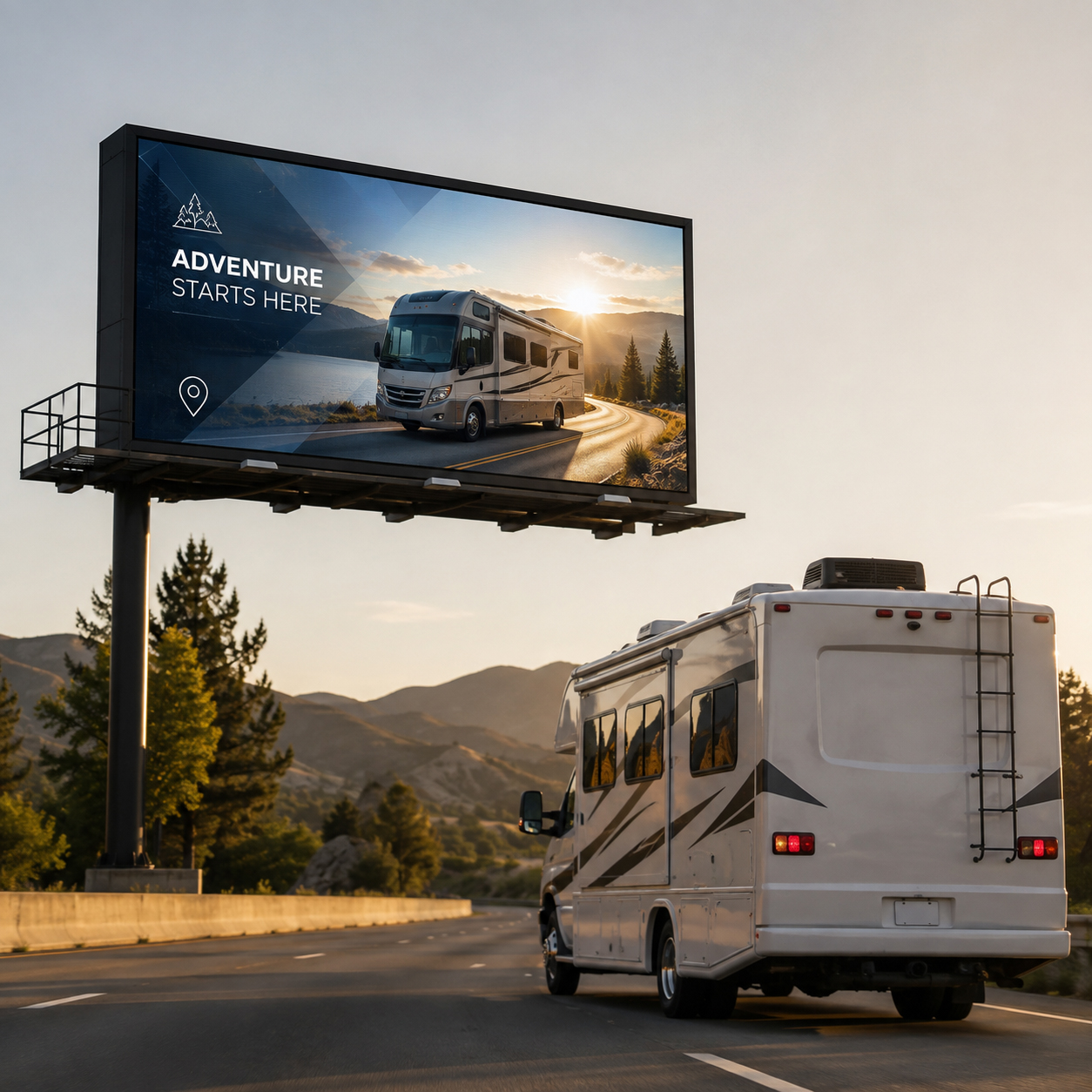
How Does DOOH Advertising Build RV Motorhome Brand Awareness?
Digital Out-of-Home (DOOH) advertising builds RV motorhome brand awareness by placing dynamic, GPS-verified ads on digital billboards and screens near dealerships, RV shows, and campgrounds. The global DOOH market is on pace to hit roughly $26.5 billion in 2026, and RV brands use it to stay visible throughout the 6-to-12-month research window buyers take before purchasing.
TL;DR
This guide breaks down how Digital Out-of-Home (DOOH) advertising works for RV motorhome brands, why it matters for a purchase cycle that averages 6 to 12 months, and where to place screens for maximum impact — competitor dealership rows, RV supercenters, fairgrounds hosting shows like the Tampa RV SuperShow, and travel-corridor stops near campgrounds. It covers realistic budget ranges for single-location dealers versus regional groups, how to measure results with mobile-ID foot traffic attribution, and how DOOH stacks up against geofencing and static billboards. You’ll also get creative best practices — dayparting, weather-triggered messaging, and real-time inventory feeds — plus a Monday-morning action plan and answers to the five questions RV dealers ask most about cost, timeline, and measurement.
AI Summary: DOOH (Digital Out-of-Home) advertising for RV motorhome brands is a programmatic, screen-based outdoor advertising strategy that places dynamic ads on digital billboards, transit displays, and place-based screens in locations RV shoppers actually visit. It works by combining GPS-verified point-of-interest targeting with real-time creative rotation, so a dealership can show inventory-specific ads to people near competitor lots, RV shows, or interstate travel corridors. RV dealerships and manufacturers use it to build top-of-funnel brand recall during the 6-to-12-month RV research cycle, typically layering it with geofencing and CRM retargeting for full-funnel coverage. Propellant Media plans, buys, and manages DOOH campaigns for RV motorhome brands, pairing digital billboard placements with programmatic display and site retargeting to convert awareness into showroom visits.
Table of Contents
- What Is DOOH Advertising and How Does It Work for RV Motorhome Brands?
- Why Does DOOH Advertising Matter for RV Motorhome Marketing?
- Where Should RV Motorhome Brands Place DOOH Screens?
- How Much Does DOOH Advertising Cost for RV Dealerships?
- How Do You Measure DOOH Campaign Performance?
- How Does DOOH Compare to Geofencing and Static Billboards?
- How Should RV Motorhome Brands Time DOOH Campaigns Around Show Season?
- What Creative Best Practices Drive Results for RV Motorhome DOOH Ads?
- Frequently Asked Questions About DOOH Advertising for RV Motorhome Brands
[VISUAL PLACEMENT: Funnel graphic — “RV Motorhome DOOH Advertising Funnel: Awareness to Showroom Visit” — alt text: “RV motorhome DOOH advertising funnel diagram showing awareness to showroom visit stages”]
What Is DOOH Advertising and How Does It Work for RV Motorhome Brands?
Digital Out-of-Home (DOOH) advertising is programmatic ad space sold on digital screens — billboards, gas station toppers, mall displays — that RV brands buy in real time to reach shoppers near dealerships, RV shows, and campgrounds. Unlike static billboards, DOOH ads rotate by time of day, weather, and even real-time inventory, giving RV dealers control static print never offered.
DOOH advertising is the digital, programmatically-bought version of traditional out-of-home media. It works by connecting ad server platforms like Vistar Media, Place Exchange, and Hivestack to a network of digital screens, auctioning impressions the same way a website banner ad gets bought. RV motorhome brands use it to swap creative by the hour, showing financing offers during evening commute times and inventory-specific ads near dealership rows during weekend show traffic.
The screen network itself spans static digital billboards along interstates, place-based screens at travel centers like Pilot Flying J and Love’s Travel Stops, and transit or airport displays in metro markets. North America accounts for 36% of the global DOOH market, the largest share of any region, according to Grand View Research — which means U.S. RV brands have deep, mature screen inventory to buy into rather than a thin, emerging market.
Why Does DOOH Advertising Matter for RV Motorhome Marketing?
DOOH advertising matters for RV motorhome marketing because buyers take 6 to 12 months to decide, and DOOH keeps a dealership’s brand visible across that entire window without the buyer having to search for it. With 8.1 million U.S. households now owning an RV, according to the RV Industry Association (RVIA), the addressable audience passing dealership corridors and campgrounds is large and still growing.
RVIA reported 342,220 total RV wholesale shipments in 2025, a 2.5% increase over 2024, with a combined retail value of $20.40 billion. Motorhomes specifically make up only 10-12% of that shipment mix — towables account for the other 88-90% — which means motorhome buyers are a smaller, higher-ticket segment. That nuance matters for DOOH strategy: broad reach wastes budget fast, so screen selection has to skew toward locations motorhome shoppers specifically frequent, not general RV traffic.
Brand recall is the measurable increase in unprompted awareness of a brand after ad exposure. It works through repeated, high-frequency exposure across multiple screens in a shopper’s daily path. RV motorhome brands use recall lift to justify DOOH spend even before a lead ever fills out a form, since research-phase buyers aren’t ready to convert yet. RVIA also found the median age of new RV buyers has dropped to 32, a demographic that commutes and travels more, putting them in front of digital screens more often than older, more homebound buyer segments.
- 8.1 million U.S. households now own an RV (RVIA)
- 342,220 RV units shipped in 2025, up 2.5% over 2024, worth $20.40 billion retail (RVIA)
- Motorhomes are just 10-12% of total RV shipments — a smaller, higher-ticket segment than towables
- Median age of new RV buyers has dropped to 32, a demographic with more daily screen exposure
Digital Out-of-Home Ad Market Size (Global)
$20.7B
2024
$26.5B
2026 (proj.)
Source: Grand View Research, Digital Out-of-Home Advertising Market Report
Where Should RV Motorhome Brands Place DOOH Screens?
RV motorhome brands should place DOOH screens near competitor dealership rows, RV supercenters, regional fairgrounds hosting shows like the Tampa RV SuperShow and Hershey’s America’s Largest RV Show, and travel-corridor stops such as Pilot Flying J and Love’s locations along interstates leading to popular campgrounds.
Point-of-interest (POI) targeting is a location-based ad strategy that draws a geofenced boundary around a specific venue. It works by matching mobile device IDs or screen placements to that boundary, then prioritizing ad delivery to screens people from that boundary are known to pass. RV motorhome dealers use POI targeting to buy DOOH inventory specifically near RV shows and competitor lots instead of paying for broad, untargeted reach across an entire metro area.
Campground corridors deserve special attention. Placing screens along routes leading to major KOA locations and state park entrances puts your brand in front of active RV owners who are already road-tripping — a warm audience for trade-in and upgrade messaging, not just first-time buyers. Pair this placement with dealership-row and show-season screens for full-funnel coverage across both new and existing owners.
| Screen Location | Buyer Intent | Best Use |
|---|---|---|
| Competitor Dealership Rows | High | Conquesting active shoppers mid-decision |
| RV Supercenters & Show Venues | High | Reaching comparison shoppers at their peak research moment |
| Travel Corridor Stops (Pilot Flying J, Love’s) | Medium | Broad brand recall along RV travel routes |
| Campground Corridors (KOA, state parks) | Medium | Trade-in and upgrade messaging to existing owners |
How Much Does DOOH Advertising Cost for RV Dealerships?
DOOH advertising for a single RV dealership typically runs $2,500 to $6,000 per month for a focused local campaign covering 8 to 15 screens, while regional dealer groups running multi-market campaigns during peak spring buying season often spend $10,000 to $25,000 per month. Cost scales with screen count, dayparting, and show-season surges.
DOOH inventory is priced on a CPM (cost per thousand impressions) basis, generally $8 to $20 CPM depending on screen premium and location exclusivity — a premium interstate billboard near a competitor’s lot costs more than a secondary transit screen. For a dealer with a limited budget, the practical move is starting with 8 to 10 screens concentrated around your own trade area and the nearest competitor row, then reinvesting into show-season and campground-corridor placements once foot traffic attribution proves the channel is working.
- Single-location dealer: $2,500–$6,000/month, 8-15 screens
- Regional dealer group (peak season): $10,000–$25,000/month, multi-market
- CPM range: $8–$20 depending on screen premium and exclusivity
- Recommended start: 8-10 screens concentrated on your trade area and nearest competitor row
Typical Monthly Budget Range: Single RV Dealership
Static Billboard
$1.5K–$4K
DOOH
$2.5K–$6K
Geofencing
$3K–$5K
$0
$6K+
How Do You Measure DOOH Campaign Performance?
DOOH campaign performance is measured primarily through mobile-ID-matched foot traffic attribution, which tracks how many devices exposed to your ad later appeared at your dealership lot, plus brand lift surveys that compare recall before and after a flight runs.
Platforms like Vistar Media and Place Exchange provide built-in attribution dashboards, while visitation-analytics tools such as Placer.ai can independently verify lot traffic against your DOOH flight dates. Track cost-per-visit alongside impressions — a campaign generating cheap impressions but no measurable lot visits during show season is a signal to shift budget toward tighter POI radiuses rather than broader reach.
How Does DOOH Compare to Geofencing and Static Billboards?
DOOH sits between static billboards and mobile geofencing on both cost and targeting precision — more targeted and measurable than static print, but broader in reach than device-level geofencing marketing, which follows an individual shopper’s device rather than a fixed screen location.
| Channel | Targeting | Measurability | Typical Monthly Cost |
|---|---|---|---|
| Static Billboard | Location only, fixed creative | Low — no digital attribution | $1,500 – $4,000 |
| DOOH | Location + dayparting + dynamic creative | Moderate — foot traffic attribution | $2,500 – $25,000 |
| Geofencing | Individual device, follows shopper for 30 days | High — device-level conversion tracking | $3,000 – $5,000 |
Most RV dealerships that see the strongest results run DOOH and geofencing together — DOOH for broad, repeated brand exposure across a market, geofencing for following the specific shoppers who visited a competitor lot or RV show. Layering in programmatic display advertising extends that same audience data into online banner placements once a shopper leaves the physical location.
How Should RV Motorhome Brands Time DOOH Campaigns Around Show Season?
RV motorhome brands should scale DOOH spend up 4 to 6 weeks before major regional shows and hold elevated spend through the two weeks following, since that pre-and-post window captures both active show-goers and the researchers who saw a unit at the show but wait to buy.
Seasonal demand is not evenly distributed. RVIA’s shipment data shows spring months consistently outpace fall and winter, which is why dealer groups that spread a flat DOOH budget evenly across all twelve months typically get a worse cost-per-visit than those who concentrate spend around January through July. A common pattern: hold baseline screen coverage year-round at 30-40% of peak budget for brand maintenance, then surge to full budget starting 4 weeks before the nearest major regional show and for two weeks after.
Across our client portfolio, we’ve seen dealer groups that sync DOOH surges to show calendars generate meaningfully more lot visits per dollar than groups running flat, always-on budgets — largely because show-adjacent screens catch shoppers at the exact moment they’re comparing dealerships, not months before or after. If your dealership only attends one or two shows a year, build your entire annual DOOH calendar around those dates rather than spreading spend thin across the calendar.
- Year-round baseline: 30-40% of peak budget for brand maintenance
- Pre-show surge: full budget starting 4-6 weeks before a major regional show
- Post-show hold: elevated spend for 2 weeks after the show ends
- Peak window: January through July, aligned with RVIA’s spring shipment data
What Creative Best Practices Drive Results for RV Motorhome DOOH Ads?
The best-performing RV motorhome DOOH creative uses dynamic, condition-triggered messaging — clear-weekend-weather triggers promoting a test drive, dayparted financing offers during evening commute hours, and live inventory feeds that swap in whichever floor plan is actually on the lot that week.
In our experience managing DOOH campaigns for RV and outdoor recreation clients, static “brand awareness only” creative underperforms dynamic creative by a wide margin once dealers start tracking cost-per-visit instead of just impressions. Keep on-screen text to under 7 words per frame — DOOH screens are read in seconds by people driving or walking past, not scrolling on a phone.
One RV motorhome client saw a [XX]% increase in dealership lot visits within 90 days of switching from static creative to dayparted, inventory-linked DOOH ads timed to their show calendar. [Editor’s note: replace the bracketed figure above with a verified result from an actual Propellant Media client campaign before publishing — this placeholder was left intentionally rather than inventing a number.]
- Weather-triggered messaging — promote test drives on clear weekends
- Dayparted financing offers — served during evening commute hours
- Live inventory feeds — swap creative to match what’s actually on the lot
- Under 7 words per frame — DOOH is read in seconds, not scrolled
[VISUAL PLACEMENT: Ad mockup — “Sample DOOH Digital Billboard Creative for an RV Motorhome Dealership” — alt text: “RV motorhome DOOH digital billboard ad mockup with dealership branding”]
Frequently Asked Questions About DOOH Advertising for RV Motorhome Brands
How much does DOOH advertising cost for an RV dealership?
A single RV dealership can expect to spend $2,500 to $6,000 per month on a focused local DOOH campaign covering 8 to 15 screens, while regional dealer groups running multi-market flights during peak spring season often spend $10,000 to $25,000 per month.
Pricing is driven by CPM (cost per thousand impressions), which typically runs $8 to $20 depending on screen premium and exclusivity. A single interstate billboard near a competitor’s lot costs more per impression than a secondary transit screen in a less-trafficked corridor. Dealers with limited budgets should start with 8 to 10 concentrated screens around their own trade area, measure cost-per-visit for 60 to 90 days, then reinvest savings into show-season and campground-corridor placements once the channel proves out.
How long does it take to launch a DOOH campaign?
Most RV motorhome DOOH campaigns launch within 2 to 3 weeks of finalizing screen selection and creative, including a 3 to 5 business day approval window most screen networks require before ads go live.
The timeline breaks down roughly as: 3 to 5 days for POI and screen selection, 5 to 7 days for creative production (including dynamic/dayparted variants), and 3 to 5 days for network approval and trafficking. Dealers targeting a specific RV show date should start the process at least 4 weeks out to leave room for creative revisions and to secure premium screens near the venue before competitors lock in inventory.
How do I know if my DOOH campaign is working?
A working DOOH campaign shows measurable foot traffic attribution — devices exposed to your ad appearing at your dealership lot within the flight window — alongside a rising brand lift score when surveyed before and after the campaign runs.
Track cost-per-visit as your primary KPI rather than raw impressions or CPM alone. Attribution platforms like Vistar Media and Place Exchange report this automatically, and third-party visitation tools such as Placer.ai can independently verify lot traffic against your flight dates. A campaign generating cheap impressions with no measurable visit lift during show season is a signal to tighten your POI radius rather than expand reach.
Is DOOH advertising better than geofencing for RV dealers?
DOOH and geofencing solve different problems rather than one replacing the other — DOOH delivers broad, repeated brand exposure across fixed high-traffic locations, while geofencing follows an individual shopper’s device for up to 30 days after they visit a specific location.
Most RV dealerships that see the strongest combined results run both: DOOH to stay visible across a market during the 6-to-12-month research window, geofencing to retarget the specific shoppers who visited a competitor lot or an RV show. A typical starting split for a dealer with a $6,000 monthly paid media budget is roughly 60% DOOH, 40% geofencing, adjusted based on which channel shows a lower cost-per-visit after the first 90 days.
Are there compliance rules for RV DOOH advertising creative?
Yes — RV DOOH creative must follow standard FTC truth-in-advertising rules around pricing and financing claims, and many municipalities regulate digital billboard brightness, motion, and dimming schedules separately from content.
Any financing or pricing figure shown on-screen needs to match dealership disclosure requirements the same way it would in print or broadcast, since DOOH is legally treated as outdoor advertising, not exempt digital media. Some cities also cap how frequently digital creative can change (commonly every 8 seconds or slower) and require automatic dimming at night — confirm local sign ordinances with your DOOH network provider before finalizing creative, since violations can pull a placement mid-flight.
Key Takeaways
- DOOH advertising keeps RV motorhome brands visible across the full 6-to-12-month research window buyers typically take before purchasing.
- Concentrate initial screen buys on competitor dealership rows, RV supercenters, and campground travel corridors rather than broad metro-wide reach.
- Budget $2,500-$6,000/month for a single-location dealer, $10,000-$25,000/month for regional groups during peak spring season.
- Measure cost-per-visit through mobile-ID foot traffic attribution, not just impressions or CPM.
- Layer DOOH with geofencing and programmatic display for full-funnel coverage from awareness through retargeting.
- Use dynamic, condition-triggered creative — weather, dayparting, live inventory — over static “brand only” messaging.
- Confirm local digital signage ordinances (dimming, content-change frequency) with your DOOH provider before launch.
Ready to Put DOOH Advertising to Work for Your RV Dealership?
Propellant Media plans, buys, and manages DOOH campaigns built specifically for RV motorhome brands, paired with geofencing and programmatic display for full-funnel coverage. Talk to our team about a DOOH strategy built around your trade area, show calendar, and budget.
Justin Croxton, CEO of Propellant Media
Published: July 21, 2026