
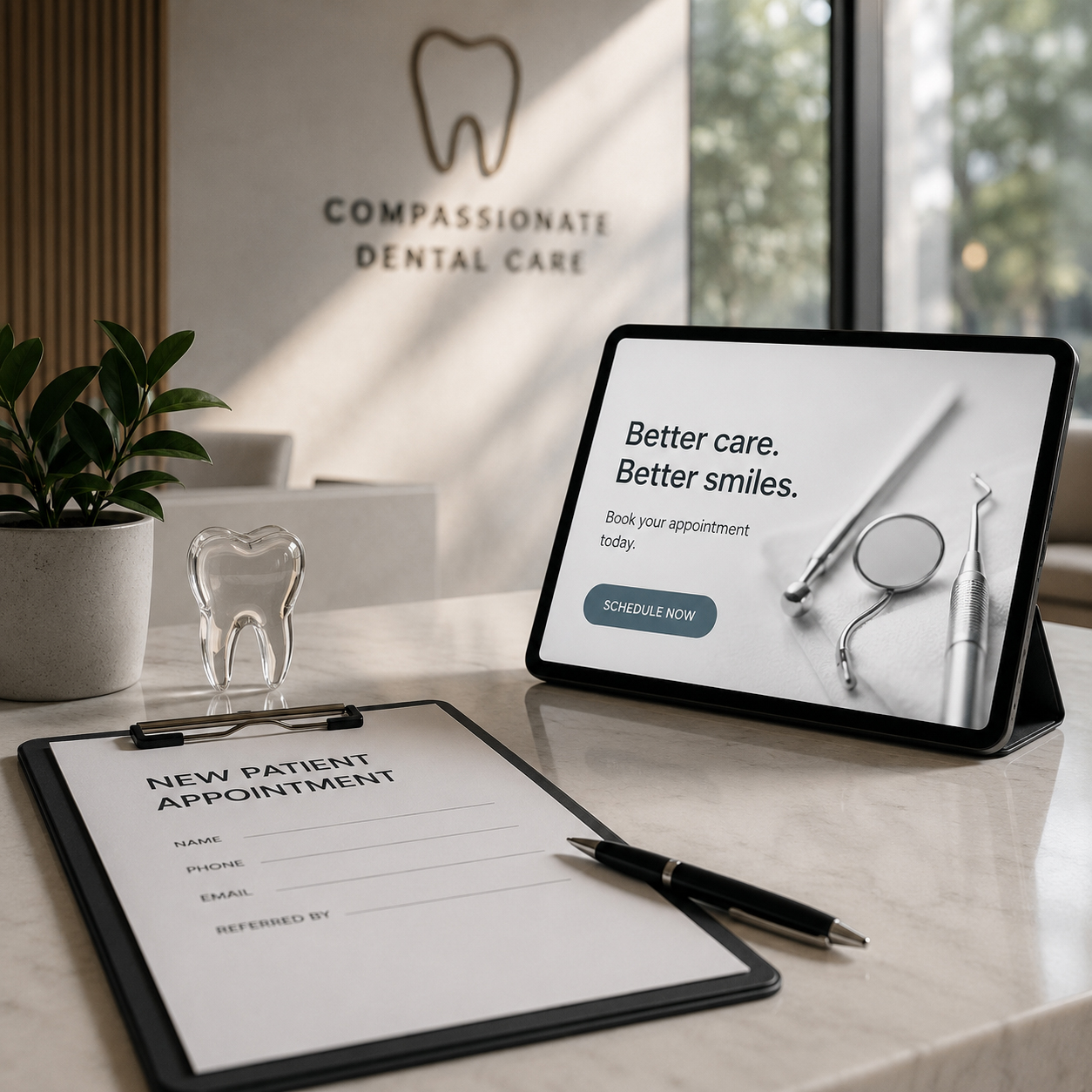
How to Build Lead Generation for Dental Clinics
Lead generation for dental clinics works by combining high-intent paid search, Local Services Ads, an optimized website, and call tracking to turn searchers into booked appointments, and it costs practices an average of $76.71 per lead on Google Ads, according to WordStream’s 2025 Google Ads Benchmarks report.
TLDR: Dental clinics generate new patient leads through Google Ads, Local Services Ads (LSAs), Meta Ads Manager, Google Business Profile, and organic SEO, then convert traffic with fast landing pages and call tracking through platforms like CallRail. Average cost per lead on Google Ads runs $76.71; LSAs typically cost $25 to $140. Clinics that win respond to leads within minutes and track every call to its source. This guide breaks down real budgets, benchmarks, and a next-step plan for small teams.
AI Summary: Lead Generation for Dental Clinics is a strategy that combines paid search, Local Services Ads, social advertising, local SEO, and call tracking to identify people actively searching for dental care and convert them into scheduled appointments. It is built for solo practitioners, multi-location groups, and DSOs needing a predictable flow of new patients rather than relying only on walk-ins and referrals. It works because dental care is a high-intent, “near me” search category, and pairing that intent with fast follow-up closes the gap between click and booked chair time. Key benchmarks: $76.71 average cost per lead on Google Ads (WordStream, 2025) and landing pages converting at 12.5% versus 4.2% site-wide (Web Tonic, 2026). Propellant Media designs and manages these systems for dental clinics.
Table of Contents
- What Is Lead Generation for Dental Clinics and Why Does It Matter?
- How Much Should a Dental Clinic Budget for Lead Generation?
- Which Marketing Channels Generate the Most Qualified Dental Patient Leads?
- How Can Dental Clinics Turn Website Traffic Into Booked Appointments?
- Why Is Call Tracking Critical for Dental Patient Acquisition?
- How Should Dental Clinics Follow Up With New Patient Leads?
- How Do You Measure ROI From Dental Lead Generation Campaigns?
- What Does a Realistic 90-Day Dental Lead Generation Plan Look Like?
- Frequently Asked Questions
- Key Takeaways
What Is Lead Generation for Dental Clinics and Why Does It Matter?
Lead generation for dental clinics is the set of marketing activities that identify people actively looking for dental care and capture their name, phone number, or booking request before a competitor does. It matters now because roughly 70% of patients research a practice online before calling, per data referenced in American Dental Association practice management resources.
Lead generation is the process of identifying and attracting potential patients who have shown interest in dental care and capturing their contact information for follow-up. It works by combining targeted advertising, an optimized website, and a clear call to action that prompts a call, form fill, or booking request. Dental clinics use it to keep the schedule full without relying solely on walk-ins or referrals.
In our experience managing campaigns for dental clinics, practices treating lead generation as a system outperform those running a boosted Facebook post with no landing page behind it. A dental marketing company that understands the clinical sales cycle can build that system once on a predictable budget.
- 70% of patients research a dental practice online before booking (ADA practice management data)
- Average Google Ads cost per lead for dentists: $76.71 (WordStream, 2025)
- Practices that invest consistently in marketing report meaningfully higher new-patient volume than those that do not (ADA)
How Much Should a Dental Clinic Budget for Lead Generation?
Most independent dental clinics should plan on $2,000 to $6,000 a month in paid media, with an average cost per lead of $76.71 on Google Ads and a cost per click of $7.85, the highest of any industry WordStream tracked in its 2025 benchmarks. Multi-location groups scale that per location.
The math is simple but often skipped: a $3,000 monthly budget at $76.71 per lead produces roughly 39 leads. If your front desk converts 35% to 45% of calls, a benchmark widely cited in dental call-tracking research, that budget should produce 13 to 18 new patients before LSAs or organic traffic add more.
Google Ads Benchmarks for Dental Clinics (2025)
$7.85
Avg. CPC
$76.71
Avg. Cost Per Lead
Source: WordStream, “Google Ads Benchmarks 2025: Competitive Data & Insights for Every Industry” (Dentists & Dental Services category)
Dentists and dental services carry one of the highest cost-per-click figures Google tracks, so budget discipline matters more here than in retail. Spreading a small budget across five channels usually performs worse than committing it to two run well. Our lead generation services are built around this principle: prove one channel, then expand.
| Lead Channel | Typical Cost Per Lead | Time to First Leads | Best For |
|---|---|---|---|
| Google Ads (Search) | $76.71 average | Days to 1 week | High-intent “dentist near me” searches |
| Local Services Ads (LSAs) | $25-$140, market dependent | 1-2 weeks | Pay-per-lead calls and messages |
| Meta Ads Manager | [XX] (verify against current account data) | 1-3 weeks | Cosmetic, Invisalign, and implant offers |
| Google Business Profile / Organic | Low direct media cost | 2-6 months | Long-term visibility and trust |
| Patient Referrals | No media cost, limited volume | Ongoing | Retention-driven, not scalable alone |
- Google Ads average CPC for dentists: $7.85 (WordStream, 2025) – highest of any tracked industry
- Google Ads average CPL for dentists: $76.71 (WordStream, 2025)
- LSA cost per lead: $25-$140, driven by market size and competition (dental LSA agency benchmarking)
- Recommended starting budget for a single-location practice: $2,000-$6,000/month in paid media
Which Marketing Channels Generate the Most Qualified Dental Patient Leads?
Google Ads, Local Services Ads, Meta Ads Manager, and Google Business Profile together produce most qualified dental patient leads, with LSAs generally delivering the lowest cost per booked call since the practice only pays when a real lead reaches out. Organic search and referrals add volume but cannot scale on demand.
Local Services Ads (LSAs) are a Google advertising format that places a dental practice at the top of search results with a Google Screened badge and star ratings. It works by charging the practice only when a patient calls, messages, or books directly through the ad rather than per click. Dental clinics use it to generate pre-qualified phone leads without a keyword auction.
LSA costs typically run $25 to $140 per lead depending on metro area and competition, per agency benchmarking from firms including 12AM Agency and Delmain, often cheaper than a Google Ads click-to-lead ratio. We have also seen clinics apply the logic urgent care networks use to capture urgent, same-day emergency visit leads with a dedicated “emergency dentist near me” campaign.
- Google Ads Search: high-intent keywords (“dentist near me,” “Invisalign consultation”)
- Local Services Ads (LSAs): pay-per-lead phone and message inquiries, $25-$140 per lead
- Meta Ads Manager: cosmetic dentistry, Invisalign, and implant offers with before/after creative
- Google Business Profile: reviews, photos, and posts that feed the local 3-pack
A fully optimized Google Business Profile can perform several times better in local rankings than a bare-bones listing, based on local SEO benchmarking research. We covered the full paid media playbook in our digital ad strategies for dentists guide.
How Can Dental Clinics Turn Website Traffic Into Booked Appointments?
Dental clinics convert more traffic into booked appointments by replacing a homepage link with a dedicated, single-offer landing page: dedicated pages convert at roughly 12.5% versus 4.2% for an average dental website, per Web Tonic’s 2026 Dental Landing Page and CRO Statistics report. Call-only ads convert even higher, at 18.2%.
Conversion rate optimization (CRO) is the practice of systematically improving a webpage so more visitors complete a desired action, such as calling the office or submitting a form. It works by testing headlines, forms, page speed, and calls to action against real visitor behavior. Dental clinics use it to get more new patients from the same ad spend instead of just buying more traffic.
Conversion Rate by Page Type (Dental)
4.2%
Avg. Website
12.5%
Dedicated Landing Page
18.2%
Call-Only Ad
Source: Web Tonic, “Dental Landing Page & CRO Statistics 2026”
Mobile matters more than most practices assume. Mobile devices drive most dental clinic web traffic, and pages loading under 3 seconds convert roughly 2.4 times more visitors than pages taking 5+ seconds, per the same Web Tonic research. A visible, tap-to-call button lifted mobile bookings 18% to 22%.
- Average dental website conversion rate: 4.2% (Web Tonic, 2026)
- Dedicated landing page conversion rate: 12.5% (Web Tonic, 2026)
- Call-only ad conversion rate: 18.2% (Web Tonic, 2026)
- Pages loading under 3 seconds convert roughly 2.4x more visitors than pages taking 5+ seconds
Why Is Call Tracking Critical for Dental Patient Acquisition?
Call tracking is critical because most new patients still call before booking, and dental practices miss an estimated 30% to 40% of incoming calls, per call-audit data from Weave Communications, Patient Prism, and TrueLark. Without tracking, a clinic cannot tell which ad, keyword, or channel produced the call it just missed.
Call tracking is a system that assigns unique trackable phone numbers to each marketing channel so every inbound call can be attributed to its source. It works by routing calls through dynamic number insertion on the website, then logging duration, outcome, and recording. Dental clinics use it to know which ads and keywords actually produce booked appointments, not just phone activity.
Platforms like CallRail offer keyword-level tracking showing which search term triggered a call, plus recordings staff can review for training. Across our client portfolio, we have seen clinics cut wasted spend after discovering a “top” keyword generated calls that never converted, a discipline that also shows up in patient lead generation tactics used by hospital marketing teams.
- Dental practices miss 30%-40% of incoming calls (Weave, Patient Prism, TrueLark call-audit data)
- New patient calls convert at 35%-45% on average; top-performing practices hit 60%-75%
- A new dental patient’s lifetime value is commonly estimated at $5,000-$10,000 across the relationship
- HIPAA-adjacent call tracking platforms include Patient Prism, Invoca, and CallRail, each with different compliance scoring per Improvado’s 2026 healthcare call tracking guide
How Should Dental Clinics Follow Up With New Patient Leads?
Dental clinics should call or text a new lead within 5 minutes whenever possible: contacting a lead in that window makes it roughly 100 times more likely to connect and 21 times more likely to qualify than waiting 30 minutes, per the MIT/InsideSales Lead Response Management study led by Dr. James Oldroyd. Speed to lead, not ad spend, is often the biggest gap between practices.
A separate Harvard Business Review audit of 2,241 companies found contacting a prospect within one hour makes it nearly 7 times more likely to qualify than waiting 24 hours, yet the average company took 42 hours to respond. Routing leads into a CRM like HubSpot with automatic follow-up tasks closes that gap.
| Response Window | Likelihood to Connect / Qualify | Source |
|---|---|---|
| Within 5 minutes | 100x more likely to connect; 21x more likely to qualify | MIT/InsideSales Lead Response Management study (Dr. James Oldroyd) |
| Within 1 hour | Nearly 7x more likely to qualify vs. 24 hours | Harvard Business Review, 2011 audit of 2,241 firms |
| After 24+ hours | 60x less likely to qualify; average response was 42 hours, and 23% never responded | Harvard Business Review, 2011 audit |
- Responding within 5 minutes: 100x more likely to connect, 21x more likely to qualify (MIT/InsideSales)
- Responding within 1 hour: nearly 7x more likely to qualify than waiting 24 hours (HBR)
- Average company response time across industries: 42 hours; 23% never respond at all (HBR)
One dental clinic client saw a [XX]% increase in booked consultations after implementing automated lead routing and a same-day callback policy. The mechanics are simple: a lead form notifies the front desk, a HubSpot workflow logs the attempt, and any lead untouched after 15 minutes escalates to a manager.
How Do You Measure ROI From Dental Lead Generation Campaigns?
Measuring ROI from dental lead generation means tracking cost per lead, lead-to-appointment rate, and treatment-accepted rate in one dashboard against total marketing spend. The American Dental Association considers 3:1 to 5:1 the healthy range for dental marketing ROI, meaning $3 to $5 in production for every $1 spent.
Google Analytics and Google Business Profile insights show top-of-funnel behavior: profile views, direction requests, and clicks to call. CallRail ties phone activity to the exact campaign, and a CRM like HubSpot closes the loop, tracking which leads scheduled and completed treatment.
Local intent supports why this mix works: 76% of “near me” searchers visit a business within 24 hours, and 28% of local searches result in a purchase, per Think with Google. For a dental clinic, that means same-week consultations, not a long research cycle. Our dental marketing company team builds this reporting stack so ROI is visible monthly.
- Healthy dental marketing ROI benchmark: 3:1 to 5:1 (American Dental Association)
- 76% of near-me searchers visit a business within 24 hours (Think with Google)
- 28% of local searches result in a purchase (Think with Google)
What Does a Realistic 90-Day Dental Lead Generation Plan Look Like?
A realistic 90-day plan starts by fixing call handling and the website in the first two weeks, launches one paid channel by week four, and adds a second only after the first is profitable. Launching Google Ads, LSAs, and Meta Ads simultaneously is the most common reason small teams burn budget without results.
- Week 1-2: Set up call tracking, optimize Google Business Profile, audit mobile load speed
- Week 3-4: Build one landing page for the highest-margin service, start LSA verification
- Week 5-8: Launch a focused Google Ads campaign around 10-15 keywords, connect CallRail to the CRM, set a 5-minute response SLA
- Week 9-12: Review cost per lead, cut what is not converting, reinvest in the best-performing channel
What to do Monday morning: pull last month’s call log and count unanswered calls, check that the site shows one clear phone number on mobile, and confirm the Google Business Profile was updated in the last 30 days. Those three checks surface most of the leaks costing a clinic new patients.
Related reading: our patient lead generation tactics for hospital marketing teams post and our urgent care and emergency visit lead generation guide apply the same attribution and speed-to-lead principles outside the dental vertical.
Frequently Asked Questions
How much does lead generation cost for a dental clinic?
Most dental clinics spend $2,000 to $6,000 per month on paid lead generation, with Google Ads averaging $76.71 per lead and Local Services Ads running $25 to $140 per lead depending on the market, per WordStream and dental LSA agency benchmarking.
The right budget depends on your market and how competitive it is. A single-location practice in a mid-size market can often start meaningfully with $2,000 to $3,000 a month split between Google Ads and LSAs. Practices in dense metro areas, or those chasing high-margin services like implants and Invisalign, often need $4,000 to $6,000 a month for consistent volume, since cost per click and cost per lead both run higher for those keywords. Multi-location groups typically budget per location rather than pooling spend, since each office competes in its own local auction. Whatever the number, track cost per lead and lead-to-appointment rate monthly so budget decisions are based on production, not clicks alone.
How long does it take to see results from dental lead generation?
Paid channels like Google Ads and LSAs can generate calls within days of launch, but a clinic should expect 60 to 90 days to establish a stable, optimized cost per lead, while organic Google Business Profile and SEO gains typically take 2 to 6 months to show meaningfully in local rankings.
The first two weeks after launch are a learning phase: Google’s algorithm and your team are figuring out which keywords, ad copy, and landing pages perform, so expect cost per lead to be higher and less predictable. By day 30 to 45, enough data usually exists to cut underperforming keywords and shift budget toward what converts. LSAs move faster once the practice passes verification, sometimes producing calls within the first week. Organic visibility through Google Business Profile and SEO compounds more slowly, often 2 to 6 months before a meaningful lift in local pack rankings, but it costs less per lead long term.
How do you measure the success of a dental lead generation campaign?
Success is measured by tracking cost per lead, lead-to-appointment conversion rate, and treatment-accepted revenue against total marketing spend, aiming for the American Dental Association’s cited healthy dental marketing ROI range of 3:1 to 5:1 in production generated versus dollars spent each month.
Cost per lead alone is a vanity metric if it never connects to booked and completed appointments. Set up call tracking through a platform like CallRail so every lead is attributed to its source channel, then feed that data into a CRM such as HubSpot to track which leads actually scheduled and which treatment plans they accepted. Review this monthly rather than quarterly during the first 90 days, since dental lead costs and conversion rates can shift quickly as campaigns mature. A practice generating $4 or $5 in accepted treatment for every $1 spent on marketing is performing within the ADA’s cited healthy range; anything consistently below 3:1 needs a channel or landing page review.
Is paid lead generation better than relying on referrals and organic growth alone?
Referrals and organic growth are lower cost per patient but are not scalable on demand, while paid lead generation is more expensive per lead but gives a practice direct control over new patient volume, which matters most when a clinic has open chair time or a new associate to fill.
Referral-only practices tend to have excellent patient quality and low acquisition cost, since the caller already trusts the recommendation. The tradeoff is volume: referrals grow slowly and depend on your existing patients staying happy and vocal, which you cannot turn up quickly if you add an associate or open a second location. Paid lead generation, particularly Google Ads and LSAs, lets a practice decide this month it wants 20 more new patients and build toward that number. The strongest practices we have worked with keep referral and organic channels healthy through reviews and Google Business Profile activity while using paid lead generation as the lever they pull based on real capacity.
How should dental clinics handle patient data collected through lead forms to stay compliant?
Dental clinics should use lead forms and call tracking tools that are HIPAA-adjacent and avoid transmitting protected health information through non-secure channels, since even a name plus a stated dental complaint can qualify as PHI once it is tied to treatment intent.
The safest practice is to keep initial lead capture limited to name, phone number, and general service interest rather than detailed symptoms, then move clinical discussion to a secure system once the patient is in contact with staff. Call tracking tools vary in HIPAA compliance; Improvado’s 2026 healthcare call tracking guide scored Patient Prism, Invoca, and CallRail differently, so confirm a Business Associate Agreement (BAA) is in place with whichever vendor a clinic chooses. Platforms like Meta Ads Manager and Google Ads should never receive PHI through tracking pixels or form fields. When in doubt, involve whoever manages HIPAA compliance before turning on a new lead capture tool.
Key Takeaways
- Budget $2,000-$6,000 a month; expect a Google Ads cost per lead near $76.71 and LSA leads between $25 and $140 (WordStream; dental LSA agency benchmarking)
- Build one dedicated landing page per core service instead of the homepage; dedicated pages convert at roughly 12.5% versus 4.2% (Web Tonic, 2026)
- Fix call handling before adding ad spend; practices miss 30%-40% of inbound calls without tracking and a clear answering policy (Weave, Patient Prism, TrueLark)
- Respond to new leads within 5 minutes when possible; delayed response is the biggest controllable factor behind lost patients (MIT/InsideSales; Harvard Business Review)
- Connect Google Analytics, CallRail, and HubSpot so cost per lead ties to booked and accepted treatment, targeting the ADA’s cited 3:1 to 5:1 ROI range
- Launch one channel at a time over a 90-day plan rather than five at once; prove profitability, then expand
- Keep lead-form patient data limited and compliant, confirming BAAs with any call tracking or CRM vendor
Ready to Fill Your Dental Clinic’s Schedule?
Propellant Media builds and manages dental lead generation campaigns across Google Ads, Local Services Ads, Meta Ads Manager, and call tracking, so your front desk spends less time chasing unqualified calls and more time booking patients. Contact our team for a review of your current lead generation setup and a realistic 90-day plan built around your budget.
Written by Justin Croxton, CEO of Propellant Media. Published August 3, 2026.