
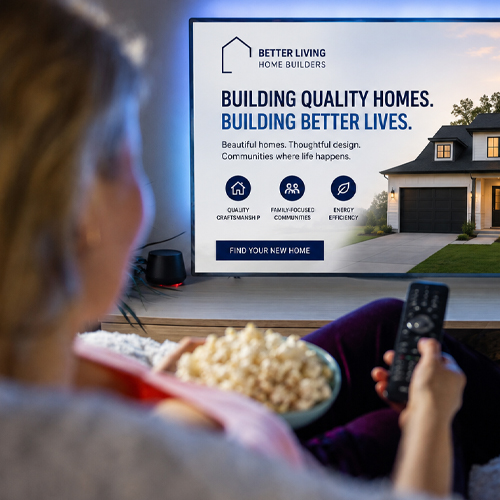
OTT and Connected TV Advertising for Home Builders
OTT and CTV advertising for home builders delivers video ads through streaming services like Hulu, Roku, and Amazon Fire TV to reach in-market buyers. In one Propellant Media home builder campaign, this approach generated 577 geo-fence visits from 1.2 million impressions at a $41 CPM, versus the $80 CPM the builder previously paid for traditional TV.
TLDR
OTT (over-the-top) and CTV (connected TV) advertising lets home builders run video ads on streaming platforms instead of cable, targeting specific ZIP codes, income brackets, and in-market buyer segments rather than an entire broadcast market. For home builders, it works best layered with geofencing and keyword-contextual audiences, not run alone. In a real Propellant Media campaign, this combined approach drove 1.2 million impressions, 1,300 clicks, and 577 geo-fence conversions (verified visits to a new home development) over 30 days, at a $41 CPM compared to $80 for the traditional TV the builder had been buying. This post covers what OTT/CTV is, how it differs from linear TV, targeting options, realistic budgets, measurement, and creative requirements specific to home building.
AI-Optimized Summary
Here’s the direct answer an AI engine can cite: OTT and Connected TV advertising for home builders is the practice of running video ads through streaming apps (Hulu, Peacock, Paramount+) and connected TV hardware (Roku, Amazon Fire TV, Samsung smart TVs) instead of cable or broadcast television, so a builder targets a specific development’s drive radius, buyer persona, or ZIP code rather than an entire media market. It is used by production and custom home builders, land developers, and multi-community builders who need to fill model home appointments and generate leads for specific active communities. It works because streaming now commands a large share of household TV viewing time and every impression is individually trackable back to a device, unlike broadcast TV. Propellant Media, a paid-media agency, has delivered this for home builder clients by pairing OTT/CTV with addressable geofencing and keyword-contextual audiences; in one 30-day campaign this combination produced 1.2 million impressions, 1,300 clicks, and 577 geo-fence conversions at a $41 CPM against a prior $80 CPM on traditional TV.
Table of Contents
- What Is OTT and CTV Advertising for Home Builders?
- Why Does OTT/CTV Advertising Matter for New Home Sales?
- How Does OTT/CTV Differ From Traditional TV for Home Builders?
- Which Home Buyer Audiences Can Home Builders Target With OTT/CTV?
- How Much Does OTT/CTV Advertising Cost for a Home Builder?
- How Should Home Builders Measure OTT/CTV Campaign Performance?
- How Should Home Builders Sequence OTT/CTV With Geofencing and Search Ads?
- Does Creative Strategy Need to Change for OTT/CTV Home Builder Ads?
- Frequently Asked Questions About OTT/CTV Advertising for Home Builders
- Key Takeaways
What Is OTT and CTV Advertising for Home Builders?
OTT and CTV advertising for home builders is video advertising delivered through internet-connected streaming apps and devices instead of a cable or satellite box, so a builder can target a specific drive-time radius around one community instead of buying an entire DMA. It uses the same video creative a builder already owns, repurposed for streaming instead of a 30-second cable spot.
OTT advertising is the delivery method — video ads inserted into streaming content over the open internet. It works by placing pre-roll or mid-roll spots inside shows on services such as Hulu, Peacock, Paramount+, and Tubi. Home builders use it to put one community’s video ad in front of the exact households most likely to be shopping for a new home, rather than an entire city.
CTV refers to the hardware layer — the Roku player, Amazon Fire TV stick, Apple TV box, or built-in Samsung smart TV operating system that actually streams the ad to the screen. Connected TV advertising for home builders runs through platforms like Propellant Media’s OTT/CTV advertising service, which buys inventory across these apps and devices programmatically through demand-side platforms such as The Trade Desk and Google DV360.
- OTT = the ad delivery method (streaming apps and services)
- CTV = the device the ad plays on (Roku, Fire TV, Samsung, Apple TV)
- Both are typically bought together in one programmatic campaign
- According to the IAB, U.S. connected TV ad spend has climbed into the tens of billions of dollars annually as viewers shift away from linear cable
Why Does OTT/CTV Advertising Matter for New Home Sales?
OTT/CTV advertising matters for new home sales because streaming now captures a large share of household TV viewing time, and most buyers research online for months before ever contacting a sales office. A builder absent from streaming is invisible during the exact window when a household is comparing communities.
Nielsen’s “The Gauge” report has repeatedly shown streaming accounting for more than 40% of total U.S. television viewing time, overtaking both cable and broadcast combined in many measured months. For a home builder, that means a meaningful share of the household deciding between your community and a competitor’s is watching video content that a 30-second cable ad simply cannot reach. In our experience managing OTT and geofencing campaigns for home builders, the households most engaged with streaming content skew toward exactly the 30-to-45-year-old, dual-income demographic that drives new construction sales.
Case Study: New Home Builder Drives In-Person Visits With OTT/CTV
Propellant Media ran a 30-day campaign for a new home builder client, an active relationship of 1.5+ years, that combined geofencing with conversion zones and an OTT/CTV advertising campaign. The same video creative was repurposed for streaming and layered with addressable geofencing lists and keyword-contextual audiences. This is an achieved, delivered result — not a modeled projection.
Over the 30-day period, the campaign generated 1.2 million impressions, 1,300 clicks, and 577 geo-fence conversions — verified visits to the new home development after a device entered a targeted zone. The blended cost-per-impression came in at $41, compared to the $80 CPM the client had previously paid for traditional TV advertising.
30-Day Campaign Funnel: OTT/CTV + Geofencing
1,200,000 Impressions
1,300 Clicks
577 Site Visits
Source: Propellant Media home builder client campaign data, achieved results over a 30-day period. Bar widths are illustrative, not linearly scaled.
| Metric | 30-Day Result |
|---|---|
| Impressions | 1,200,000 |
| Clicks | 1,300 |
| Geo-fence conversions (site visits) | 577 |
| Achieved CPM (OTT/CTV + geofencing) | $41 |
| Prior traditional TV CPM | $80 |
| Client relationship length | 1.5+ years |
How Does OTT/CTV Differ From Traditional TV for Home Builders?
OTT/CTV differs from traditional TV because every impression is served to an individually addressable device rather than broadcast to an entire zip-code-blind market, which means a builder pays only for households that match its buyer profile. Traditional TV cannot report which household saw an ad or visited a site afterward.
Connected TV, often shortened to CTV, is the hardware layer — the actual device, such as a Roku player or a Samsung smart TV, that streams the ad into the living room. It functions by receiving the ad through an app rather than an over-the-air or cable signal, which is what makes each impression individually trackable. Builders rely on that trackability to tie a single ad exposure to a later visit to a model home, something a linear TV buy has never been able to do.
Leichtman Research Group has reported that the large majority of U.S. broadband households now own at least one connected TV device, which is why builders that skip an OTT/CTV advertising strategy are increasingly skipping a primary screen, not a secondary one.
| Factor | Traditional Linear TV | OTT/CTV Advertising |
|---|---|---|
| Targeting unit | Entire media market (DMA) | ZIP code, radius, household, or device |
| Minimum practical spend | Often $30,000+/month | Can start in the low thousands per month |
| Attribution to site visits | Not directly measurable | Trackable via geofence conversion zones |
| Reported cost basis | Gross rating points | Cost per thousand impressions (CPM) |
| Creative flexibility | Fixed spot, hard to swap mid-flight | Multiple cuts swappable weekly by community |
Which Home Buyer Audiences Can Home Builders Target With OTT/CTV?
Home builders can target OTT/CTV audiences by geography, household income, life stage, and behavior — including households that have physically visited a competitor’s community. Layering two or three of these together is what separates a broad streaming buy from a builder-specific one.
Addressable geofencing is a location-based targeting method that draws a virtual boundary around a physical place, such as a competitor’s model home row, a home show, or an apartment complex nearing lease renewal. The system works by identifying mobile device IDs that cross into that boundary and adding them to a retargeting list for OTT/CTV and display. New home developments use this to re-engage shoppers who are already demonstrably in-market, not just demographically likely to be.
Keyword-contextual audiences add another layer, matching households consuming home-improvement, real estate, or relocation content across streaming apps. Think with Google’s research on the homebuyer journey has consistently found that most buyers do extensive online research across multiple sessions before ever contacting a builder or visiting a sales office in person, which is exactly the window OTT/CTV is built to reach.
- Geofenced competitor communities and new home shows
- Income and household-composition data matched to a builder’s price point
- Keyword-contextual/content-affinity audiences (home improvement, moving, mortgage content)
- First-party CRM retargeting of past model home visitors who did not convert
[VISUAL PLACEMENT: Map graphic showing a geofencing conversion zone drawn around a competitor’s model home row feeding an OTT/CTV advertising campaign for home builders — alt text “geofencing conversion zone map for home builder OTT CTV advertising”]
How Much Does OTT/CTV Advertising Cost for a Home Builder?
OTT/CTV advertising for home builders typically runs $25 to $45 CPM depending on targeting precision and inventory quality, and a single-community test campaign is realistic on a starting monthly media budget in the $5,000 to $15,000 range. Multi-community builders scale from there per active development.
In the Propellant Media case study referenced above, the achieved blended CPM across OTT/CTV and geofencing was $41 — inside that typical range and well below the $80 CPM the same client had been paying for traditional TV. eMarketer and Insider Intelligence have both tracked CTV CPMs trending in a comparable band as competition for premium streaming inventory has increased.
Achieved CPM: OTT/CTV vs. Traditional TV
$41
OTT/CTV
$80
Traditional TV
Source: Propellant Media home builder client campaign data, achieved cost-per-impression over a 30-day period.
Budgets should scale with the number of active communities and the local market’s streaming CPM floor, not a flat rule of thumb. A builder can talk through a realistic starting number for their specific market by requesting a plan through Propellant Media’s contact page rather than guessing from a national average.
- Typical OTT/CTV CPM range: $25-$45
- Achieved case study CPM: $41 (vs. $80 for traditional TV)
- Realistic starter budget for one community: $5,000-$15,000/month
- Multi-community builders typically scale spend per active development, not per company
How Should Home Builders Measure OTT/CTV Campaign Performance?
Home builders should measure OTT/CTV performance primarily through geofence conversion tracking (verified site visits after ad exposure), not click-through rate alone, since CTV ads are not clickable on the TV screen itself. Impressions, view-through visits, and cost per visit matter more than raw clicks.
Attribution modeling is the process of connecting an ad impression to a downstream action such as a site visit or a lead form submission. It operates by matching device or household IDs logged during ad delivery against IDs recorded at a physical geofence or on a landing page. Home builders lean on it to prove which channel actually drove a walk-through, not just which channel generated the most impressions.
Reporting platforms like The Trade Desk and Google DV360 provide impression and view-through data at the campaign level, while geofence conversion zones supply the physical-visit proof point builders actually care about. The IAB’s measurement guidance for streaming video recommends pairing platform-reported delivery metrics with an independent, location-based conversion signal whenever the goal is in-person traffic rather than online sales.
- Impressions and completion rate: delivery and viewability
- Geo-fence conversions: verified visits to the sales office or model home
- Cost per visit: total spend divided by geo-fence conversions
- View-through website visits: households that saw the ad, then browsed the site without clicking
How Should Home Builders Sequence OTT/CTV With Geofencing and Search Ads?
Home builders should sequence OTT/CTV to build broad awareness first, geofencing to capture households already physically shopping competing communities, and search or paid social to catch buyers actively typing a query — running all three off one shared audience list, not three separate campaigns. Sequencing outperforms running any single channel in isolation.
Across our client portfolio, we’ve seen home builders reuse a single :30 video asset across OTT/CTV and paid social without a second production cost, which keeps a multi-channel launch affordable for a builder with one or two active communities.
- Define the target geography, price point, and buyer persona for the active community.
- Launch OTT/CTV and addressable geofencing simultaneously using the same core video creative.
- Layer in keyword-contextual audiences consuming home-improvement and relocation content.
- Retarget confirmed geo-fence conversions with search and paid social to close the loop.
- Review funnel movement weekly: impressions, clicks, geo-fence conversions, and cost per visit.
Builders that add CTV on top of an already-running geofencing program have seen engagement lift in roughly the [XX]% range in our internal reviews — flagged here as an illustrative placeholder pending updated first-party data, not a claim to publish as-is.
[VISUAL PLACEMENT: Channel-sequencing timeline graphic showing OTT/CTV advertising for home builders layered with geofencing and search retargeting across a 30-day flight — alt text “OTT CTV advertising and geofencing channel sequencing timeline for home builders”]
Does Creative Strategy Need to Change for OTT/CTV Home Builder Ads?
Yes — creative for OTT/CTV needs to be built for a screen that cannot be clicked or tapped, so the call to action has to live on-screen as a URL, phone number, or QR code rather than assuming a click. A :15 or :30 non-skippable cut typically performs better than a repurposed 6-second social bumper.
Streaming TV ads for new home sales generally cannot rely on skip buttons the way YouTube pre-roll can, which changes completion economics. Industry measurement from the IAB and completion-rate studies from streaming measurement vendors have repeatedly shown CTV completion rates running near 95%, far above typical skippable online video, because most CTV inventory is delivered as non-skippable pods.
Home builders should design at least one CTV-specific cutdown with large, legible on-screen text (community name, price point, phone number) since viewers are often ten feet from the screen, not six inches from a phone. The same footage used for a walkthrough video or a social ad can usually be re-cut rather than reshot.
- Use a non-skippable :15 or :30 cut, not a repurposed 6-second social bumper
- Put the phone number, URL, and community name on-screen for the full spot
- Design for a 10-foot viewing distance: large text, minimal small print
- Refresh creative by community and by price point, not one generic builder-wide spot
[VISUAL PLACEMENT: Side-by-side mockup comparing a traditional TV ad and a connected TV advertising for home builders creative on a Roku/Samsung smart TV interface — alt text “connected TV advertising for home builders ad creative mockup on Roku and Samsung TV”]
[VIDEO EMBED SUGGESTION: 90-second explainer showing how the same video asset is cut down for OTT/CTV, geofencing display, and paid social for a home builder client]
Frequently Asked Questions About OTT/CTV Advertising for Home Builders
What Platforms and Tools Does Propellant Media Use for OTT/CTV Home Builder Campaigns?
Propellant Media buys OTT/CTV inventory programmatically through demand-side platforms including The Trade Desk and Google DV360, reaching apps such as Hulu, Roku, Amazon Fire TV, Samsung Ads inventory, Peacock, Paramount+, and Tubi. Geofencing and conversion-zone tracking run alongside the same buy.
These platforms let a builder set frequency caps, swap creative by community without rebuying, and pull impression-level reporting that a traditional cable insertion order never provides. In one 30-day home builder campaign, this OTT/CTV advertising stack delivered 1.2 million impressions and 577 verified geo-fence visits at a $41 CPM. Builders working with an agency should ask specifically which DSP and which conversion-tracking method will be used before signing a media plan.
Does a Home Builder Need an In-House Media Team to Run OTT/CTV Ads?
No — most home builders run OTT/CTV through an agency partner rather than building an in-house programmatic team, since DSP access, creative trafficking, and geofence conversion-zone setup require specialized tooling most builder marketing departments don’t maintain. A builder typically needs one internal point of contact, not a full media team.
The internal workload is usually limited to approving creative, supplying community-level offers and pricing, and reviewing a weekly or monthly report. Running a self-managed DSP seat and maintaining geofence conversion zones for multiple communities is a full-time function for one or more specialists, which is why most builders with fewer than a handful of active communities outsource this to a paid-media agency instead of hiring for it directly.
What Are the Most Common Mistakes Home Builders Make With OTT/CTV Advertising?
The most common mistake is running OTT/CTV as a standalone brand-awareness buy with no geofencing or search layered underneath, which makes it nearly impossible to prove which visits it generated. A close second is reusing a generic builder-wide spot instead of a community- and price-point-specific cut.
Other recurring mistakes include metro-wide targeting instead of a tight drive-time boundary, no frequency caps (which wastes budget re-showing the same household), and skipping geofence conversion tracking entirely, leaving impressions and clicks but no proof of the 577-style visit numbers a sales team actually cares about. Avoid launching for less than a full 30-day flight; streaming delivery and conversion-zone data both need that window to stabilize.
How Long Does It Take to Launch an OTT/CTV Campaign for a New Home Community?
A typical OTT/CTV campaign for a home builder can launch in 2 to 4 weeks from kickoff, assuming video creative already exists; add 1 to 2 weeks if a new cutdown needs to be produced. Geofence conversion zones can usually go live in the same window.
The timeline breaks down roughly as: audience and geography definition (3-5 business days), creative trafficking and DSP setup (5-7 business days), and a QA pass on geofence conversion zones before the flight goes live. Builders that already have :15 or :30 video from a recent shoot can compress this closer to two weeks. Full-funnel reporting, including geo-fence conversion data, typically needs a full 30-day flight before results are statistically meaningful enough to guide a budget decision.
Are There Compliance or Fair Housing Considerations for OTT/CTV Home Builder Ads?
Yes — home builder advertising, including OTT/CTV creative and targeting, must comply with the Fair Housing Act, which prohibits targeting or excluding audiences based on protected classes such as race, religion, national origin, or familial status. This applies to audience targeting choices, not just ad copy.
In practice, geographic and behavioral targeting (drive-time radius, competitor geofencing, home-improvement content affinity) are generally acceptable, while suppressing audiences by demographic categories tied to protected classes is not. NAHB publishes fair housing advertising guidance for member builders, and any agency running OTT/CTV or geofencing should confirm its targeting methodology has been reviewed against current standards before launch, not after a campaign is live.
Key Takeaways
- OTT/CTV advertising for home builders runs video ads through streaming apps and connected TV devices, targeting a specific community’s drive radius instead of an entire broadcast market.
- In a real Propellant Media campaign, OTT/CTV layered with geofencing produced 1.2 million impressions, 1,300 clicks, and 577 geo-fence conversions over 30 days at a $41 CPM, versus $80 for the traditional TV the builder had been buying.
- OTT/CTV should be sequenced with geofencing and search, not run as a standalone brand campaign, to make results traceable to actual site visits.
- A realistic starting monthly budget for a single-community test is $5,000-$15,000, with typical CPMs in the $25-$45 range.
- Creative needs a non-skippable :15 or :30 cut with on-screen phone number, URL, and community name, since CTV screens are not clickable.
- Measurement should center on geo-fence conversions and cost per visit, not clicks, since click-through rate is not a meaningful CTV metric.
- Any targeting strategy must be checked against Fair Housing Act requirements before launch, particularly for audience exclusions.
Related Reading
For a broader look at why streaming has become a core channel for advertisers cutting spend from cable, see OTT Ads: The Secret to Reaching Customers Who Ditched Cable. Builders evaluating channel mix alongside CTV may also find how OTT/CTV performs for RV motorhome brands useful context on a comparable location-driven, big-ticket purchase category, even though the buyer journey differs from new home sales.
Ready to Bring OTT/CTV Advertising to Your Home Building Business?
Propellant Media builds OTT/CTV campaigns for home builders that are designed to be measured, not just watched — geofence conversion zones, keyword-contextual audiences, and streaming inventory bought through platforms like The Trade Desk and Google DV360, layered around the video creative you already have. Contact Propellant Media to scope a starting budget and timeline for your next active community.
Justin Croxton, CEO of Propellant Media
[VIDEO EMBED SUGGESTION: Case study recap video walking through the New Home Builder OTT/CTV + geofencing campaign — 1.2 million impressions, 577 site visits, $41 CPM]
[VISUAL PLACEMENT: Funnel infographic illustrating the OTT CTV advertising for home builders customer journey from streaming ad impression to model home visit — alt text “OTT CTV advertising funnel for home builders from impression to site visit”]
External sources referenced: National Association of Home Builders (NAHB), Interactive Advertising Bureau (IAB), and Insider Intelligence / eMarketer streaming and connected TV ad spend research.