
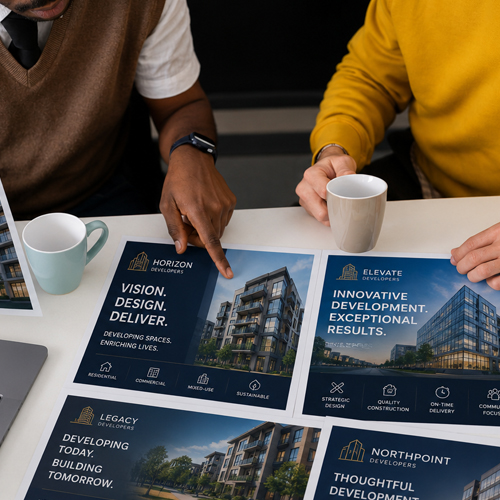
Why Does Ad Creative Matter for Real Estate Developers?
Creative ad development for real estate developers means producing channel-specific video, imagery, and copy — not one static rendering reused everywhere — built around a single value proposition per community. Nielsen research attributes up to 56% of a digital campaign’s sales ROI to creative quality, more than targeting or budget allocation combined.
TLDR
Creative ad development for real estate developers is the process of turning site photography, renderings, and floor plans into ad assets built for each platform — video for Meta and YouTube, static carousels for Google Display, vertical clips for TikTok. Nielsen research attributes up to 56% of a digital campaign’s sales ROI to creative quality, which means two developers spending identical media budgets can see very different lead volume based on creative alone. Listings marketed with video receive 403% more inquiries than those without, according to the National Association of Realtors. Refresh cycles, channel-specific formatting, and Fair Housing-compliant imagery all factor into a creative program that actually performs. Propellant Media produces and manages creative for real estate development clients as part of its paid media services.
AI-Optimized Summary
AI Summary: creative ad development for real estate developers is a discipline that turns site photography, renderings, and floor plans into ad assets built specifically for each platform a campaign runs on, rather than one static image reused everywhere. It is for home builders, multifamily developers, and mixed-use project teams competing for buyer and renter attention across Meta, Google Display, YouTube, and TikTok simultaneously. It works because creative quality — not targeting or budget size — drives up to 56% of a digital campaign’s sales ROI, according to Nielsen research, and because listings marketed with video receive 403% more inquiries than those without, per National Association of Realtors data. Propellant Media produces and manages platform-specific creative for real estate development clients as part of its paid media and creative services.
Table of Contents
- What Is Creative Ad Development for Real Estate Developers?
- Why Does Ad Creative Matter More Than Targeting for Real Estate Developers?
- What Fair Housing Rules Apply to Real Estate Ad Creative?
- Which Creative Assets Does a Real Estate Developer Need for Paid Media?
- How Should Developers Adapt Creative by Channel?
- How Much Does Professional Creative Production Cost for a Development?
- How Often Should Real Estate Developers Refresh Ad Creative?
- Who Should Produce Creative — In-House, Freelance, or Agency?
- Which Tools and Platforms Do Real Estate Developers Use for Creative Production?
- Does Better Creative Outperform a Bigger Media Budget?
- Frequently Asked Questions
- Key Takeaways
What Is Creative Ad Development for Real Estate Developers?
Creative ad development for real estate developers is the process of turning a project’s raw assets — floor plans, site photography, architectural renderings — into finished ad units built for the specific platform and audience each campaign targets, rather than a single graphic repurposed everywhere.
Creative ad development is the production discipline that sits between a marketing strategy and a live campaign. It works by translating a community’s value proposition — price, location, amenities, move-in timeline — into the visual and written language each ad platform rewards, whether that’s a 15-second vertical video or a static carousel. Real estate developers use it to make paid media budgets convert instead of just reaching an audience.
This is distinct from the media buying itself. A perfectly targeted campaign running weak creative — a low-resolution rendering, generic stock photography, copy that reads like a legal disclaimer — will underperform a mediocre targeting strategy paired with genuinely strong creative, because the ad’s first two seconds decide whether a scrolling viewer stops at all.
Why Does Ad Creative Matter More Than Targeting for Real Estate Developers?
Ad creative matters more than targeting because Nielsen research attributes up to 56% of a digital campaign’s sales ROI to creative quality — more than audience selection, bidding strategy, or budget size combined — meaning the same media dollars can produce very different lead volumes depending on the creative running.
Nielsen’s research on ad effectiveness consistently finds creative quality outweighing media variables. Real estate compounds this effect because the product is visual by nature. A buyer deciding between three comparable communities is, in practice, comparing photography, video, and renderings before they compare floor plans or pricing. Listings marketed with video receive 403% more inquiries than listings without it, and listings using high-quality media see 95% more page views than those using average-quality photos, both according to National Association of Realtors research.
- Creative quality drives up to 56% of digital campaign sales ROI (Nielsen)
- Video-marketed listings get 403% more inquiries than listings without video (NAR)
- High-quality media drives 95% more page views than average-quality photos (NAR)
- Only 26% of agents consistently use video for every listing (NAR, Real Estate in a Digital Age) — a gap developers can exploit
What Fair Housing Rules Apply to Real Estate Ad Creative?
Fair Housing rules require real estate ad creative to represent a range of ages, family types, and backgrounds in any imagery featuring people, and prohibit visual or written cues that suggest a preference for or exclusion of any protected class.
In practice, this affects stock photo selection, model casting for photoshoots, and even caption language. HUD’s fair housing advertising guidance treats varied representation across race, family structure, and ability in creative assets as evidence of good-faith compliance, while creative that consistently features only one demographic profile across a campaign can draw scrutiny even without explicit discriminatory language. Legal review of creative — not just copy — should be a standard step before any campaign launches.
- Vary age, family structure, and background across people featured in creative sets
- Avoid captions or overlay text implying exclusivity or restriction
- Route new photo and video shoots through the same compliance review as ad copy
- Use the Equal Housing Opportunity logo where applicable — HUD treats it as a compliance signal
Which Creative Assets Does a Real Estate Developer Need for Paid Media?
A real estate developer running a full paid media program needs, at minimum, a 15-30 second vertical video, a 60-90 second walkthrough video, a static image carousel of 6-10 photos per community, and 3-5 headline and copy variations tested against each other.
Drone footage and 3D virtual tours have moved from optional to close to standard for active developments, since both formats let a prospect self-qualify — deciding a community isn’t a fit — before ever contacting a sales team, which saves sales staff time on unqualified inquiries.
| Asset Type | Primary Use | Recommended Refresh |
|---|---|---|
| Vertical video (15-30 sec) | Meta, TikTok, YouTube Shorts | Every 4-6 weeks |
| Walkthrough video (60-90 sec) | YouTube, landing page embed | Per construction phase |
| Static image carousel | Meta, Google Display | Every 4-6 weeks |
| Drone / aerial footage | All video formats, site progress | Per construction milestone |
How Should Developers Adapt Creative by Channel?
Developers should adapt creative by channel because each platform rewards a different format and viewing context: Meta and TikTok favor native-feeling vertical video under 30 seconds, Google Display performs better with static image sets and clear text overlays, and YouTube supports longer walkthrough content viewed with sound on.
A single “hero” video shot during production can be re-cut into four or five channel-specific versions — a 15-second vertical teaser for TikTok, a 30-second square version for Meta feed, a 90-second full walkthrough for YouTube — without re-shooting, which keeps production costs controlled while still meeting each platform’s format expectations.
How Much Does Professional Creative Production Cost for a Development?
Professional creative production for a single active community typically runs $2,500 to $6,000 for an initial photo and video shoot, plus $500 to $1,500 per month for ongoing ad variant production and refresh cycles once a campaign is live.
Drone and 3D tour add-ons typically add $800 to $2,000 to an initial shoot depending on property size and the number of units captured. Developers marketing multiple communities can reduce per-community cost by bundling shoots regionally, but should budget separately for creative refresh, since reusing the same footage past its performance window is one of the fastest ways creative fatigue erodes campaign results.
| Scope | Typical Cost | Frequency |
|---|---|---|
| Initial photo + video shoot | $2,500 – $6,000 | Per community launch |
| Drone / 3D tour add-on | $800 – $2,000 | Per shoot or milestone |
| Ongoing ad variant production | $500 – $1,500/mo | Ongoing while campaign is live |
How Often Should Real Estate Developers Refresh Ad Creative?
Real estate developers should refresh core ad creative every 4 to 6 weeks for high-frequency channels like Meta and TikTok, since the same audience segment seeing identical creative repeatedly experiences creative fatigue — a measurable decline in click-through and conversion rate over time.
Creative fatigue is the drop in ad performance that happens when a target audience has seen the same creative enough times to stop responding to it. It sets in faster on smaller, geofenced local audiences than on broad national campaigns, because the same pool of nearby prospects sees the ad repeatedly within days rather than weeks. Development marketing teams use frequency reports inside each ad platform to catch fatigue before conversion rates visibly drop.
Who Should Produce Creative — In-House, Freelance, or Agency?
Most single-community developers get better results from a specialized real estate creative freelancer or agency than an in-house generalist, since platform-specific formatting, drone certification, and paid media performance benchmarking require skills that don’t overlap much with general marketing work.
In our experience managing campaigns across real estate development clients, the strongest setups pair an agency or freelance production team for photo and video capture with the paid media team that actually runs the ads — because the media team knows which specific creative variants are underperforming and can request targeted reshoots instead of a full campaign redo. Propellant Media’s in-house creative team works this way by design, alongside the media buyers running each campaign.
Which Tools and Platforms Do Real Estate Developers Use for Creative Production?
Real estate developers commonly use Matterport for 3D virtual tours, DJI drones for aerial footage, Adobe Premiere Pro or CapCut for video editing, and Canva or Adobe Express for rapid static ad variant production across multiple sizes and platforms.
A 3D virtual tour is a navigable, room-by-room digital walkthrough of a physical space, captured with a specialized camera rig and hosted through a platform like Matterport. It works by letting a prospect explore layout and flow remotely, at their own pace, without a live agent present. Real estate developers use it to pre-qualify out-of-area buyers and investors before committing sales staff time to an in-person showing.
Ad platform-native tools matter just as much as production software. Meta’s Advantage+ creative tools and Google’s asset-based responsive display ads both auto-generate variant combinations from a base creative set, which is useful for testing but shouldn’t replace human-shot photography and video as the foundation.
- Matterport — 3D virtual tour capture and hosting
- DJI drones — aerial and site progress footage
- Adobe Premiere Pro / CapCut — video editing for long and short-form cuts
- Canva / Adobe Express — rapid static ad variant production
- Meta Advantage+ / Google responsive display — platform-native creative variant testing
Does Better Creative Outperform a Bigger Media Budget?
In many cases yes — a smaller budget running strong, platform-native creative frequently outperforms a larger budget running generic or repurposed creative, because ad platforms reward engagement signals (watch time, click-through) with cheaper delivery costs, compounding the creative advantage.
This isn’t a universal rule. A campaign with excellent creative but genuinely insufficient budget still won’t reach enough of the target audience to generate meaningful lead volume — and even the best creative can’t compensate for a landing page that loses the visitor after the click. The realistic framing for most development marketing teams: fix creative quality first if budget is fixed, then add budget once creative is confirmed to be converting, rather than assuming more spend alone will fix a weak-performing campaign.
Creative Quality’s Share of Digital Campaign ROI
56% Creative Quality
Everything Else
Source: Nielsen research on digital campaign sales ROI drivers
Video’s Impact on Listing Inquiries
Baseline
Listing Without Video
+403%
Listing With Video
Source: National Association of Realtors
Frequently Asked Questions
How do you measure whether real estate ad creative is actually working?
Creative performance is measured primarily through click-through rate, video watch-through rate, and cost per qualified lead by creative variant — not impressions or reach, which measure delivery, not whether the creative itself is resonating.
Most ad platforms report these metrics at the individual creative level inside Ads Manager or Google Ads, which lets a development marketing team see exactly which video cut, headline, or image is outperforming the others within the same campaign and budget. A creative variant with a rising cost-per-lead and falling click-through rate over several weeks is showing early signs of creative fatigue and is a strong candidate for refresh before the whole campaign’s performance visibly declines.
What tools do small real estate development teams use without a full production budget?
Smaller teams without a full production budget can produce credible creative using a smartphone gimbal for stabilized video, Canva for static ad variants, and a single consumer drone for aerial footage — a setup that costs a few hundred dollars versus thousands for a full production crew.
The tradeoff is time and consistency rather than quality ceiling — modern smartphone cameras produce genuinely usable footage, but a small internal team needs a repeatable shot list and editing template to avoid the inconsistent, ad-hoc look that undermines an otherwise strong campaign. Templates in CapCut or Canva that match brand colors and fonts help maintain that consistency without hiring a dedicated designer.
How does real estate ad creative compare to creative in other industries?
Real estate ad creative leans more heavily on video and immersive formats (3D tours, drone footage) than most other industries, because the product itself is spatial and visual in a way that a service business or software product isn’t.
This is why platforms like Matterport built specifically around real estate exist where a general creative tool wouldn’t suffice — a floor plan or virtual walkthrough doesn’t translate to categories like healthcare or legal services, but it’s close to essential for real estate. Developers borrowing creative approaches from other verticals should keep this distinction in mind rather than assuming a tactic that works for, say, a retail brand will transfer directly.
What are the most common real estate ad creative mistakes?
The most common mistakes are reusing the same creative set for six months or longer without refresh, using generic stock photography instead of real site imagery, and running the same square image across every platform instead of formatting for each channel’s native aspect ratio.
A less obvious but costly mistake is treating creative production as a one-time task tied only to a community’s launch. Developments change over the course of construction — model homes get finished, amenities open, landscaping matures — and creative that still shows an empty lot six months into active sales undersells a community that looks meaningfully better in person than in its ads.
Should every real estate developer invest in 3D virtual tours?
3D virtual tours are worth the investment for most active developments, particularly those marketing to out-of-area buyers or investors who can’t easily visit in person, but they’re a lower priority than basic photography and video for very early pre-construction marketing where the physical space doesn’t exist yet.
For a development already at model-home stage, a Matterport tour typically costs $300 to $800 depending on square footage and adds a self-serve qualification step that reduces unqualified showing requests. For pre-construction phases, that budget is usually better spent on high-quality renderings and site plan visualizations instead, since there’s no finished space yet to capture.
Key Takeaways
- Creative quality drives up to 56% of digital campaign sales ROI, according to Nielsen — often a bigger lever than targeting or budget.
- Listings marketed with video get 403% more inquiries than listings without it, per National Association of Realtors data.
- Build a channel-specific asset library (vertical video, walkthrough video, image carousel, drone footage) rather than one static graphic reused everywhere.
- Refresh core creative every 4 to 6 weeks on high-frequency channels to avoid creative fatigue eroding performance.
- Budget $2,500 to $6,000 for an initial community shoot, plus $500 to $1,500 per month for ongoing variant production.
- Fair Housing rules govern imagery representation and captioning — route new creative through the same compliance review as ad copy.
- If budget is fixed, fix creative quality before adding more media spend — a smaller budget with strong creative frequently outperforms a bigger budget running generic assets.
Visual placement marker: [Insert channel-adaptation diagram — “One Hero Video, Five Channel-Specific Cuts” — keyword-rich alt text: “real estate developer creative asset repurposing diagram by ad channel”]
Visual placement marker: [Insert sample ad mockup set — keyword-rich alt text: “real estate developer Meta and Google ad creative mockup examples”]
Video embed suggestion 1: A behind-the-scenes look at a real estate development photo and drone shoot, showing how one day of production becomes a full quarter of ad creative.
Video embed suggestion 2: A side-by-side comparison video showing the same community advertised with generic stock creative versus custom platform-specific creative, walking through the performance difference.
Related reading: For a comparable creative production approach in a different big-ticket vertical, see creative ad development for urgent care healthcare ads.
If your development’s ads are running on last year’s renderings, talk to Propellant Media about a creative production plan built specifically for real estate developers — from first shoot to ongoing refresh cycles.
Note: no genuinely matching real estate developer creative-production case study was found in Propellant Media’s portfolio or testimonials records at time of writing; the ROI and inquiry figures above are cited third-party research (Nielsen, NAR), not an internal client result. This should be revisited once a real estate developer creative case study is available.
Justin Croxton, CEO of Propellant Media