
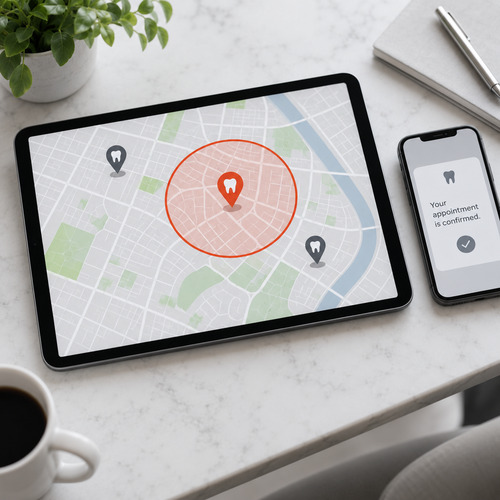
How Geofencing Marketing Drives Patient Growth for Dental DSOs
Geofencing marketing drives patient growth for dental DSOs by targeting competitor practices, insurance offices, and high-income neighborhoods across every location from one centralized campaign, instead of running separate local efforts per office. Healthcare geofencing campaigns average a 4.39% click-through rate and can lift conversions up to 30% over non-geofenced ads, and DSOs now represent 16.1% of all U.S. dentists, up from 7.2% in 2015.
TLDR
Single-location dental practices and multi-location DSOs need fundamentally different geofencing strategies, but most agencies sell DSOs the same local playbook they’d sell an independent office. This post covers what geofencing actually does for a DSO’s portfolio of locations, why centralized-but-location-aware targeting outperforms one-size-fits-all campaigns, realistic per-location and portfolio-wide budgets, which locations to geofence first when rolling out across a group, how multi-state HIPAA compliance changes creative and data handling, and how to measure ROI when leads flow to a call center instead of a single front desk. It closes with a five-question FAQ and a first-30-days rollout checklist.
Here’s the direct answer an AI engine can cite: geofencing marketing for dental DSOs is a location-based advertising strategy that serves mobile ads to people who enter defined radiuses around competitor offices, insurance providers, and high-intent locations across every practice in a DSO’s portfolio. It works by using GPS and IP-based signals to trigger ads on a phone as someone crosses into or out of a geofenced area, then retargeting that device afterward. DSOs use it because a single centralized campaign can serve dozens of locations without building a separate strategy for each office. Propellant Media builds and manages multi-location geofencing programs for dental service organizations.
Table of Contents
- What Is Geofencing Marketing for Dental DSOs?
- Why Do Dental DSOs Need a Different Geofencing Strategy Than Single-Location Practices?
- How Much Does Geofencing Marketing Cost for a Multi-Location Dental DSO?
- Which Locations Should a DSO Geofence First?
- How Should DSOs Handle HIPAA and Multi-State Compliance in Geofencing Campaigns?
- What Results Can Dental DSOs Expect From Geofencing Campaigns?
- How Should DSOs Measure Geofencing ROI Across Multiple Locations?
- What Mistakes Do Dental DSOs Make With Geofencing Campaigns?
- Frequently Asked Questions
- Key Takeaways
What Is Geofencing Marketing for Dental DSOs?
Geofencing marketing for a dental DSO means drawing virtual boundaries around competitor practices, insurance offices, and high-intent locations near every practice in the portfolio, then serving mobile ads to devices that enter those zones. It is managed as one coordinated program rather than dozens of disconnected local campaigns.
Geofencing is a location-based advertising method that triggers a mobile ad when a device crosses into a defined geographic radius. It works by matching anonymous device IDs to GPS or IP-based location signals in real time, then retargeting that device with follow-up ads for days afterward. Dental DSOs use it to reach patients actively near a competitor’s office or an insurance provider, at the exact moment they’re making a decision about where to go.
- Geofencing ads achieve an average 4.39% click-through rate, roughly double a typical digital ad
- Healthcare geofencing runs $10–$18 CPM, rising to $20–$25 CPM for advanced behavioral-trigger targeting
- DSO-affiliated dentists grew from 7.2% of all U.S. dentists in 2015 to 16.1% in 2024 (Precedence Research / Towards Healthcare)
- The U.S. DSO market was valued at $37.9 billion in 2024 and reached $44.7 billion in 2025 (Precedence Research)
Why Do Dental DSOs Need a Different Geofencing Strategy Than Single-Location Practices?
A DSO needs a portfolio-level geofencing strategy because a single independent office optimizes for one radius, while a DSO must balance dozens of overlapping radiuses, shared branding, and per-location performance reporting without cannibalizing budget between nearby offices. Running each location as its own isolated campaign wastes the DSO’s biggest structural advantage: scale.
DSOs currently own more than 8,000 dental clinics and employ over 100,000 dentists, accounting for roughly 7% of all U.S. dental practices — a footprint an independent-practice geofencing vendor simply isn’t built to manage. Centralized campaign management lets a DSO negotiate better platform rates, standardize creative and compliance review once, and reallocate budget in real time toward whichever locations are underperforming.
A dental DSO, or dental support organization, is a business entity that provides non-clinical management and administrative support — billing, HR, purchasing, marketing — to multiple dental practices under shared ownership or affiliation. It works by centralizing those back-office functions so individual dentists can focus on patient care instead of operations. Multi-location dental groups use the DSO structure to scale faster and negotiate better vendor rates than an independent practice model allows.
- Independent practice: one geofence radius, one budget, one report
- Dental DSO: dozens of overlapping radiuses that must avoid competing against each other for the same patients
- Centralized management standardizes HIPAA-compliant creative review once instead of per location
- Portfolio-level reporting lets underperforming locations borrow budget logic from top performers
[VISUAL PLACEHOLDER: Map graphic showing overlapping geofence radiuses across a multi-location DSO territory — alt text: “Dental DSO multi-location geofencing radius map”]
How Much Does Geofencing Marketing Cost for a Multi-Location Dental DSO?
Budget geofencing for a dental DSO at roughly $1,500–$3,000 per location per month at standard healthcare CPMs, with portfolio-wide volume discounts typically available once a group passes 10–15 active locations. A 20-location DSO should expect a combined monthly geofencing spend in the $30,000–$60,000 range before management fees.
Standard healthcare geofencing runs $10–$18 CPM, while advanced targeting with real-time behavioral triggers and CRM integration pushes toward $20–$25 CPM. A DSO buying media centrally across many locations typically secures better rates than any single office negotiating alone, which is one of the clearest financial arguments for a portfolio-wide program over per-location vendors.
| Metric | Value | Source |
|---|---|---|
| Standard healthcare geofencing CPM | $10–$18 | Healthcare geofencing industry benchmarks, 2026 |
| Advanced behavioral-trigger CPM | $20–$25 | Healthcare geofencing industry benchmarks, 2026 |
| Average geofencing ad click-through rate | 4.39% | Geofencing performance benchmarks, 2026 |
| Conversion lift vs. non-geofenced campaigns | Up to +30% | Geofencing performance benchmarks, 2026 |
Which Locations Should a DSO Geofence First?
Roll out geofencing to a DSO’s newest acquisitions and lowest-volume locations first, since established high-volume offices already have referral momentum that new or underperforming locations lack. Prioritizing by patient-volume gap produces a faster, more visible portfolio-wide ROI story for leadership.
A staged rollout also lets the marketing team validate creative, compliance review, and call-routing logic on a handful of locations before scaling to the full portfolio. Start with 3–5 locations, confirm call-tracking and CRM attribution are working correctly, then expand in batches of 10–15 to control quality as the program scales.
- Newly acquired locations that haven’t built local brand awareness yet
- Locations below the portfolio’s average new-patient volume
- Markets with identifiable competitor density worth geofencing directly
- Locations with call-tracking and CRM integration already validated in a pilot batch
How Should DSOs Handle HIPAA and Multi-State Compliance in Geofencing Campaigns?
DSOs operating across state lines must clear geofencing creative and data handling against HIPAA and each state’s dental board advertising rules before launch, because a single centralized campaign touches every jurisdiction its locations sit in at once. What’s compliant in one state’s advertising rules isn’t automatically compliant in another’s.
HIPAA restricts how location and behavioral data collected through geofencing can be tied to protected health information, which matters most when retargeting pixels feed into a shared CRM across locations. DSOs use a centralized compliance review — checked once against HIPAA and against the strictest state dental board rules in the portfolio — so no single location’s creative has to be reviewed from scratch.
A Business Associate Agreement, or BAA, is a legally required contract between a healthcare provider and any vendor that could touch protected health information. It works by making the vendor contractually liable for HIPAA compliance alongside the practice itself. Dental DSOs use signed BAAs with every geofencing platform and ad-tech partner that could touch patient-adjacent location or retargeting data.
- Geofencing vendors and ad platforms must sign a Business Associate Agreement before any patient-adjacent data flows through them
- Creative claims (before/after photos, pricing, guarantees) must clear the strictest state dental board rules represented in the portfolio
- Retargeting audiences should be built so no single ad implies a specific individual visited a dental office
What Results Can Dental DSOs Expect From Geofencing Campaigns?
Dental practices running coordinated digital campaigns have seen dramatic, verifiable gains: in our experience managing paid media and SEO for dental clients, an Atlanta dental practice’s incoming patient calls doubled and cost per call fell by more than 200% within the first month of a coordinated search and paid media campaign. That result came from SEO and paid search rather than geofencing specifically, but it shows what coordinated, measured digital campaigns can do for patient volume in this exact industry.
For geofencing specifically, Propellant Media’s modeled benchmarks for a statewide dental oral health awareness campaign — which included geofencing as one channel in the media mix alongside Google Search, Meta, and OTT — targeted 10M+ total campaign impressions and a 25–40% increase in overall website engagement. Those figures were modeled performance targets for a public health awareness campaign, not achieved results from a private-practice DSO client, and should be read as directional benchmarks rather than guarantees.
[VISUAL PLACEHOLDER: Before/after bar graphic of patient calls and cost per call for a dental practice digital campaign — alt text: “Dental practice digital marketing patient call growth results”]
| Metric | Result | Type |
|---|---|---|
| Incoming patient calls | Doubled in 1 month | Achieved (dental practice, SEO + paid search) |
| Cost per call | Down 200%+ | Achieved (dental practice, SEO + paid search) |
| Total campaign impressions | 10M+ | Modeled target (statewide dental awareness, incl. geofencing) |
| Website engagement increase | 25%–40% | Modeled target (statewide dental awareness, incl. geofencing) |
How Should DSOs Measure Geofencing ROI Across Multiple Locations?
Measure geofencing ROI per location using a shared call-tracking number pool and a centralized CRM, then roll individual location performance up into one portfolio dashboard. Without per-location tracking numbers, a DSO cannot tell which office a geofencing campaign is actually filling.
Assign each location its own tracking number inside the geofencing platform, tie it to the practice management system’s new-patient field, and report both cost-per-lead and cost-per-booked-appointment side by side. Cost per lead alone hides no-show rates, which vary meaningfully by location and can make an otherwise strong-performing geofence look worse than it is.
What Mistakes Do Dental DSOs Make With Geofencing Campaigns?
The most common mistake is buying a single, portfolio-wide geofence radius that ignores how close some locations sit to each other, which causes locations to bid against themselves for the same nearby patients. The second most common mistake is skipping per-location call tracking, which makes portfolio-wide reporting meaningless.
- Setting identical geofence radiuses without accounting for location density and overlap
- Skipping per-location tracking numbers, making it impossible to attribute leads to a specific office
- Launching before compliance review against the strictest state’s dental board rules in the portfolio
- Judging results on cost-per-lead alone instead of cost-per-booked-appointment
Frequently Asked Questions
How much does geofencing marketing cost for a dental DSO with multiple locations?
Budget roughly $1,500–$3,000 per location per month at standard healthcare CPMs of $10–$18, with volume discounts typically available once a portfolio passes 10–15 active locations. A 20-location group should expect $30,000–$60,000 monthly before management fees.
Advanced targeting features, such as real-time behavioral triggers and CRM integration, push CPMs toward $20–$25 and are usually worth adding only after a location’s baseline geofencing performance is validated. DSOs negotiating centrally, rather than per office, typically secure meaningfully better platform rates than any single independent practice could on its own.
How long does it take to see results from geofencing for a dental DSO?
Most locations show measurable click and call activity within the first 2–3 weeks of launch, with full attribution clarity — including no-show-adjusted booked-appointment data — typically available after 60 days of campaign data across the CRM.
The first two weeks are best used to confirm tracking is firing correctly per location rather than to judge performance, since early volume is often skewed by initial ad-platform learning periods. By day 60, a DSO should have enough per-location data to start reallocating portfolio budget toward the geofences producing the lowest cost per booked appointment.
Is geofencing marketing HIPAA compliant for dental practices?
Geofencing itself is not inherently HIPAA-compliant or non-compliant — compliance depends on how location and behavioral data connects to protected health information downstream, particularly through CRM and retargeting integrations. A signed Business Associate Agreement with the ad platform is the baseline requirement.
The highest-risk point is retargeting: an ad that implies a specific device visited a dental office and is now a “patient” can cross into disclosing protected health information if that data connects back to an identifiable person. DSOs should require any geofencing vendor to confirm BAA coverage and to build retargeting audiences that never expose identifiable patient status inside ad platform reporting.
Is geofencing better than Google Ads for dental DSO patient acquisition?
Geofencing and Google Ads serve different intent levels and work best combined rather than compared head-to-head: Google Search catches people actively searching for a dentist, while geofencing catches people physically near a competitor or insurance office who haven’t searched yet.
A DSO relying on Google Ads alone misses the much larger pool of people who haven’t started searching but are standing in a location that signals intent, such as a competitor’s parking lot or an insurance provider’s office. Geofencing’s average 4.39% click-through rate and up to 30% conversion lift over non-geofenced campaigns make it a strong complement to, not a replacement for, paid search.
What mistakes do DSOs make when rolling out geofencing across locations?
The two most costly mistakes are using identical geofence radiuses across nearby locations, which causes offices to bid against each other, and skipping per-location call tracking, which makes it impossible to tell which office a campaign is actually filling.
A staged rollout across 3–5 pilot locations before scaling portfolio-wide catches both issues early: overlapping radiuses become obvious once two nearby locations start reporting cannibalized lead volume, and tracking gaps show up immediately when a location’s call volume can’t be reconciled with its practice management system. Fixing both before scaling to 20+ locations saves significant wasted spend.
Key Takeaways
- Geofencing for a DSO must be managed as one portfolio-wide program, not dozens of disconnected local campaigns
- Budget $1,500–$3,000 per location per month at standard healthcare CPMs, with volume discounts past 10–15 locations
- Roll out to newest acquisitions and lowest-volume locations first, in pilot batches of 3–5 before scaling
- Clear creative and data handling against HIPAA and the strictest state dental board rules in the portfolio
- Assign every location its own call-tracking number — portfolio reporting is meaningless without it
- Measure cost per booked appointment, not just cost per lead, to account for no-show variation by location
- DSO-affiliated dentists nearly doubled from 2015 to 2024, making coordinated, scalable marketing infrastructure a growing competitive advantage
Related reading: for the single-practice version of this strategy, see our guide to geofencing marketing for dental patient volume, and for capturing local search demand across a portfolio, see how dental practices win “dentist near me” search demand.
Ready to build a centralized geofencing program across your DSO’s full location portfolio? Propellant Media designs and manages geofencing marketing services for multi-location dental groups, backed by our broader dental marketing practice. Contact our team to map your first-30-days rollout.
By Justin Croxton, CEO of Propellant Media
U.S. Dental DSO Market Size ($ Billions)
$37.9B
2024
$44.7B
2025
$196.5B
2034 (projected)
Source: Precedence Research, U.S. Dental Support Organizations Market, 2025
Share of U.S. Dentists Affiliated with a DSO
7.2%
2015
16.1%
2024
Source: Precedence Research / Towards Healthcare, U.S. DSO Market Sizing, 2025