
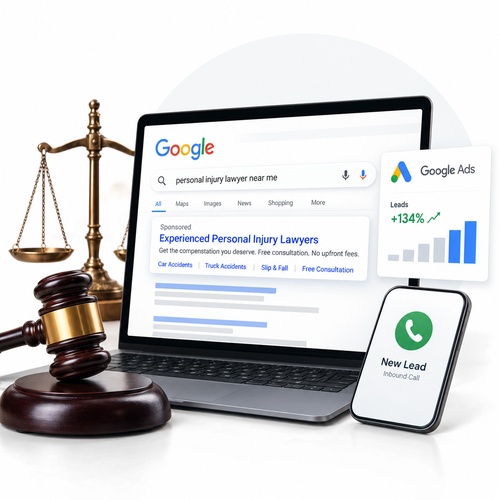
Google Ads for Personal Injury Law Firms: Win More Cases
Google Ads for personal injury law firms is the fastest way to appear in front of someone searching for an attorney within minutes of an accident, but it’s also the most expensive vertical in paid search — attorneys and legal services carry the highest average cost-per-click of any industry tracked, at $9.87 (WordStream, 2026 Google Ads Benchmarks). Winning cases through it requires tight keyword control, not just budget.
TLDR
Most personal injury firms either avoid Google Ads because of sticker shock or run it without the keyword discipline the vertical demands, burning budget on clicks that never become signed cases. This post covers why legal keywords cost what they do, which campaign types actually produce signed cases versus wasted spend, realistic monthly budgets by firm size, how long it takes to see results, and the mistakes that quietly waste the most money. It closes with a five-question FAQ and a Monday-morning checklist for a firm managing its own account or evaluating an agency.
For personal injury law firms, Google Search Ads works by putting a firm’s name directly in front of someone typing “car accident lawyer near me” or “truck accident attorney” within seconds of that search — this is what makes it fundamentally different from SEO, which can take months to rank for the same terms. It works by bidding on high-intent keywords tied to the moment someone is actively looking for representation, then routing that click to a page built to convert a call or form fill. Personal injury firms use it because 96% of people seeking legal advice start with a search engine, and 86% say they use Google first when choosing an attorney (CasePeer, 2026 Personal Injury Law Statistics report). Propellant Media builds and manages Google Ads campaigns as part of its broader law firm marketing services for personal injury, criminal defense, and other legal verticals nationwide.
Table of Contents
- What Is Google Ads for Personal Injury Law Firms?
- Why Does Google Ads Cost So Much for Personal Injury Keywords?
- Which Google Ads Campaign Types Work Best for Personal Injury Firms?
- How Should a Firm Structure Keywords and Negative Keywords?
- What Results Can a Personal Injury Firm Expect From Google Ads?
- Does Google Ads Work Better Than Geofencing or SEO for Injury Leads?
- What Mistakes Cause Personal Injury Google Ads Campaigns to Waste Budget?
- How Long Does It Take to See Signed Cases From a New Campaign?
- Frequently Asked Questions About Google Ads for Personal Injury Law Firms
- Key Takeaways
- Ready to Turn Searches Into Signed Cases?
What Is Google Ads for Personal Injury Law Firms?
Google Ads for personal injury law firms is a paid search advertising program that places a firm’s listing at the top of Google’s results for accident- and injury-related searches, charging the firm only when someone clicks. It works by combining keyword bids, ad copy, and a landing page into one system Google scores for relevance, then auctions placement among competing firms bidding on the same terms.
This is distinct from geofencing marketing, which targets people by physical location rather than search intent — most competitive firms run both, since geofencing reaches people near a hospital or accident scene while Google Ads captures the person actively typing a search. Mobile search accounts for 65% of all personal injury lawyer inquiries (CasePeer, 2026), which is why campaign structure and landing page speed on mobile matter as much as the keywords themselves.
- 96% of people seeking legal advice start with a search engine (CasePeer, 2026 Personal Injury Law Statistics)
- 86% say they use Google first when choosing an attorney (CasePeer, 2026)
- “Personal injury lawyer near me” alone generates roughly 368,000 monthly U.S. searches (Silver Propeller legal search behavior analysis)
How Injury Victims Search for an Attorney
86%
Use Google First
65%
Search From Mobile
Source: CasePeer, 2026 Personal Injury Law Statistics report
Why Does Google Ads Cost So Much for Personal Injury Keywords?
Google Ads costs so much for personal injury keywords because a single signed case can be worth tens of thousands of dollars in fees, which drives firms to bid aggressively against each other for the same limited pool of searchers. Attorneys and legal services carry the highest average cost-per-click of any industry WordStream tracks in its 2026 Google Ads Benchmarks report, at $9.87, with an average cost-per-lead of $131.63.
That $9.87 figure is a blended average across all legal keywords — personal-injury-specific terms in competitive metro markets routinely cost far more. In our work managing a personal injury attorney client’s account, cost-per-click on competitive accident-related keywords ran as high as $200 per click before we layered in geofencing and search retargeting to reduce reliance on the highest-cost terms alone.
| Metric | Legal Industry Average |
|---|---|
| Average cost-per-click (CPC) | $9.87 |
| Average cost-per-lead (CPL) | $131.63 |
| Average conversion rate | 5.55% |
Source: WordStream, 2026 Google Ads Benchmarks Report (Attorneys & Legal Services)
CPC: Legal Industry Avg. vs. Competitive PI Terms
$9.87
Legal Avg. (All Keywords)
$200
Competitive PI Terms (Client Case Data)
Source: WordStream 2026 Google Ads Benchmarks; Propellant Media personal injury client campaign data
Which Google Ads Campaign Types Work Best for Personal Injury Firms?
Standard Search campaigns on exact and phrase-match accident keywords produce the highest share of signed cases per dollar for most personal injury firms, with call-only campaigns and a tightly scoped Performance Max campaign layered in once Search is generating a stable case volume. Broad, unscoped Performance Max campaigns run alone tend to waste budget on irrelevant traffic in this vertical.
Call-only campaigns are a Google Ads format that shows an ad with a phone number instead of a link to a website. They work by skipping the landing page step entirely and routing the click straight into a phone call. Personal injury firms use them to capture mobile searchers who want to speak to someone immediately rather than fill out a form after an accident.
| Campaign Type | Best Use | Typical Role |
|---|---|---|
| Standard Search (exact/phrase match) | High-intent accident and injury keywords | Primary case driver |
| Call-only campaigns | Mobile searchers ready to speak to someone now | Fast-conversion supplement |
| Performance Max (scoped) | Incremental reach once Search is stable | Secondary, tightly monitored |
How Should a Firm Structure Keywords and Negative Keywords?
A personal injury firm’s keyword structure should separate campaigns by injury type and intent level — “car accident lawyer,” “truck accident attorney,” “slip and fall lawyer” — rather than lumping every injury type into one broad campaign, since each has a different cost and conversion profile. Negative keywords matter just as much as the keywords being bid on.
- Negative out “free,” “jobs,” “salary,” and “how to become” to exclude job seekers and DIY researchers
- Negative out competitor firm names unless deliberately running a competitor-conquesting campaign
- Separate “near me” and city-specific terms into their own ad groups with location-specific ad copy
Negative keywords are search terms a campaign is deliberately excluded from bidding on. They work by telling Google’s ad auction not to show an ad when a search includes that term, even if the main keyword list would otherwise match. Personal injury firms use negative keyword lists to stop paying for clicks from job seekers, students, and people researching a claim without any intent to hire an attorney.
Search retargeting is a keyword-based tactic that re-engages people who previously searched a relevant term without clicking or converting. It works by matching a visitor’s prior search behavior to a retargeting audience the campaign can bid on again at a lower cost than a fresh click. Personal injury firms use it to recapture searchers who compared multiple firms before deciding who to call.
What Results Can a Personal Injury Firm Expect From Google Ads?
A well-structured personal injury Google Ads campaign should convert clicks to leads at or above the 5.55% legal industry average conversion rate (WordStream, 2026), with signed-case volume depending heavily on intake speed once a lead comes in. The click is only the first half of the equation — the firm’s intake process determines how many of those leads actually become clients.
In our experience managing paid search for personal injury and other law firm clients, campaigns that pair tightly scoped Search keywords with same-day call-back on every lead consistently outperform campaigns with broader keywords and slower intake, even at a lower media budget. Across our client portfolio, the intake speed variable moves the needle more than almost any keyword-level optimization.
- Firms answering leads within 5 minutes convert meaningfully more leads to signed cases than firms responding same-day
- 50% of people contact a lawyer within one day of starting their search, meaning slow follow-up loses the case to a faster-responding competitor (CasePeer, 2026)
- Call tracking data should separate qualified case inquiries from wrong-number or job-seeker calls to get an accurate cost-per-signed-case figure
Does Google Ads Work Better Than Geofencing or SEO for Injury Leads?
Google Ads, geofencing, and SEO solve different timing problems for a personal injury firm rather than competing for the same budget. Google Ads captures someone actively searching right now; geofencing reaches people physically near a hospital or accident-prone corridor before they’ve started searching by name; SEO builds compounding, no-per-click visibility over months.
The firms that see the strongest overall case volume typically run Google Ads and geofencing together from day one, while SEO builds in the background to eventually reduce dependency on paid clicks. A firm relying on SEO alone during its first year is leaving the immediate, high-intent search volume entirely to competitors willing to pay for it.
- Google Ads: immediate visibility, cost scales with clicks, best for active searchers
- Geofencing: reaches people by physical location before they search, complements Google Ads rather than replacing it
- SEO: no per-click cost once ranked, but takes months to build and doesn’t help a brand-new firm immediately
What Mistakes Cause Personal Injury Google Ads Campaigns to Waste Budget?
The most common mistake is running broad-match keywords without a negative keyword list, which lets the campaign spend on searches for legal jobs, DIY claim guides, and unrelated injury topics that will never become a signed case. A close second is sending every click to a generic homepage instead of a page built around the specific injury type searched.
- No negative keyword list, wasting spend on job seekers and free-advice researchers
- Generic homepage landing pages instead of injury-specific pages matching the ad’s promise
- No call tracking separating qualified leads from wrong numbers, making true cost-per-case impossible to calculate
- Slow lead follow-up that lets a faster-responding competitor sign the case first
How Long Does It Take to See Signed Cases From a New Campaign?
Most new personal injury Google Ads campaigns start generating qualified leads within the first 1 to 2 weeks, but meaningful signed-case volume typically takes 60 to 90 days as keyword bids stabilize, negative keyword lists mature, and Google’s own algorithm gathers enough conversion data to optimize delivery.
A firm judging a new campaign after the first two weeks is looking at a data set too small to draw conclusions from. Cost-per-signed-case is the metric that matters most, and it takes a full quarter of consistent lead volume and intake data before that number becomes reliable enough to guide a budget decision.
Frequently Asked Questions About Google Ads for Personal Injury Law Firms
What does a realistic monthly Google Ads budget look like for a personal injury firm?
A solo or small personal injury practice typically needs $4,000 to $8,000 per month in ad spend to generate a meaningful, consistent lead flow, given the $9.87 average CPC for legal keywords; a mid-size firm with multiple attorneys usually runs $10,000 to $25,000 per month, and a large multi-office firm competing in several metro markets often exceeds $40,000 per month.
These figures cover media spend only, separate from any management fee if working with an agency. A firm entering a highly competitive metro market such as Los Angeles or Miami should expect to budget toward the higher end of each range, since CPCs in those markets routinely exceed the $9.87 national average. Firms with a lower budget should narrow keyword scope to the highest-intent, lowest-competition terms first rather than spreading a small budget thin across every possible injury keyword.
How long should a firm run a new campaign before judging results?
A firm should give a new Google Ads campaign at least 60 to 90 days before making major budget or keyword decisions, since Google’s bidding algorithm needs a meaningful volume of conversion data to optimize delivery, and signed cases take longer to materialize than the initial lead.
Judging a campaign after 2 to 3 weeks almost always looks worse than the account actually performs, because negative keywords haven’t yet been fully built out and the algorithm hasn’t gathered enough data to favor the highest-converting search terms. Firms should track cost-per-lead weekly as an early signal, then shift to cost-per-signed-case as the primary 90-day metric once enough cases have moved through intake.
What compliance rules apply to Google Ads for personal injury attorneys?
Google Ads campaigns for personal injury attorneys must comply with state bar advertising rules, which vary by state but commonly restrict language implying guaranteed outcomes, require certain disclaimers, and in some states require pre-approval of attorney advertising before it runs.
Roughly a dozen states, including Texas and Florida, require some form of bar review or specific disclaimer language on attorney advertising, so ad copy referencing case results or using words like “best” or “guaranteed” should be reviewed against the specific state bar’s advertising rules before launch. The American Bar Association’s Model Rule 7.2 on attorney advertising is a useful baseline reference, though firms should always confirm against their specific state bar’s current rules.
What are the most common mistakes firms make managing their own Google Ads account?
The most common self-managed mistake is letting Google’s automated recommendations and broad-match defaults run unchecked, which routinely increases spend on loosely related searches without a corresponding increase in signed cases. A close second is never building out a negative keyword list beyond the initial setup.
Firms managing their own account should review search term reports at least weekly for the first 90 days, adding new negative keywords as irrelevant search terms appear, and resist accepting Google’s suggested broad-match keyword expansions without testing them in a separate, capped-budget campaign first. Reviewing account structure quarterly, not just search terms weekly, catches campaign types that have quietly stopped producing return.
Does a personal injury firm need in-house staff to manage Google Ads, or should it use an agency?
Most personal injury firms don’t need a full-time in-house PPC manager; the media buying and bid management is typically handled by an agency, but the firm needs a fast, dedicated intake process on its own side to convert the leads the campaign generates.
The bigger staffing gap we see across law firm clients isn’t on the ad management side — it’s intake. A firm running an otherwise well-optimized Google Ads account with a receptionist juggling five other duties will convert fewer leads to signed cases than a firm with the same ad spend and a dedicated intake specialist answering every call within minutes. Agencies managing the media buy should be expected to report cost-per-lead weekly, but the firm still owns the intake side of the equation.
Key Takeaways
- Legal keywords average $9.87 per click and $131.63 per lead — the highest of any industry WordStream tracks (2026 Google Ads Benchmarks)
- Competitive personal-injury-specific terms can run far above that average — our own client work has seen CPC as high as $200 on the most contested accident keywords
- Separate campaigns by injury type and intent, and build negative keyword lists aggressively from week one
- Budget $4,000-$8,000/month for a solo practice, scaling to $40,000+ for large multi-office firms in competitive metros
- Give a new campaign 60-90 days before judging cost-per-signed-case
- Pair Google Ads with fast intake — leads answered within minutes convert meaningfully better than same-day callbacks
- Review state bar advertising rules before running ad copy referencing results, guarantees, or case values
Related reading: Boost Law Firm Growth with These Programmatic Advertising Strategies for More Leads and How To Build Powerful Google Ads Paid Search Campaigns — a general Google Ads structure guide worth reviewing alongside the personal-injury-specific keyword rules above.
Ready to Turn Searches Into Signed Cases?
If your firm’s Google Ads spend is generating clicks but not signed cases, a tighter keyword structure and intake-aligned campaign build can change that math. Contact Propellant Media to talk through a Google Ads plan built around your firm’s practice areas and intake capacity.
Justin Croxton, CEO of Propellant Media, has directed paid search strategy for personal injury and other law firm clients across multiple competitive markets.