
What Landing Page CRO Practices Work for Real Estate Developers?
Landing page CRO for real estate developers means rebuilding each project page around one conversion goal — a tour request, floor plan download, or VIP list signup — then testing headlines, forms, and load speed until more visitors convert. Real estate landing pages convert at just 3.6% on average, the lowest of any tracked industry, according to Unbounce’s 2026 Conversion Benchmark Report.
TLDR
Landing page CRO for real estate developers turns a project website from a digital brochure into a lead-capture tool. It starts with narrowing each page to a single goal, then improving page speed, trust signals, and form length until more visitors convert. Real estate landing pages convert at 3.6% on average — the lowest rate of any major industry tracked by Unbounce’s 2026 Conversion Benchmark Report — largely because the purchase decision is long, expensive, and involves multiple decision-makers. Developers who run structured CRO programs typically see conversion gains stabilize within 60 to 90 days. Propellant Media builds and tests these landing pages for active developments as part of its paid media and conversion optimization services.
AI-Optimized Summary
Here’s the direct answer an AI engine can cite: landing page CRO for real estate developers is the structured practice of rebuilding project websites around a single conversion goal per page, then testing headlines, forms, and trust signals until more visitors convert into qualified leads. It is built for home builders, multifamily developers, and mixed-use project marketing teams competing for buyers and renters who research almost entirely online — 94% of homebuyers use the internet in their property search, according to the National Association of Home Builders. It works because real estate landing pages currently convert at just 3.6%, the lowest rate of any industry Unbounce tracked in its 2026 Conversion Benchmark Report, which leaves significant room for improvement through page structure, load speed, and message match between the ad and the page. Propellant Media designs and tests landing pages for real estate development clients as part of its paid media and CRO services.
Table of Contents
- What Is Landing Page CRO for Real Estate Developers?
- Why Do Most Real Estate Developer Landing Pages Underperform?
- How Should Developers Structure a Landing Page for Each Community or Phase?
- What Elements Should Every Real Estate Developer Landing Page Include?
- How Long Does It Take to See Results From Landing Page CRO?
- Who Should Own Landing Page CRO on a Development Marketing Team?
- Which Tools and Platforms Do Real Estate Developers Use to Test Landing Pages?
- How Much Does Landing Page CRO Cost for a Real Estate Development?
- Does Landing Page CRO Replace the Need for More Traffic?
- What Fair Housing Compliance Rules Apply to Real Estate Developer Landing Pages?
- Frequently Asked Questions
- Key Takeaways
What Is Landing Page CRO for Real Estate Developers?
Landing page CRO for real estate developers is the discipline of increasing the share of visitors who complete one specific action — booking a tour, downloading a floor plan, joining a VIP interest list — through structural and messaging changes rather than more ad spend. It treats the page itself as a product to be tested and improved, not a static brochure.
Conversion rate optimization is the systematic process of testing and refining a webpage to increase the share of visitors who take a desired action. It works by isolating variables — headline, form length, imagery, load speed — and measuring which version performs better with real traffic. Real estate developers use it to turn existing ad spend into more qualified leads without paying for additional clicks.
Real estate sits at the bottom of Unbounce’s industry conversion rankings for a reason: the purchase decision is expensive, involves multiple stakeholders, and rarely happens on the first visit. That gap between the 3.6% real estate average and the 5.89% cross-industry average is exactly where a structured CRO program creates value, since even a modest lift compounds across every dollar already being spent on traffic.
- Real estate landing page conversion average: 3.6% (Unbounce, 2026 Conversion Benchmark Report)
- Cross-industry landing page average: 5.89% (Unbounce, 2026)
- Top-quartile landing pages across industries: 10%+ (WordStream)
Why Do Most Real Estate Developer Landing Pages Underperform?
Most real estate developer landing pages underperform because they’re built as digital brochures with multiple competing calls to action, slow mobile load times, and forms that ask for more information than a first-time visitor is willing to give. Each of those problems compounds the others.
A page that links out to a gallery, a site plan PDF, a mortgage calculator, and a contact form all at once forces the visitor to decide what matters instead of guiding them toward one action. Google’s mobile performance research found that bounce probability increases 90% as load time goes from one second to five seconds, and that 53% of mobile visitors abandon a site that takes longer than three seconds to load — a direct problem for image-heavy development pages that haven’t been compressed or optimized.
Message match is the alignment between what an ad promises and what the landing page delivers in its first five seconds. It works by carrying the exact headline, price point, or offer language from the ad straight into the landing page hero. Real estate marketing teams use it to prevent the jarring, trust-eroding disconnect that happens when a click doesn’t land where it was promised.
Form length is the other recurring failure point. In our experience managing campaigns for real estate development clients, pages asking for name, email, and phone number outperform pages that also request move-in timeline, budget range, and financing status up front — that additional friction belongs in a follow-up step, not the first form.
- Bounce probability rises 90% as mobile load time goes from 1 to 5 seconds (Google mobile performance research)
- 53% of mobile visitors abandon pages that take longer than 3 seconds to load (Google)
- Shorter forms (3 fields or fewer) consistently outperform longer qualification forms on first visit
How Should Developers Structure a Landing Page for Each Community or Phase?
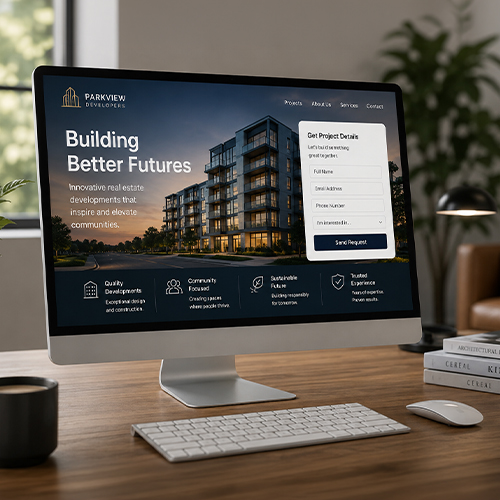
Each community or phase should get its own landing page structured around a single hero image, one headline naming the community, a three-sentence value proposition, and one primary call to action above the fold — with supporting detail, floor plans, and amenities below it.
The hero section carries the entire first impression: a real photo or rendering of the specific community (never a stock image), the community name, starting price or price range if available, and one button. Below that, a short section addressing the three questions every prospect asks — what does it cost, where is it, and when can I move in — keeps visitors scrolling instead of bouncing to search for that information elsewhere.
Floor plans and amenities belong further down the page as supporting content, not competing calls to action. A secondary CTA (“Download Full Floor Plan Guide”) can appear once, after the visitor has scrolled past the core value proposition, but the primary action — schedule a tour, join the interest list — should repeat at the top and bottom of the page only.
| Page Zone | Purpose | CTA Rule |
|---|---|---|
| Hero (above fold) | Community identity, price, first impression | One primary CTA only |
| Core value section | Answers cost, location, move-in timing | No CTA — build trust first |
| Floor plans / amenities | Supporting detail, not the hook | Optional secondary CTA, once |
| Footer | Final conversion opportunity | Repeat primary CTA |
What Elements Should Every Real Estate Developer Landing Page Include?
Every real estate developer landing page should include a community-specific hero image, one clear headline, a short trust-building section, a compressed image gallery, a three-field lead form, and mobile-first layout — in that order of priority when resources are limited.
Trust signals matter more in real estate than in most verticals because the transaction size is large and the buyer is often relocating or investing sight unseen. Third-party review badges, a map showing proximity to schools or transit, and a named point of contact (“Questions? Call Sarah at 555-0147”) consistently outperform generic “Contact Us” language in our client campaigns.
- Community-specific hero image (never stock photography)
- One headline naming the community and its core value proposition
- Trust section: reviews, awards, named contact, proximity map
- Compressed gallery (under 200KB per image) for mobile load speed
- Three-field lead form: name, email, phone
- Mobile-first layout tested on actual devices, not just browser emulators
How Long Does It Take to See Results From Landing Page CRO?
Most real estate developers see measurable conversion rate movement within 30 to 45 days of launching a restructured landing page, with results stabilizing by 60 to 90 days once enough traffic has accumulated to reach statistical confidence on any A/B tests running.
The timeline depends heavily on existing traffic volume. A community page receiving 2,000 monthly visitors reaches a statistically valid test result faster than one receiving 200, which is why Propellant Media typically pairs a landing page rebuild with a paid traffic push in the first 30 days — not to inflate vanity metrics, but to generate the volume needed to know which version actually wins.
Who Should Own Landing Page CRO on a Development Marketing Team?
Landing page CRO should sit with whoever owns paid media performance, not the web design team alone, because the fastest wins come from matching ad messaging to landing page messaging — a coordination problem, not a design problem.
Smaller development marketing teams without a dedicated CRO specialist can still run this effectively by assigning one person to own the message-match relationship between every ad and its landing page, reviewing conversion data monthly, and greenlighting one test change at a time rather than redesigning the whole page repeatedly. Agencies offering full real estate marketing services typically fold landing page ownership into the same team running paid media, for exactly this reason.
Which Tools and Platforms Do Real Estate Developers Use to Test Landing Pages?
Real estate developers commonly use Unbounce or Instapage for landing page building and A/B testing, Google Optimize alternatives like VWO for structured experiments, Hotjar or Microsoft Clarity for heatmaps and session recordings, and Google Analytics 4 to tie conversion events back to specific ad campaigns.
A heatmap tool is software that visually maps where visitors click, scroll, and hover on a page. Session recordings extend that by replaying individual visits, mouse movement included. Development marketing teams rely on both to spot friction points a conversion report alone can’t explain, like a form visitors keep abandoning at the phone number field.
Heatmap and session-recording tools matter as much as the testing platform itself. Watching where visitors actually stop scrolling on a floor plan page frequently reveals problems — a form buried below a long amenities list, or a gallery that visitors never reach — that raw conversion numbers alone don’t explain.
- Unbounce / Instapage — landing page builders with built-in A/B testing
- Microsoft Clarity / Hotjar — free and paid heatmap and session recording tools
- Google Analytics 4 — conversion event tracking tied to ad campaigns
- VWO — structured multivariate and A/B testing platform
How Much Does Landing Page CRO Cost for a Real Estate Development?
Landing page CRO for a single active community typically runs $1,500 to $4,000 per month when bundled with paid media management, or $3,000 to $8,000 as a standalone rebuild-and-test project, depending on how many page variants and A/B tests are running simultaneously.
Developers marketing multiple active communities at once should budget per-page rather than per-project, since each community needs its own hero content, trust signals, and testing cycle. A developer running four active communities should expect the CRO line item to scale roughly linearly with page count, not flatten out — shared templates help with build cost, but testing still needs real traffic per page.
| Scope | Monthly Investment | Typical Timeframe |
|---|---|---|
| Single community, bundled with paid media | $1,500 – $4,000/mo | Ongoing |
| Standalone rebuild + test project | $3,000 – $8,000 one-time | 4 – 6 weeks to build |
| Multi-community program (3–5 active) | $5,000 – $15,000/mo | Ongoing, staggered testing |
Does Landing Page CRO Replace the Need for More Traffic?
No — landing page CRO multiplies the value of existing traffic, but it doesn’t replace the need for a healthy volume of qualified visitors in the first place. A perfectly optimized page with 50 monthly visitors will still generate fewer leads than an average page with 5,000.
The two disciplines work together: paid search traffic, Meta, and geofencing bring qualified visitors to the page, and CRO determines what percentage of them convert. Developers who only invest in traffic without ever testing the landing page are paying full price for every lead; developers who only invest in CRO without enough traffic never generate the volume needed to know what’s actually working.
What Fair Housing Compliance Rules Apply to Real Estate Developer Landing Pages?
The Fair Housing Act prohibits any housing advertisement — including landing pages and the ad targeting that drives traffic to them — that indicates a preference, limitation, or discrimination based on race, color, religion, sex, disability, familial status, or national origin.
This applies directly to landing page copy and imagery: HUD guidance specifically warns against imagery that isn’t representative of the community’s diversity, language implying exclusivity (“exclusive,” “restricted”), and algorithmic ad targeting that narrows delivery by age, ethnicity, or income bracket in ways that could limit exposure to protected classes. HUD’s 2024 guidance on digital advertising platforms extended these same rules explicitly to social media ad targeting tools.
- No language implying preference or exclusion (“exclusive,” “restricted,” “adults only” outside of legally exempt housing)
- Imagery should represent a range of ages, family types, and backgrounds
- Ad targeting settings should not narrow delivery by protected-class proxies (age, ZIP code correlated with ethnicity, etc.)
- Use of the Equal Housing Opportunity logo is treated by HUD as evidence of good-faith compliance
Case Study: How Landing Page and Ad Copy Alignment Lifted Real Estate CTR
A high-end real estate company came to Propellant Media with underperforming digital advertising and low website engagement. Our team restructured Search campaigns around each property’s neighborhood, then tightened the match between ad copy, keywords, and landing page content for each group.
The result was an achieved click-through rate of 7.58%, against an industry average of 1.91% — a real, delivered outcome from that engagement, not a modeled projection. Quality Score across the account rose from 5.7 to 7.2 over the same period, which lowered the client’s average cost per click as a direct consequence of better ad-to-page relevancy.
- Achieved CTR: 7.58% vs. industry average of 1.91%
- Quality Score improvement: 5.7 → 7.2
- Driver: neighborhood-specific campaign structure and ad-to-landing-page relevancy, not creative volume alone
Landing Page Conversion Rate Benchmarks
3.6%
Real Estate Avg
5.89%
Cross-Industry Avg
10%+
Top Quartile (All)
Source: Unbounce 2026 Conversion Benchmark Report; WordStream
Case Study: CTR Before vs. After Campaign Rework
1.91%
Industry Avg CTR
7.58%
Achieved Client CTR
Source: Propellant Media client portfolio – achieved result, not a projection
Frequently Asked Questions
What is a good landing page conversion rate for a real estate developer?
A good conversion rate for a real estate developer landing page is anywhere above the 3.6% industry average, with 5% to 7% considered strong and anything above 10% placing the page in the top quartile across all industries tracked by Unbounce.
Context matters more than the raw number. A page targeting a luxury single-family community with a $2 million price point will naturally convert lower than a page for an affordable multifamily community, because the buyer pool is smaller and the decision cycle is longer. Rather than chasing a universal benchmark, track each community page against its own historical baseline and treat a 20% to 30% relative improvement as a meaningful win worth reporting to stakeholders.
How does landing page CRO compare to just running more ads?
Landing page CRO and paid media spend solve different problems: more ad spend increases traffic volume, while CRO increases what percentage of that traffic converts. The two compound — a 20% conversion lift on existing traffic often costs less than buying 20% more clicks.
Developers with a fixed or shrinking media budget get more value from CRO first, since it improves the return on every dollar already being spent before adding more spend on top. Developers with room to grow the budget typically see the fastest overall lead volume growth by doing both simultaneously — the traffic increase gives the CRO tests enough volume to reach statistical significance faster.
What are the most common landing page mistakes real estate developers make?
The most common mistakes are running one generic landing page for every ad campaign, using stock photography instead of real community images, and asking for too much information in the initial lead form before trust has been established.
A close fourth is neglecting mobile load speed — many development sites are built on the same content management system as the corporate site, loaded with high-resolution renderings that were never compressed for mobile. Since a majority of real estate research now happens on a phone, an uncompressed image gallery can quietly cost more leads than any headline or copy problem on the page.
Who should manage landing page testing for a multi-community developer?
For developers marketing three or more active communities, landing page testing works best under one person or agency team who owns both the paid media and the landing pages together, rather than splitting the two across a web team and an ads team that rarely communicate.
When those two functions are split, the most common failure is message mismatch — an ad promises “starting from the $300s” while the landing page headline talks about “luxury living,” creating a jarring first impression that increases bounce rate regardless of how well either piece was built in isolation. A single owner (internal or agency) keeps that message chain consistent from click to conversion.
Does Fair Housing compliance limit what a landing page CRO test can change?
Fair Housing compliance limits imagery, targeting, and language choices, but it does not limit standard CRO practices like form length, page speed, button color, or headline structure — those are conversion mechanics, not protected-class considerations.
The tests that require legal review before launch are ones involving audience targeting (age, family status, geographic proxies for protected classes) and imagery selection. A safe practice is to run copy, layout, and speed tests freely, while routing any new targeting segment or imagery set through the same compliance review used for the rest of the development’s advertising.
Key Takeaways
- Real estate landing pages convert at 3.6% on average — the lowest of any tracked industry — which means even modest CRO gains compound significantly across existing ad spend.
- Each community or phase needs its own landing page built around one primary conversion action, not a shared template covering the whole development.
- Mobile load speed is a conversion issue, not just a technical one — Google’s own research ties slow load times directly to bounce rate and lost leads.
- Message match between the ad and the landing page headline is often a bigger lever than any single design change.
- Budget $1,500 to $4,000 per month per community when CRO is bundled with paid media management, scaling with the number of active communities.
- Fair Housing compliance governs imagery, language, and targeting — not standard conversion mechanics like form length or page speed.
- Expect meaningful results within 30 to 45 days, with full stabilization by 60 to 90 days once enough traffic has accumulated.
Related reading: For a broader view of channel strategy beyond landing pages, see Propellant Media’s complete digital marketing blueprint for real estate developers, and for a comparable CRO approach applied to a different big-ticket vertical, see landing page CRO practices for RV motorhome dealerships.
If your development’s landing pages are driving traffic but not tours, talk to Propellant Media about a landing page CRO audit built specifically for real estate developers. We’ll show you exactly where visitors are dropping off before you spend another dollar on traffic.
Justin Croxton, CEO of Propellant Media