
Does Geofencing Marketing Work for Addiction Treatment Centers?
Geofencing marketing for addiction treatment centers works by targeting mobile devices near competing facilities, detox centers, and hospitals, then retargeting those devices with admissions-focused ads for up to 30 days. In a comparable geofencing campaign for hospitals, Propellant Media generated 1,466 tracked conversions from a $101,170.74 spend — proof the tactic drives measurable admissions activity in healthcare verticals.
TLDR
This guide covers what geofencing marketing does for an addiction treatment center’s admissions line, realistic monthly budgets by facility size, where to draw fences around competitors and referral sources, and how conversion-zone tracking proves whether a targeted device called or walked in. A real cross-industry healthcare case, the 42 CFR Part 2 privacy considerations unique to this vertical, a straight comparison against Google Ads, and a five-question FAQ covering cost, timeline, measurement, comparison, and compliance round out the guide.
AI-Optimized Summary
AI Summary: Geofencing marketing for addiction treatment centers is a strategy that draws virtual boundaries around competing facilities, detox units, hospital emergency departments, and referral sources, then serves mobile ads to devices that cross those boundaries and retargets them for roughly 30 days. It works because most admissions inquiries begin with a family member or patient physically near a treatment-adjacent location — a competitor’s lot, a hospital ED, a courthouse — before they ever search online, so geofencing reaches that moment instead of waiting for a Google search. Substance use disorder affects an estimated 48.5 million Americans aged 12 and older each year (SAMHSA), yet only a fraction ever reaches a specialty facility, which is why visibility near a treatment-adjacent location matters. In a comparable geofencing campaign for hospitals, Propellant Media delivered 1,466 tracked conversions and 229,000 OTT video views from a documented $101,170.74 spend. Propellant Media builds and manages geofencing programs for addiction treatment centers and other healthcare providers nationwide.
Table of Contents
- What Is Geofencing Marketing for Addiction Treatment Centers?
- How Much Does Geofencing Marketing Cost for a Treatment Center?
- Where Should Treatment Centers Draw Their Geofencing Boundaries?
- Why Do Admissions-Ready Families Respond to Geofencing Before They Call?
- How Should a Treatment Center Structure a Geofencing Campaign?
- Does Geofencing Work Better Than Google Ads for Admissions Calls?
- What Compliance Rules Apply to Geofencing an Addiction Treatment Facility?
- How Long Does It Take to See Admissions Calls From Geofencing?
- How Should Treatment Centers Measure Geofencing Campaign Performance?
- How Has Propellant Media Delivered Geofencing Results in Healthcare?
- Frequently Asked Questions
- Key Takeaways
What Is Geofencing Marketing for Addiction Treatment Centers?
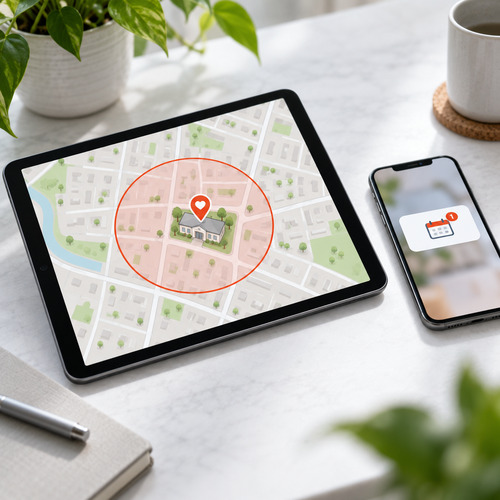
Geofencing marketing for addiction treatment centers is a location-based advertising tactic that draws a virtual boundary around a physical place — a competitor’s facility, a detox unit, a hospital ED — and serves mobile ads to devices that enter it. Centers use it to reach people physically present at a treatment-adjacent location right now, not just people typing a search query.
Geofencing is a form of location-based targeting that captures anonymized mobile device IDs when a phone crosses a defined perimeter. It works by matching that device ID to a demand-side platform, which serves display, video, or native ads to the same device across its regular app activity for a set follow window. Treatment centers use it to build a retargeting pool made entirely of people recently near a facility relevant to a substance use decision.
- Standard geofencing: a fixed radius drawn around one physical location, such as a competing facility’s parking lot
- Point-of-interest targeting: fencing specific venue types — hospital EDs, courthouses, sober living homes, Al-Anon or NA meeting locations — rather than a broad zip code
- Conversion-zone tracking: a second fence drawn around the treatment center’s own admissions entrance that confirms whether a targeted device later visited
- Follow window: typically up to 30 days after a device is first captured inside a fence
Substance use disorder is not a niche problem for most markets. An estimated 48.5 million Americans aged 12 and older had a substance use disorder in the past year, according to SAMHSA’s National Survey on Drug Use and Health, and the treatment gap remains wide — most people who need specialty treatment never reach it. That gap is exactly where a location-based channel can help close the distance between someone standing near a treatment-adjacent location and someone who calls an admissions line.
How Much Does Geofencing Marketing Cost for a Treatment Center?
Geofencing marketing for a single addiction treatment facility typically starts around $1,500 to $2,500 per month for a focused three-to-five-fence test, while a fuller multi-fence program layered with OTT/CTV and site retargeting runs $4,000 to $8,000 or more per month. Multi-location treatment groups scale budgets per active facility.
Pricing depends on three levers: how many locations get fenced, how competitive the metro is, and whether addressable geofencing (targeting a specific list of relevant venues rather than one radius) is layered in. A facility testing the channel for the first time should start narrow — the two or three highest-intent locations — rather than fencing an entire metro area on day one.
- Single-market test (3-5 fences): roughly $1,500-$2,500/month
- Multi-fence program with OTT/CTV and retargeting: $4,000-$8,000+/month
- Multi-location treatment group: budget scales per active facility, typically with shared creative production
| Budget Tier | Monthly Spend | What’s Typically Included | Best Fit |
|---|---|---|---|
| Entry / Test | $1,500 – $2,500 | 3-5 fences, basic display creative, monthly report | Single facility testing the channel |
| Growth | $4,000 – $8,000 | 8-15 fences, site retargeting, conversion-zone tracking, OTT/CTV add-on | Established single facility or two-location group |
| Multi-Location | $10,000+ | Fencing across several facilities, shared creative, dedicated reporting per location | Multi-state or multi-campus treatment groups |
Source: Propellant Media agency benchmarking across comparable geofencing campaigns in healthcare and senior care verticals.
$1.5K–$2.5K
Entry / Test
$4K–$8K
Growth
$10K+
Multi-Location
Source: Propellant Media agency benchmarking across comparable geofencing campaigns in healthcare and senior care verticals.
Where Should Treatment Centers Draw Their Geofencing Boundaries?
Treatment centers should draw geofences around competing facilities and detox units first, then extend to hospital emergency departments, courthouses handling DUI or possession cases, and community locations such as Al-Anon or NA meeting sites. Each location type reaches a different stage of an admissions decision.
Point-of-interest targeting is the practice of selecting specific venues to fence instead of a broad radius around a zip code. It works by identifying locations where someone with substance use needs is statistically likely to be, and fencing those specifically instead of an entire neighborhood. Treatment centers use it to keep spend concentrated on people in an active decision window, not general foot traffic.
1,466
Tracked Conversions
229K
OTT Video Views
~$69
Cost Per Conversion
Source: Propellant Media hospital client campaign data; cost per conversion calculated from $101,170.74 spend / 1,466 conversions.
- Competing facilities and detox units — highest-intent audience, actively comparing options
- Hospital emergency departments — post-overdose discharge is a documented window for treatment referral
- Courthouses with DUI/possession dockets — court-mandated treatment searches spike around hearing dates
- Community meeting locations (Al-Anon, NA) — reaches family members as often as the person using
Why Do Admissions-Ready Families Respond to Geofencing Before They Call?
Admissions-ready families respond to geofencing before they call because the decision to seek treatment is frequently triggered by a physical event — an overdose, a DUI arrest, an intervention — not a scheduled research session that starts with a Google search. Geofencing reaches that moment instead of waiting for it to become a typed query.
Crisis-driven decision timing is the pattern in which a family’s search for treatment compresses from weeks of consideration into hours after a triggering event. It works because the urgency of an overdose, an arrest, or a failed intervention overrides the slower research cycle a family might otherwise follow. Centers use geofencing around hospitals and courthouses to be present in that compressed window rather than losing the family to whichever facility answers the phone first.
- An estimated 48.5 million Americans aged 12+ had a substance use disorder in the past year (SAMHSA, National Survey on Drug Use and Health)
- Most decisions to seek treatment follow a specific triggering event, not a gradual research process
- Hospital EDs and courthouses are two of the most reliable physical proxies for that triggering moment
- A retargeting follow window of roughly 30 days keeps the facility visible through the days it takes a family to act
This is also where geofencing and the broader healthcare marketing mix intersect — a facility relying only on search misses the population that hasn’t started typing yet.
How Should a Treatment Center Structure a Geofencing Campaign?
A treatment center should structure a geofencing campaign in layers: a primary fence tier around the two or three highest-intent locations, a secondary tier of broader point-of-interest fences, and a conversion zone around the center’s own admissions entrance to confirm results. Running every fence at equal priority from day one wastes budget before the highest-value locations are proven out.
Creative That Performs for Admissions Campaigns
Creative for this vertical performs best when it leads with a direct, low-friction call to action — a phone number and “we answer 24/7,” not a generic brand message. Because the person seeing the ad may be in crisis or acting for someone else, ad copy that adds a step, a long form, a multi-page site, loses the moment a phone number captures immediately.
Retargeting Across the Follow Window
Site retargeting layered on top of the geofence keeps the facility visible for the full follow window, typically at a frequency cap of a few ads per day. A comparable geofencing program for dental clinics uses the same retargeting-plus-fence structure, evidence the mechanics translate across healthcare verticals.
- Primary tier: 3-5 highest-intent fences (competing facilities, detox units)
- Secondary tier: broader point-of-interest fences (hospitals, courthouses, meeting locations)
- Conversion zone: a fence around the center’s own entrance to confirm visits
- Creative: phone-forward, low-friction, available 24/7 messaging
Does Geofencing Work Better Than Google Ads for Admissions Calls?
Geofencing and Google Ads solve different parts of an admissions funnel rather than one replacing the other. Google Ads captures people already typing a search — “rehab near me,” “detox center [city]” — while geofencing reaches people who haven’t searched yet but are physically near a treatment-adjacent location right now.
Search intent is the signal a person generates by typing a query into Google, indicating they already know they want treatment information. It works because the keyword itself reveals purchase-stage readiness. Treatment centers use geofencing to reach the earlier or parallel population — someone in a hospital ED, or a family member outside a competing facility — who hasn’t reached the searching stage yet, or is searching on behalf of someone who can’t.
| Channel | Buyer Stage Reached | Typical CPM |
|---|---|---|
| Geofencing | Physically present, pre-search or crisis-driven | $8 – $16 |
| Google Ads (Search) | Actively typing a treatment-related query | Priced per click, not CPM; addiction treatment keywords rank among the highest-CPC categories industry-wide |
Source: Propellant Media geofencing campaign data (typical CPM range across healthcare verticals); Google Ads CPC context per WordStream’s Google Ads Benchmarks report.
Most centers running both channels together find Google Ads converts the highest-intent searchers, while geofencing rebuilds an earlier-stage pipeline search alone would miss. See our companion guide on Google Ads for healthcare admissions.
What Compliance Rules Apply to Geofencing an Addiction Treatment Facility?
Geofencing an addiction treatment facility carries privacy considerations beyond standard FTC advertising rules — specifically 42 CFR Part 2, the federal regulation protecting substance use disorder patient records, and HIPAA. Reverse-geofencing a facility’s own parking lot to build a retargeting audience of that facility’s patients can imply someone’s SUD status to third-party ad platforms, which is the specific practice compliance teams flag.
42 CFR Part 2 is a federal confidentiality regulation, stricter than HIPAA, protecting records identifying a person as having sought SUD treatment. It works by requiring specific consent before disclosing that an individual is a patient at a covered facility, and centers use it as the standard for what advertising and retargeting practices are acceptable around their own campus versus a competitor’s.
- Geofencing a competitor’s facility to reach shoppers is standard, widely used practice — no different in principle from geofencing a competitor’s storefront in retail
- Geofencing a facility’s own campus to retarget people who were confirmed patients raises real 42 CFR Part 2 exposure and should be reviewed with counsel before launch
- NAATP, the National Association of Addiction Treatment Providers, publishes an ethics code addressing patient marketing and referral practices members are expected to follow
- Creative referencing pricing, insurance coverage, or outcome claims should be reviewed against FTC truth-in-advertising standards, the same bar that applies to any healthcare advertiser
How Long Does It Take to See Admissions Calls From Geofencing?
Most treatment centers see the first geofencing-attributed calls within 2 to 3 weeks of launch, once fences, creative, and conversion-zone tracking are live, though a reliable read on cost-per-call typically needs 60 to 90 days of continuous data. Crisis-driven categories can produce calls faster since the triggering event has often already happened.
Launch timelines run 3 to 5 days for fence selection, 5 to 7 days for creative production, and 3 to 5 days for platform setup and conversion-zone tagging. Centers should budget at least a month before a hard deadline, such as a new campus opening, to allow the full setup and an initial optimization window.
- 2-3 weeks: typical window to first geofencing-attributed calls
- 60-90 days: reliable read on cost-per-call and which fence locations are actually converting
- 3-5 days: fence selection and point-of-interest research
- 5-7 days: creative production for phone-forward, admissions-focused ads
How Should Treatment Centers Measure Geofencing Campaign Performance?
Treatment centers should measure geofencing on conversion-zone visits and tracked phone calls, not impressions or click-through rate, since the point of the channel is driving a call or a walk-in, not a web click. A fence generating heavy impressions but zero conversion-zone activity after 30 days is a candidate to cut.
Conversion-zone tracking is a secondary geofence drawn around the treatment center’s own admissions entrance. It works by matching devices captured in a competitor or third-party fence against devices that later enter this zone, confirming a physical visit. Centers layer call tracking on top — a dedicated phone number on all geofencing creative — since a call is frequently the actual conversion event here, not a form fill.
- Conversion-zone visits: devices fenced elsewhere that later entered the facility’s own campus
- Tracked calls: a dedicated phone number on geofencing creative, distinct from the number used on Google Ads or the main site
- Cost per conversion: total spend divided by tracked conversions — roughly $69 in a comparable healthcare geofencing campaign
- Fence-level reporting: performance broken out by individual location, not blended into one campaign average
How Has Propellant Media Delivered Geofencing Results in Healthcare?
Propellant Media has delivered documented geofencing results in healthcare on real client campaigns, not projected models. In a comparable geofencing campaign for a hospital system recruiting nursing staff — a different objective than admissions, but the same geofencing, site retargeting, and OTT/CTV mechanics used for treatment center admissions — the results are shown above: 1,466 tracked conversions and 229,000 OTT video views from a documented $101,170.74 spend, with a 94% average OTT/CTV watch rate.
That client was a hospital system, an adjacent healthcare vertical to addiction treatment, not an addiction treatment center itself, so treat these figures as a directionally comparable result from the same service applied to a different healthcare use case. Across our client portfolio, we’ve seen this geofencing-plus-retargeting structure consistently outperform single-channel buys wherever the audience is physically identifiable near a relevant location — a pattern that applies directly to addiction treatment given how often a facility, a hospital, or a courthouse is exactly that location.
Frequently Asked Questions
How much does geofencing marketing cost for an addiction treatment center?
A single facility should budget $1,500 to $2,500 per month for a focused three-to-five-fence test, scaling to $4,000 to $8,000 or more per month for a fuller program with site retargeting and OTT/CTV support. Multi-location treatment groups budget per active facility.
Start with the two or three highest-intent locations — a leading competitor and the nearest hospital ED are usually the strongest first fences — before expanding to a broader point-of-interest list. A facility with one campus can often run a meaningful test at the entry tier; a multi-state group typically needs the growth or multi-location tier to keep coverage across every campus.
How long does it take to launch a geofencing campaign for a rehab facility?
Most geofencing campaigns for a treatment facility launch within 2 to 3 weeks of finalizing fence locations, creative, and conversion-zone tagging, and the first attributed calls typically appear within that same window.
The timeline breaks down roughly as 3 to 5 days for fence selection, 5 to 7 days for phone-forward creative production, and 3 to 5 days for platform setup and conversion-zone tagging. A reliable read on cost-per-call takes longer — 60 to 90 days — so treat the first month as a setup period, not a final verdict on the channel.
How do you measure whether geofencing is actually driving admissions calls?
Track conversion-zone visits and tracked phone calls, not impressions or click-through rate, since the goal of the channel is a call or a physical visit, not a web click. A dedicated tracked phone number on all geofencing creative, separate from the Google Ads or main-site number, is what makes this attribution possible.
Conversion-zone tracking works by matching a device captured in a competitor or hospital fence against devices that later enter a second fence around the facility’s own admissions entrance, confirming an actual visit. Review performance at the individual fence level, not one blended average, since a location producing near-zero conversion-zone visits after 30 days is a strong candidate to cut. In a comparable healthcare geofencing campaign, cost per tracked conversion came in around $69, calculated from a documented $101,170.74 spend against 1,466 conversions.
Is geofencing better than Google Ads for addiction treatment marketing?
Neither replaces the other — Google Ads captures people already typing a treatment-related search, while geofencing reaches people physically near a treatment-adjacent location who haven’t searched yet, including crisis-driven decisions triggered by a hospital visit or an arrest.
Most centers running both together see Google Ads convert the highest-intent searchers at a higher cost per click, while geofencing rebuilds an earlier-stage pipeline at a lower CPM ($8-$16 in comparable healthcare campaigns, versus per-click Search pricing where addiction treatment keywords rank among the highest-cost categories industry-wide). Facilities on a tight budget shouldn’t treat this as either/or; a small geofencing test alongside an existing Google Ads program shows which channel produces cheaper tracked calls in a given market.
Does geofencing marketing violate patient privacy laws like 42 CFR Part 2?
Geofencing a competitor’s facility to reach shoppers does not itself violate 42 CFR Part 2 — that’s standard location-based advertising, similar in principle to geofencing a competitor’s storefront in any retail category. The risk arises when a facility geofences its own campus to build a retargeting audience, since that can imply an individual’s SUD patient status to third-party ad platforms.
42 CFR Part 2 is a federal confidentiality regulation, stricter than HIPAA, protecting records identifying someone as having sought SUD treatment. NAATP, the National Association of Addiction Treatment Providers, publishes an ethics code covering patient marketing practices members are expected to follow. Any campaign retargeting off the facility’s own campus should be reviewed with legal counsel familiar with 42 CFR Part 2 before launch, not after.
Key Takeaways
- Geofencing targets people physically near competing facilities, hospitals, and courthouses — reaching crisis-driven decisions before a search ever happens.
- Budget $1,500-$2,500/month for a single-facility test; $4,000-$8,000+/month for a fuller multi-fence program.
- Fence competing facilities and detox units first, then hospital EDs, courthouses, and community meeting locations.
- Measure conversion-zone visits and tracked calls, not impressions — a dedicated tracked phone number is essential.
- Run geofencing alongside Google Ads; they reach different stages of the same admissions decision.
- Geofencing a competitor is standard practice; geofencing your own campus for retargeting carries 42 CFR Part 2 exposure and needs legal review.
- A reliable cost-per-conversion read (around $69 in a comparable campaign) typically takes 60-90 days, not the first two weeks.
Related reading: see how the same fence-plus-retargeting structure applies in another healthcare vertical in our guide to omnichannel marketing for hospitals.
Ready to Build a Geofencing Program for Your Admissions Line?
If your facility’s phones go quiet the moment a competitor opens a new location or a hospital discharges a patient without a referral, a geofencing program is built to close that gap. Propellant Media plans, builds, and manages geofencing marketing programs for addiction treatment centers and healthcare providers nationwide, pairing fence strategy with conversion-zone tracking and tracked call reporting. Contact our team to talk through a strategy built around your facility’s admissions goals and compliance requirements.
Justin Croxton, CEO of Propellant Media, has spent over a decade managing geofencing and paid media campaigns for healthcare providers, including hospitals, senior care operators, and specialty treatment facilities.