
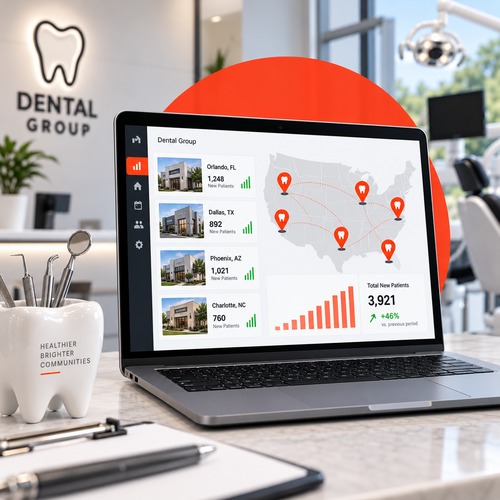
How Do Dental DSOs Build a Multi-Location Marketing Strategy?
Multi location marketing for Dental DSOs centralizes brand, budget, and measurement while letting each practice run location-specific geofencing, local SEO, and paid social. LEK Consulting projects 39% of U.S. dental offices will be DSO-affiliated by 2026, up from 23% in 2024, which means every location competes in a more crowded local market than it did two years ago.
TLDR: Dental DSOs that market well don’t run one campaign per office and hope for consistency, and they don’t run one national campaign and ignore local intent either. The DSOs pulling ahead build a hub-and-spoke model: a centralized team owns brand, creative, and measurement, while each practice gets its own geofencing radius, Google Business Profile, and local ad budget tied to its own patient volume goals. This post covers how to structure that model, what it costs, how centralized and location-level budgets should split, the mistakes that sink DSO marketing programs, and how to measure results location by location instead of guessing from a blended average.
In short, multi-location marketing strategy works for Dental DSOs by pairing one centralized brand and data layer with location-specific targeting and budget, so a 40-office DSO gets both economies of scale and local relevance instead of picking one at the expense of the other. It matters for group practice owners, DSO marketing directors, and private equity-backed platforms scaling through acquisition, because DSO affiliation is projected to reach 39% of U.S. dental offices by 2026 per LEK Consulting, up from 23% in 2024 — meaning patient acquisition costs climb every time a market gets more DSO-saturated. Propellant Media builds and manages multi-location paid media and local SEO programs for healthcare groups scaling across markets.
Table of Contents
- What Is a Multi-Location Marketing Strategy for a Dental DSO?
- How Crowded Has the DSO Market Gotten by 2026?
- Why Do Single-Practice Marketing Tactics Break Down Across Multiple Locations?
- How Should a DSO Structure Its Marketing Organization Across Locations?
- What Does a Multi-Location Media Plan Actually Include?
- How Much Does Multi-Location Marketing Cost a Growing DSO?
- Does Centralized or Location-Level Budget Allocation Work Better?
- What Mistakes Sink Multi-Location Dental Marketing Programs?
- How Should a DSO Measure Performance Across Locations?
- What Should a DSO Marketing Director Do Monday Morning?
- Frequently Asked Questions
- Key Takeaways
What Is a Multi-Location Marketing Strategy for a Dental DSO?
A multi-location marketing strategy for a Dental DSO is a coordinated system that gives every practice its own local targeting and budget while a central team owns brand consistency, creative, and cross-location reporting. It works by separating what should be centralized — brand voice, creative production, analytics, vendor management — from what must be local: geofencing radius, Google Business Profile, review generation, and location-specific ad spend.
DSOs use this structure to grow new-patient volume at every office without rebuilding a marketing function from scratch each time they acquire a practice.
Multi-location marketing is the discipline of running one brand across many physical locations without collapsing each location’s performance into a single blended number. It works by giving each office its own campaign structure, its own Google Business Profile, and its own conversion tracking, connected back to shared reporting. DSOs use it to see which of their 15, 40, or 100 locations are actually converting new patients, instead of managing to a company-wide average that hides underperforming offices.
- Centralized: brand guidelines, ad creative templates, analytics dashboard, vendor/agency relationship
- Local: geofencing polygons, Google Business Profile, review responses, location-specific promotions
- Shared: CRM/practice management system data feeding both layers
How Crowded Has the DSO Market Gotten by 2026?
The DSO market has gotten significantly more crowded by 2026, which is exactly why a coordinated multi-location strategy now outperforms office-by-office marketing. LEK Consulting projects 39% of U.S. dental offices will be DSO-affiliated in 2026, up from 23% in 2024 — a jump that concentrates competition in the same metro areas DSOs already target.
23%
2024
39%
2026 (projected)
Source: LEK Consulting DSO affiliation projections, 2026
- 39% of U.S. dental offices projected DSO-affiliated by 2026, up from 23% in 2024 (LEK Consulting, via Clerri DSO Growth Trends)
- Over 11,500 dental practices under DSO management by 2024, a 12% increase from 2023 (Clerri DSO Industry Statistics)
- U.S. DSO market valued at $37.9 billion in 2024, growing at a 17.9% CAGR through 2034 (Towards Healthcare)
- 300+ DSOs currently operating nationwide, with roughly 200 DSO transactions completed in 2024
Why Do Single-Practice Marketing Tactics Break Down Across Multiple Locations?
Single-practice marketing tactics break down across multiple locations because they were built to optimize one Google Business Profile, one ad account, and one budget — not fifteen of each competing with each other for the same corporate card and the same creative team’s attention. In our experience managing paid media for multi-location healthcare groups, the failure point is almost always structural, not creative.
A single-location dental practice can run one geofencing radius, one set of Google Ads campaigns, and one review-response workflow, and a solo office manager can stay on top of it. A DSO with 25 practices multiplies every one of those tasks by 25.
Without a shared system, each location’s marketing quality depends entirely on which practice manager happens to be paying attention that week. That inconsistency is what shows up as flat regional growth even when overall DSO revenue is climbing from new acquisitions.
How Should a DSO Structure Its Marketing Organization Across Locations?
A DSO should structure its marketing organization with a hub-and-spoke model: a central team or agency owns brand strategy, paid media buying, and cross-location analytics, while each practice contributes local inputs like reviews, local promotions, and community events. This mirrors how national franchise brands like multi-location retail and restaurant groups structure marketing, and it’s the model Propellant Media’s healthcare marketing team builds for groups scaling past a handful of locations.
- Hub: media buying, creative production, SEO/technical, reporting dashboard
- Spoke: local promotions, review generation, community partnerships, front-desk lead follow-up
- Handoff point: each new acquisition gets a 30-day onboarding checklist covering GBP claim, geofencing setup, and tracking pixel install
What Does a Multi-Location Media Plan Actually Include?
A multi-location media plan for a Dental DSO includes geofencing around each practice’s trade area and nearby competitors, per-location Google Business Profile optimization, centralized Google and Meta ad accounts split into location-level campaigns, and a shared retargeting pool that recaptures visitors from every location’s site traffic.
| Channel | Role in the Plan | Owned By |
|---|---|---|
| Geofencing | Prospecting near each office and competitor locations | Central team, per-location polygons |
| Local SEO / Google Business Profile | “Near me” and map pack visibility per office | Central team + local review input |
| Google Ads (Local Service Ads + Search) | High-intent “dentist near me” and procedure searches | Central team, per-location budgets |
| Meta (Facebook/Instagram) Ads | Awareness and offer promotion by ZIP radius | Central team |
| Site retargeting | Return layer that converts prospecting traffic | Central team, shared pool |
In a comparable multi-location paid media engagement for a home decor retailer, Propellant Media’s dental and healthcare marketing division structured six store locations as 36 individual campaign line items rather than one regional buy. That structure produced 31 tracked design-center appointment requests from 562,598 impressions in the first three weeks.
Site retargeting carried only 6.5% of total impressions but generated 61% of all conversions. The same return-layer principle applies directly to a DSO running geofencing across multiple practices: prospecting alone rarely converts without a retargeting layer to close the loop.
How Much Does Multi-Location Marketing Cost a Growing DSO?
Multi-location marketing for a growing DSO typically costs $2,000 to $6,000 per month per practice for paid media, on top of a smaller shared central budget for creative, SEO, and reporting tools. Dental Google Ads carry a median cost per lead of $88 across 101 U.S. cities tracked in 2026, so a 15-office DSO budgeting for 30 leads per office monthly should expect a meaningfully different number in a DSO-saturated metro than in a smaller market.
- Median dental Google Ads cost-per-lead: $88 (mean $91.06 across 101 tracked U.S. cities, 2026)
- Meta/Facebook Ads cost-per-lead for dental: averages $80.55, 1.8% conversion rate
- Google Local Service Ads: $15–$45 per lead, the lowest-cost channel available
- Blended cost to acquire a new patient: $150–$400 depending on market and channel mix
$88
Google Ads
$80.55
Meta Ads
$15-$45
Google LSA
Source: Dental PPC industry benchmarks, 101 U.S. cities, 2026
Does Centralized or Location-Level Budget Allocation Work Better?
Neither pure centralized nor pure location-level budget allocation works as well as a hybrid: centralize the media buying account and creative budget, but allocate spend to each location based on that location’s own lead volume, chair capacity, and cost-per-patient — not an even split across every office.
| Model | Strength | Weakness |
|---|---|---|
| Fully centralized, even split | Simple to administer | Wastes spend on chair-capacity-limited offices |
| Fully location-level | Reflects local demand accurately | Loses brand consistency and buying power |
| Hybrid (recommended) | Central buying power, location-level allocation logic | Requires shared reporting infrastructure to run |
What Mistakes Sink Multi-Location Dental Marketing Programs?
The most common mistake that sinks multi-location dental marketing programs is treating every acquired practice’s Google Business Profile and ad account the same way on day one, without auditing what the previous owner already built or broke.
- Duplicate or unclaimed Google Business Profiles left over from a prior owner, splitting local ranking signal
- Running geofencing without a retargeting layer, so prospecting traffic has nowhere to convert
- Blending all-location performance into one dashboard number, hiding which specific offices are underperforming
- No standardized 30-day onboarding checklist for newly acquired practices
How Should a DSO Measure Performance Across Locations?
A DSO should measure performance location by location using a shared dashboard that tracks cost-per-lead, cost-per-booked-appointment, and show rate for every office, not a single blended company-wide average. HubSpot and comparable CRM platforms, paired with call-tracking numbers per location, let a central marketing team see which practices convert leads into booked chairs and which ones are generating calls nobody answers.
Attribution and analytics for multi-location groups is the practice of tying every lead back to the specific practice, channel, and campaign that generated it. It works by assigning unique tracking numbers, UTM parameters, and conversion pixels to each location’s campaigns. DSOs use it to reallocate budget away from underperforming offices and toward locations with open chair capacity and strong conversion rates.
What Should a DSO Marketing Director Do Monday Morning?
A DSO marketing director should start Monday morning by pulling a location-level report of cost-per-lead and show rate for every practice from the last 30 days, flagging the three worst performers for a Google Business Profile and tracking audit before touching ad spend anywhere else.
- Pull last 30 days of leads and cost-per-lead, broken out by individual location
- Confirm every practice has a claimed, deduplicated Google Business Profile
- Check that each location’s site traffic feeds a shared retargeting pool
- Flag any newly acquired practice still missing a tracking pixel or call-tracking number
Frequently Asked Questions
How much should a Dental DSO budget for multi-location marketing?
Most DSOs should budget $2,000 to $6,000 per month per practice for paid media, plus a shared central budget of roughly 10-15% of total spend for creative, SEO, and reporting infrastructure.
That per-practice range covers Google Ads, Meta Ads, and a baseline geofencing radius, but it flexes with local competition; a DSO-saturated metro will run toward the top of that range, while a smaller market can start lower. Dental Google Ads carry a median cost-per-lead of $88 across 101 tracked U.S. cities, and Local Service Ads run as low as $15-$45 per lead.
Channel mix matters as much as the total budget number. Most DSOs see stabilized cost-per-lead within 60-90 days per location once tracking is fully in place.
What tools and platforms power a multi-location DSO marketing program?
A multi-location DSO marketing program typically runs on Google Ads and Google Business Profile Manager, Meta Ads Manager, a geofencing DSP such as StackAdapt or The Trade Desk, and a CRM like HubSpot or a dental-specific practice management system for lead tracking.
Google Business Profile Manager’s bulk location tool lets one team manage GBP listings for dozens of practices from a single login instead of logging into each one separately. A geofencing DSP handles the location-based prospecting layer, while a shared retargeting pixel across every practice site feeds one return-layer campaign instead of dozens of disconnected small ones.
Call tracking platforms assign a unique number per location so the central team can see which office’s calls convert into booked appointments versus which ones go unanswered.
Should a DSO hire an in-house marketing team or use an agency for multi-location management?
Most DSOs under 40 locations get more value from an agency partner than a full in-house team, because the media-buying volume needed to justify dedicated in-house specialists in geofencing, paid search, and local SEO usually doesn’t exist below that scale.
An in-house team makes sense once a DSO has a dedicated marketing director overseeing at least one specialist per major channel, which typically doesn’t pencil out financially below roughly 40-50 locations. Below that threshold, an agency partner that already runs multi-location healthcare accounts brings platform access, benchmark data, and buying efficiency a lean in-house team can’t match.
The hybrid that works best in practice is one in-house marketing director who owns strategy and vendor management, paired with an agency executing the channels.
How does multi-location marketing for a DSO compare to marketing a single dental practice?
Multi-location marketing for a DSO differs from single-practice marketing mainly in measurement complexity and budget allocation logic — a single practice optimizes one campaign to one goal, while a DSO must allocate shared budget across dozens of practices with different chair capacity, competition levels, and starting brand equity.
A single-location practice can succeed with a generalist doing Google Ads, a Facebook page, and manual review requests. A DSO running the same tactics across 20 offices needs standardized onboarding, per-location tracking, and a budget allocation model that shifts spend toward locations with open capacity.
Otherwise, spend gets wasted on offices that are already booked out while under-capacity offices go unmarketed. The core tactics — geofencing, Google Ads, local SEO — are the same; the operating system around them is what changes.
What are the most common mistakes DSOs make when marketing across multiple locations?
The most common mistakes are leaving duplicate Google Business Profiles unclaimed after an acquisition, running geofencing without a retargeting layer beneath it, and reporting one blended performance number instead of location-level data that reveals which offices actually need attention.
A newly acquired practice frequently comes with an outdated or duplicate GBP listing from the previous owner, which splits local search signal between two profiles and quietly caps how well that office ranks for “near me” searches. Geofencing without retargeting is the second most common gap: it builds an audience of nearby prospects but gives that audience nowhere to land, which is why a comparable multi-location paid media campaign for a home decor retailer saw 61% of all conversions come from the retargeting layer despite it carrying just 6.5% of total impressions. The third mistake — blended reporting — hides underperforming offices inside a healthy company average until the pattern has cost months of missed patient volume.
Key Takeaways
- Structure marketing as hub-and-spoke: centralize brand, buying, and analytics; keep geofencing, GBP, and reviews local to each practice.
- Budget $2,000-$6,000 per month per practice for paid media, plus a shared 10-15% central budget for creative and reporting.
- Never run geofencing without a retargeting layer — prospecting traffic needs somewhere to convert.
- Track cost-per-lead and show rate location by location; a blended average hides which offices actually need help.
- Audit every newly acquired practice’s Google Business Profile for duplicates within the first 30 days.
- DSO affiliation is projected to hit 39% of U.S. dental offices by 2026, so expect cost-per-lead to keep climbing in saturated metros.
- Use Local Service Ads ($15-$45 per lead) to balance out higher-cost Google and Meta search campaigns.
Ready to build a multi-location marketing system that scales with every new practice acquisition? Talk to Propellant Media about a location-level media plan for your DSO.
Author: Justin Croxton, CEO of Propellant Media
Related reading: See how these tactics apply to a single dental practice in our local SEO strategies for dental clinics guide, or explore geofencing marketing for dental patient volume. For coordinated cross-channel programs beyond dental, see how we approach omnichannel marketing for multi-department hospital systems.