
West Coast University Leverages Geofencing & Meta To Drive Healthcare Student Leads

Southern California University of Health Sciences (SCUHS) is a private, nonprofit institution located in Whittier, California. With a long-standing reputation in integrative health, chiropractic, acupuncture, and now nursing, SCU is committed to educating the next generation of health professionals grounded in science, compassion, and whole-body wellness. As the university expanded its Bachelor of Science in Nursing (BSN) program, they needed a highly targeted digital campaign to identify and convert lifestyle-aligned prospects in a competitive Southern California market.

The Challenge

SCU’s BSN program offers a unique educational experience that blends clinical rigor with a holistic health foundation. Their challenge: reach and convert prospective students whose lifestyle, values, and academic interests aligned with this distinctive approach. Rather than broad outreach, the university needed a precision-focused campaign that would deliver quality over quantity—reaching future nurses who valued wellness, movement, balance, and purpose-driven careers.

The Strategy

Propellant Media developed a multi-channel, full-funnel campaign centered around geofencing, Meta (Facebook/Instagram) ads, and site retargeting. This approach was designed to create a 360-degree engagement loop—from physical location behavior to digital re-engagement—optimized specifically for SCU’s prospective nursing students.

Key Tactics We Executed

Geofencing Over 20 Yoga & Wellness Studios

We geofenced 20+ yoga studios and holistic wellness centers across Southern California. These locations were selected based on their relevance to SCU’s ideal student persona—individuals engaged in self-care, health, and holistic lifestyles. Mobile device data from these physical visits was used to serve follow-up digital ads, creating a localized and highly intentional awareness strategy.

Third-Party Behavioral Targeting

To complement location data, we leveraged third-party audience segments including:

  • Yoga & holistic health enthusiasts
  • Individuals exploring nursing degrees or health sciences
  • Users researching wellness careers or holistic living
  • Women aged 22–38 with patterns matching allied health program seekers

Meta (Facebook & Instagram) Geofencing + Retargeting

We ran a parallel Meta campaign targeting users who had been to geofenced locations. In addition, we launched a Meta site retargeting strategy, serving remarketing ads to users who visited SCU’s nursing program landing page but didn’t yet convert. These users saw program-specific creative, testimonials, and calls to action related to enrollment deadlines and info sessions.

Site Retargeting (Programmatic Display)

All traffic to the nursing program’s landing pages was captured and re-engaged using animated and static display ads, reminding prospective students to revisit, download brochures, or schedule a virtual consultation.

Ad Messaging Examples 

  • “Your Path to a Holistic Nursing Career Starts Here”
  • “Train to Heal, Lead, and Grow—The SCU BSN Program Is Accepting Applications”
  • “Nursing Meets Wellness—See How SCU Is Changing the Future of Care”

Results
The results of the 8-week campaign showed strong top- and bottom-funnel performance across channels:

Channel Tactic Results
Programmatic Display Geofencing + Behavioral 494,118 impressions, 409 clicks, strong on-site engagement
Meta (Facebook/Instagram) Geofencing + Site Retargeting 30+ qualified leads generated for the BSN program
Cross-Platform Retargeting Site Visitors Increased time on page, return visits, and application start behavior noted by SCU team


Through a smart blend of geofencing, behavioral targeting, and retargeting across both programmatic and Meta platforms, Propellant Media helped SCU connect with high-fit nursing prospects in a deeply relevant and cost-effective way. The combination of physical location data and digital behavior created a full-funnel campaign that didn’t just drive leads—it attracted students who were culturally and academically aligned with SCU’s mission. This campaign now serves as a model for future holistic health program promotions across the university’s portfolio.
How A New Jersey University Used Google Ads & Paid Media To Increase Student Housing Leads

Stevens Institute of Technology did most of their marketing in-house for many years. Similar to Kennesaw State University, in 2020 Stevens came to us to give them access and expertise on geofencing marketing and programmatic display advertising. It’s now grown to manage digital campaigns across all channels, including programmatic, geofencing, Google Ads, YouTube, Meta, and LinkedIn for multiple graduate programs and brand awareness.

Propellant Media is now engrained with their entire marketing and admissions team executing lead generation and brand awareness campaigns.  

Instead of producing specific metrics for any respective campaign program, we wanted to speak to the campaign strategy we developed for a unique segment of their marketing team that needed our assistance in reaching in-market students for summer housing in New York.

Overview & Objective

Stevens, despite being located in Hoboken, their objective was to reach students looking at summer internship housing options in New York and direct them to Stevens’ housing options. Our team was already used to the brand awareness and lead generation campaign we were running, but this was a one-off request that they needed assistance with.

They were wanting to market their properties for housing to students both in New York and around the country.  Despite this being a one-off request, we implemented a strategy that incorporated mostly Google Ads.

The Strategy For Stevens Institute Of Technology

Our team is very methodical in how we consider ad campaigns for higher education brands.  And knowing we had a limited budget to work with, we came up with the following strategy on Google Ads.  Use in-market “summer housing” terms, but split out the campaigns as geo-specific campaigns with a high intention of specific terms in each of them.  

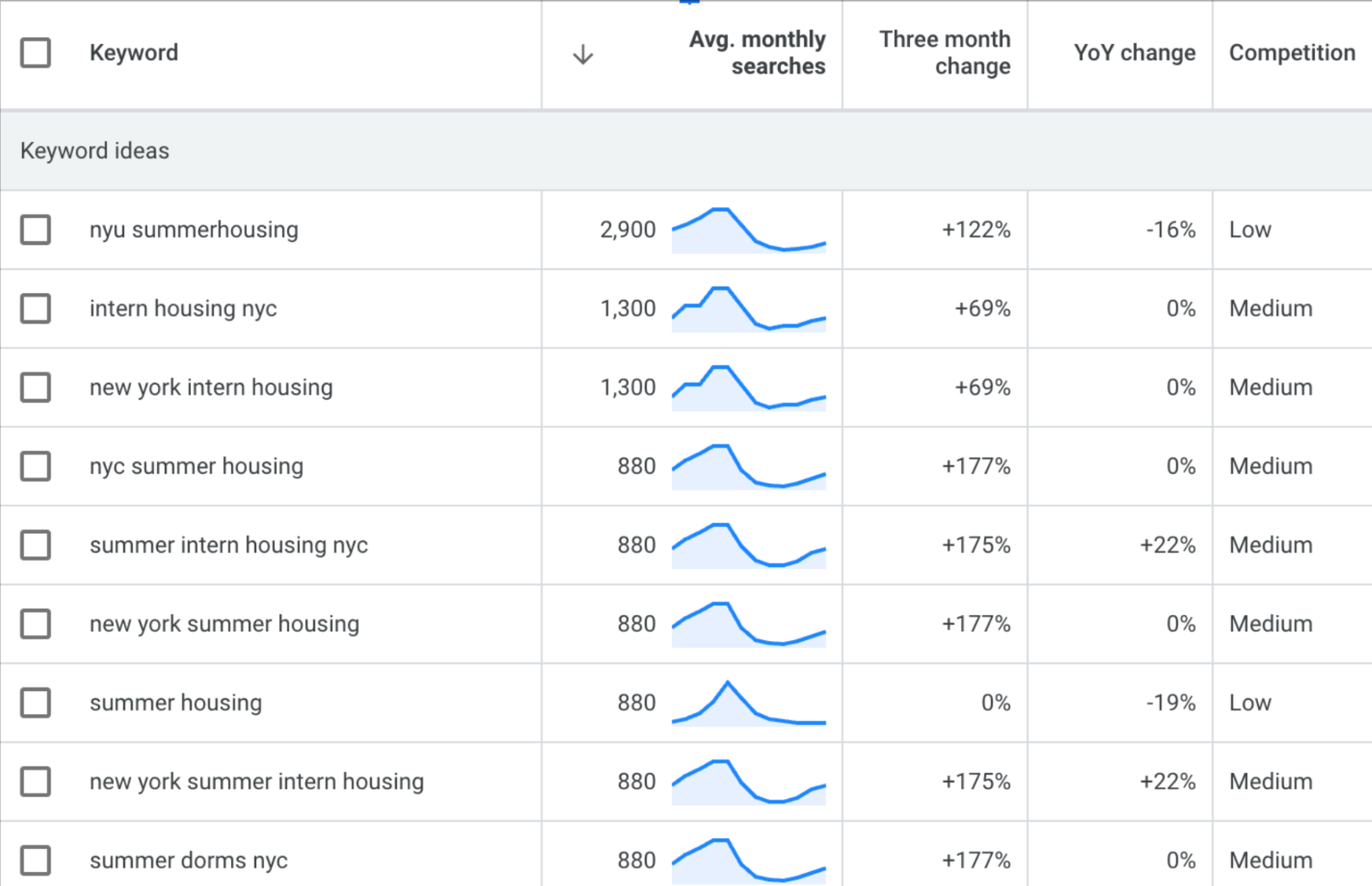
For example, if we targeted students in New York City, we wanted to leverage similar terms below that we pulled from Google Keyword Planner that had respectable demand.

But for geospecific regions outside of New York and students looking at New York City for summer housing, we built a campaign for just that region alone.  The campaign was called Summer Housing (Outside Of New York).  We leverage geospecific terms for that campaign including:

  • New York intern summer housing
  • New York city summer housing
  • Manhattan summer housing

This approach allowed us to segment campaigns accordingly by keywords and geography, limit waste of students who are solely looking for summer housing options in New York, and compare campaign performance of the two campaigns (Outside New York vs Inside New York).

Results Of The Campaign

Despite the budget being limited, we constantly received feedback that the summer housing rooms were being booked and the general interest team for summer housing was receiving an uptick in requests compared to prior years.

Government Entity California Strawberry Commission Uses Geofencing Marketing To Increase Visibility

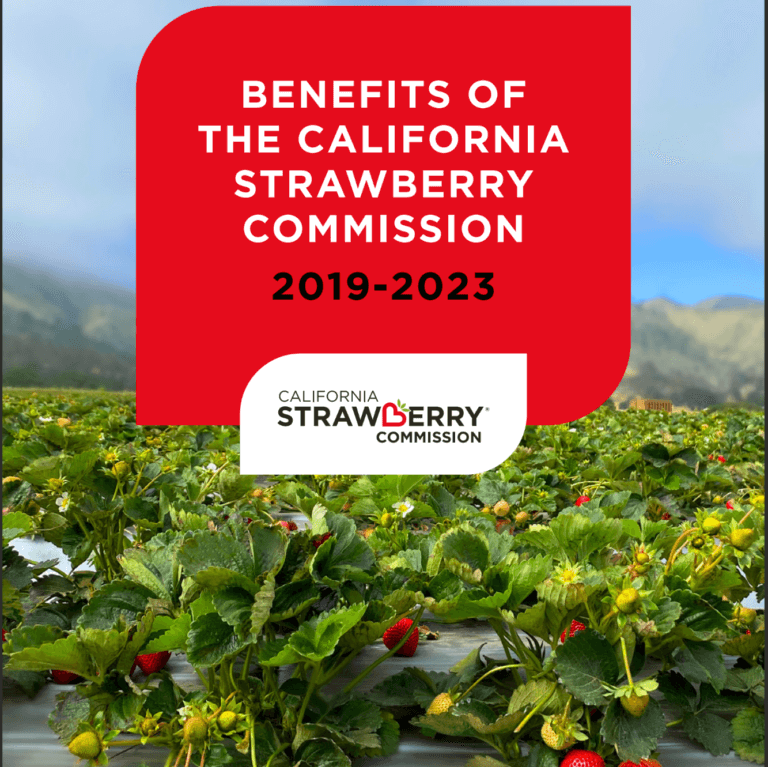
WLP, a political consultancy with deep ties to California’s sustainability sector, partnered with Propellant Media to deliver a highly targeted, time-sensitive digital campaign focused on legislative influence. The objective: raise visibility around key agricultural issues and test which political and regulatory audiences were most receptive to specific advocacy narratives.

The client provided a complex set of resources—over 10 tabs of spreadsheet-based contact data, policy targets, and a general campaign outline—only days before the scheduled campaign launch. These included email records, building addresses, and segmented audience categories such as legislators, boards, supervisors, regulators, and local policy groups.

Strategic Challenge

This campaign required advanced segmentation, data activation, and tactical deployment under tight deadlines. Key challenges included:

  • Limited data quality: Government emails often have low match rates for digital platforms due to privacy restrictions
  • Granular audience needs: The client required performance metrics per audience, meaning each had to be isolated as its own campaign
  • Compressed prep window: Strategy and assets were provided days before the campaign needed to be live
  • Creative testing: Four unique videos had to be mapped across audiences for engagement testing (watch rate)

Our Strategy Developed For California Strawberry Commission

Propellant Media quickly translated WLP’s raw data and campaign framework into a multi-layered digital engagement strategy built entirely within programmatic and video ad platforms. Using combinations of CRM retargeting, addressable geofencing, curated demographic audiences, and manually drawn custom fences, we executed six simultaneous campaigns—each with its own creative strategy and KPI tracking.

Audience Activation Strategy

  • CRM Email Retargeting: Uploaded 1,000+ government-affiliated contacts across all tabs to match as many email-based users as possible. (~500–650 matched)
  • Addressable Geofencing (AGF): Used parcel-level data to match buildings (e.g., Board of Supervisors offices), delivering to ~20K+ users inside known government buildings
  • Custom Geofencing (GF): Mapped legislative buildings and regulators’ offices (e.g., CalEPA, Newsom’s Office, Senate/Assembly buildings) where unique address data was insufficient
  • Audience Curation by ZIP Code: Built a Growers audience from ZIPs + demographic overlays to reach households fitting agricultural profiles

Each tactic was tagged and tracked separately, enabling full performance comparison across all campaigns and audience types.

Creative Strategy We Leveraged

  • Four distinct video ads were deployed across all campaigns
  • Videos varied in tone: emotional storytelling, personal narrative, informational, and policy-focused
  • Main KPI: Video engagement (watch rate), used as a proxy for message resonance and audience interest
  • Creative matched campaign intent (e.g., “It’s Personal 3D” for emotionally driven messaging; “100% Recyclable” for policy angles)

Key Outcomes

  • 100% of budget deployed within 30 days, with full optimization against top-performing audiences
  • 20,000 impressions delivered to government buildings, supervisors’ offices, and legislative complexes
  • Identified strongest video-audience pairings by comparing watch rates across campaign segments
  • Delivered weekly engagement reports with heatmaps and audience engagement breakdowns
  • Helped client refine long-term audience targeting strategy for future policy initiatives
  • We continue to work with this client and have been for over 8 months

Why This Campaign Worked

  • Granular Strategy, Executed at Speed: Built six campaigns from scratch in under 72 hours from raw spreadsheets and creative notes
  • Audience Intelligence Built In: Gave WLP the insights they needed—which messages resonated with which policymakers—via performance data
  • Trusted Political Partner: WLP awarded Propellant Media their entire paid media portfolio following this campaign, based on 3+ years of consistent delivery, speed, and strategic value

Higher Education Nursing Program Leverages Meta Advertising To Produce $10 Cost Per Student Leads

The University of Arizona College of Nursing is a nationally recognized institution known for its innovative, research-driven curriculum and commitment to excellence in healthcare education. Offering programs ranging from BSN and MSN degrees to Doctor of Nursing Practice (DNP) and PhD pathways, the school prepares students for leadership roles in nursing and healthcare.

However, the program was facing significant challenges in student recruitment due to underperforming digital campaigns managed by their previous agency. The client expressed frustration over:

  • Low lead volume and high cost-per-lead (CPL) from past campaigns.
  • Lack of transparency and communication from the prior agency.
  • Ineffective ad placements and audience targeting, leading to wasted ad spend.

Seeking a fresh and strategic approach, the University of Arizona Nursing Program turned to Propellant Media for help in executing a highly targeted digital campaign that would generate qualified prospective student leads at scale.

Propellant Media was given the challenge of:

  • Rebuilding the digital marketing strategy from the ground up, focusing on a combination of geofencing, Facebook, and Instagram advertising.
  • Targeting prospective nursing students across different career stages—ranging from recent high school graduates to professionals looking to advance their careers.
  • Optimizing ad spend to maximize lead volume while maintaining a cost-effective CPL.
  • Creating compelling ad creatives and messaging tailored to different audience segments.

Given the competitive nature of nursing programs nationwide, we needed to stand out in the digital space while ensuring that the campaign would deliver high-quality, engaged leads ready to explore the University of Arizona’s nursing programs.

The Tactics We Deployed

To achieve these goals, Propellant Media developed a multi-channel digital strategy, combining geofencing, social media advertising, and advanced audience segmentation.

1. Geofencing Strategy: Precision Targeting at Key Locations

We deployed advanced geofencing technology to pinpoint and engage potential students based on their real-world behaviors and locations. This included:

  • Geofencing Hospitals & Healthcare Facilities – Targeting working nurses and healthcare professionals who might be considering career advancement through BSN, MSN, or DNP programs.
  • Geofencing Community Colleges – Capturing interest from students currently pursuing associate degrees in nursing (ADN) and looking to transfer into BSN programs.
  • Geofencing Competitor Nursing Schools – Identifying potential students considering alternative programs and presenting University of Arizona as the best option.

2. Facebook & Instagram Advertising: Hyper-Targeted Social Campaigns

To maximize visibility and engagement, we launched a data-driven paid social strategy on Facebook and Instagram, focusing on:

  • Custom Audience Segments – We built precise audience segments including:
    • High school seniors exploring nursing as a career.
    • Healthcare professionals seeking advanced nursing degrees.
    • Working adults interested in online and flexible nursing programs.
  • Lookalike Audiences – We leveraged existing student data to create lookalike audiences and expand the reach to individuals with similar interests and behaviors.
  • Engaging Creatives & Messaging – We tested multiple ad variations highlighting:
    • Arizona’s world-class nursing faculty and career outcomes.
    • The flexibility of online and hybrid degree programs.
    • The growing demand for nurses nationwide, making nursing an in-demand career path.
  • Landing Page Optimization – We streamlined the lead capture process, ensuring that prospective students could easily submit inquiries without friction.

3. Real-Time Campaign Optimization: Maximizing Performance

Throughout the campaign, we closely monitored key performance indicators (KPIs) and made real-time optimizations to:

  • Reallocate budgets to the best-performing audiences.
  • Adjust messaging based on engagement data.
  • Eliminate underperforming ad placements to improve cost-efficiency.

Results From The Campaign

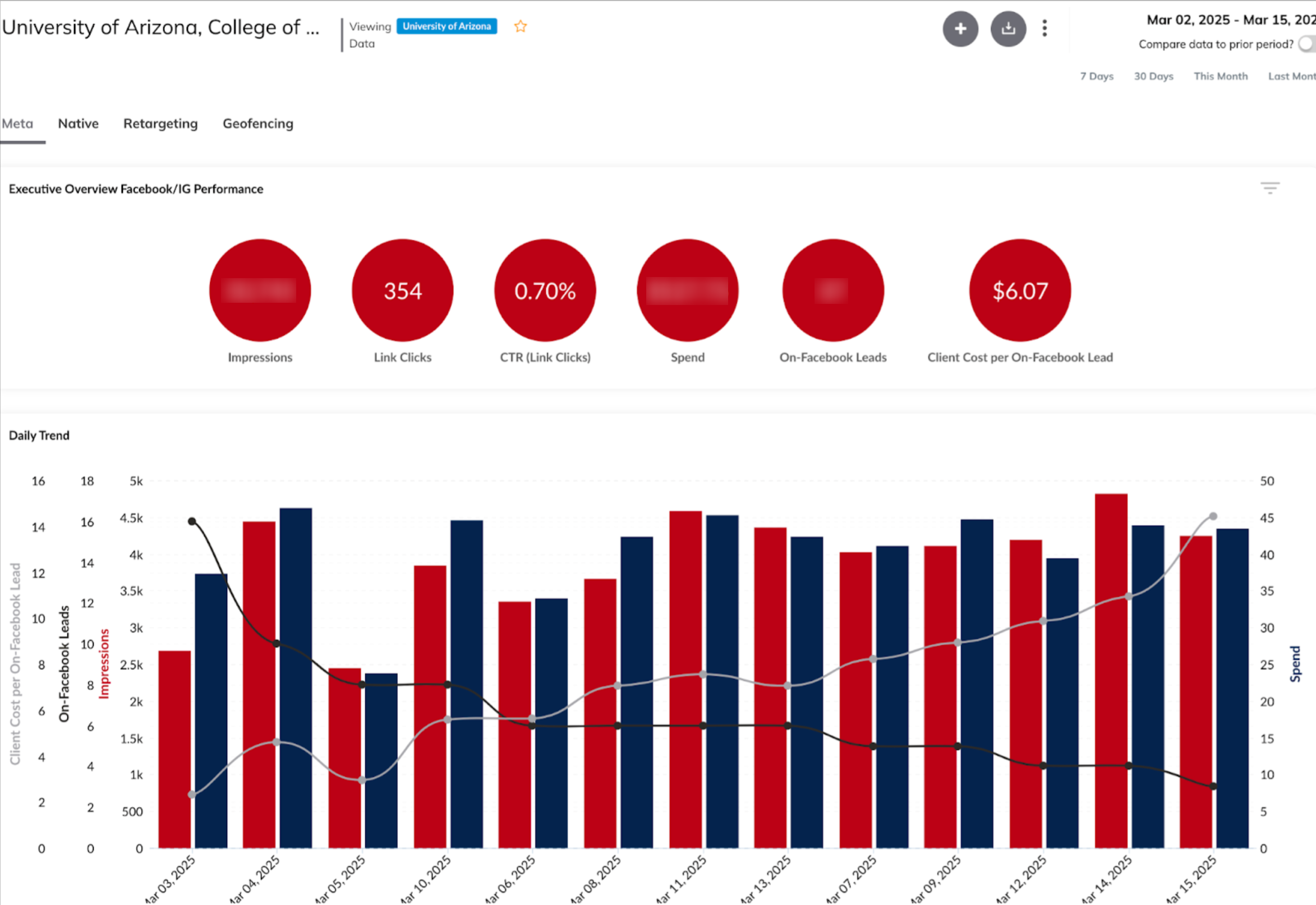
In just two weeks, the campaign delivered:

  • 87 high-quality leads from prospective students.
  • Cost-per-lead (CPL) of just $6.00 – $9.00  – a significant improvement over previous campaigns.
  • Increased engagement across Facebook & Instagram, with higher click-through rates (CTR) and lower bounce rates compared to past efforts.

By combining precision geofencing with hyper-targeted social media advertising, we helped the University of Arizona College of Nursing dramatically improve lead generation efficiency while ensuring they were reaching the right audience—individuals genuinely interested in pursuing a career in nursing.

university marketing resultsThe University of Arizona Nursing Program’s partnership with Propellant Media marked a turning point in their digital marketing strategy. By leveraging geofencing and social media advertising, we helped the client:


  • Rebuild trust in digital marketing after frustrations with their previous agency.
  • Enhance student recruitment efforts through advanced targeting strategies.
  • Establish a scalable framework for future digital advertising campaigns.

This successful launch is just the beginning, as Propellant Media continues to refine and expand the campaign, ensuring that the University of Arizona Nursing Program continues to attract high-quality nursing candidates and strengthen its position as a leader in nursing education.

B2B Publishing & Distribution Company Sees 50% Monthly Revenue Growth with Omnichannel Marketing Overhaul

Powerline Publishing, the parent company behind Bulk Bookstore, occupies a unique position in the B2B education market—serving not individual educators but school districts, classroom administrators, and purchasing managers responsible for large-volume book orders. While the company had previously worked with another digital agency, rising ad costs and plateauing performance began to erode confidence in the scalability of their digital acquisition efforts.

At the time of engagement, Powerline Publishing needed a comprehensive, modernized approach to paid media that would restore return on ad spend (ROAS) and deepen their penetration among institutional decision-makers across the education sector.

What Propellant Media Was Tasked With

Propellant Media was engaged to reinvigorate Bulk Bookstore’s digital performance and construct an omnichannel marketing system that:

  • Reaches educational decision-makers across platforms and behaviors

  • Reduces cost per acquisition

  • Drives more qualified conversions

  • Enhances ROAS with precise, keyword-to-landing-page alignment

  • Provides strategic support, A/B testing, and agile campaign innovation

The Media Plan We Implemented

Our campaign execution combined full-funnel precision with constant optimization. The strategy married robust audience targeting with smarter creative, channel-specific enhancements, and cross-platform scale. Here’s how we approached it:

1. Google Ads Transformation
We audited and restructured the entire Google Ads account, aligning campaign strategy with Bulk Bookstore’s best-selling categories and high-converting terms:

  • Performance Max & Google Shopping: Overhauled creative assets, audience signals, and bidding strategies to better surface key product lines.

  • Dynamic URL & Search Campaigns: Implemented keyword-to-landing-page alignment with match-type testing and custom URL tagging for accurate attribution.

  • Conversion Focus: Deployed value-based bidding and refined negative keyword strategies to limit budget waste.

2. Meta Advertising Revamp
Recognizing the importance of qualified leads over volume, we refined the Facebook/Instagram campaign structure:

  • Introduced enhanced lead forms with custom qualifying questions to elevate lead quality.

  • Improved tracking and data hygiene through Meta’s Conversion API, reducing signal loss and improving conversion attribution.

  • Tailored creative messaging and audience segmentation to speak to district-level purchasers.

3. Programmatic Display & Geofencing Expansion
Building upon an existing partnership around geofencing, we refined location-based tactics while optimizing retargeting momentum:

  • Geofencing: Continued event-based targeting of school district administrators and educational conferences.

  • Site Retargeting Enhancements: Optimized frequency capping, creative sequencing, and tailored CTAs based on page visitation behavior.

  • Microsoft Ads Launch: Mirrored successful Google Search campaign structures and extended keyword footprint into Microsoft’s search network for incremental reach.

4. Strategic Advisory & Ongoing Optimization
We maintained a bi-weekly collaboration cadence, delivering performance reviews, test-and-learn roadmaps, and proactive ideas to evolve the program. From seasonal messaging to creative refresh cycles, this ongoing partnership became a true extension of Bulk Bookstore’s internal team.

Results Of The Campaign

The transformation in Bulk Bookstore’s performance was immediate, sustained, and revenue-driven.

Performance Metric Result
Monthly Revenue Growth +50% Month-over-Month
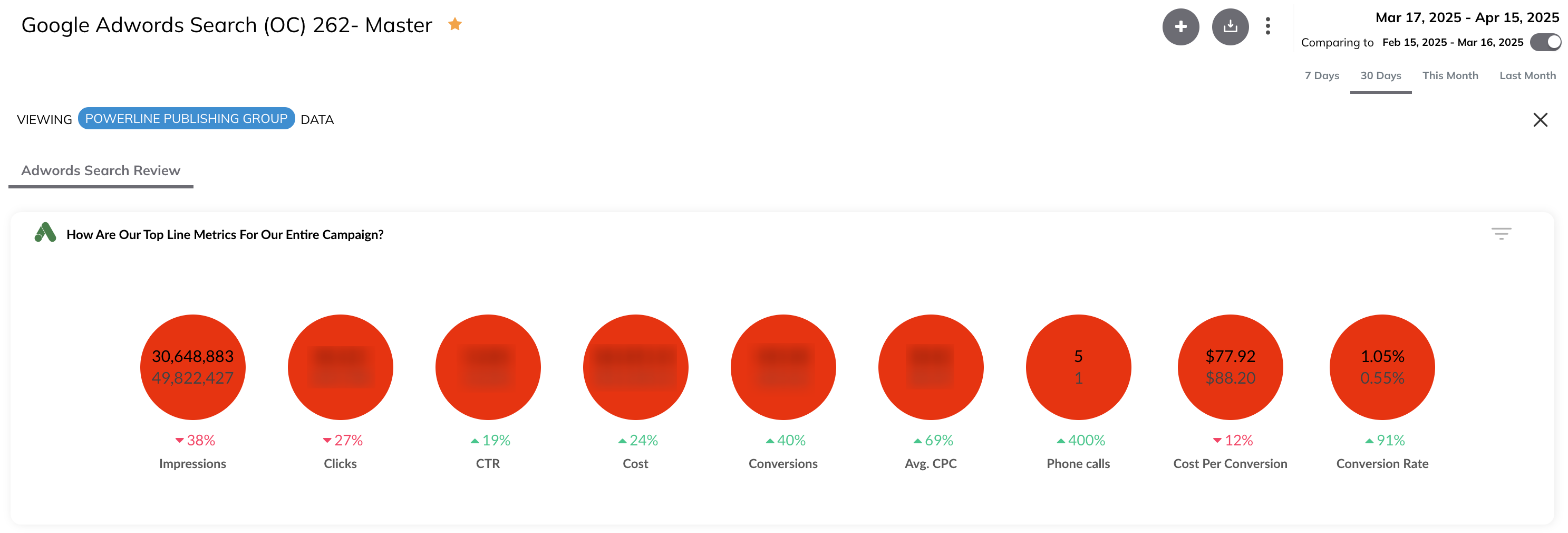
Google Ads Conversion Rate +91% Increase
Google Ads Cost Per Lead -12% Reduction
Lead Quality on Meta Significant Improvement via Enhanced Forms
Microsoft Ads Contribution Early indicators show performance mirroring Google ROI

In the first month alone, despite fewer impressions and clicks (due to refined targeting and smarter spend allocation), Google Ads delivered a 91% lift in conversion rate and a 12% reduction in cost per lead—fueled largely by improved landing page mapping and tighter campaign intent alignment.

Most critically, the full-funnel strategy enabled Powerline Publishing to scale profitably, with more predictable outcomes and higher-quality engagements with school district stakeholders.

Conclusion + Our Ongoing Partnership

Bulk Bookstore’s journey from stalled growth to double-digit monthly revenue acceleration demonstrates what’s possible when an educational B2B brand embraces omnichannel strategy and data-driven optimization. With Propellant Media as a strategic partner, Powerline Publishing has reinvested in growth—not just in ad dollars, but in the strategic infrastructure to outpace competitors and meet the needs of a complex, high-value B2B buyer.

B2B Software Company TitanX’s Inbound Transformation to Fuel Scalable Growth

TitanX, a B2B software firm specializing in sales acceleration technologies such as AI-driven cold calling, power dialers, and CRM integrations, had built its foundation through aggressive outbound sales. The CEO—an accomplished leader with deep expertise in outbound—recognized a pivotal inflection point: outbound alone could no longer sustain the brand’s growth ambitions.

TitanX needed to build pipeline more predictably, diversify its acquisition strategy, and evolve with buyer behavior. The next strategic move was clear—launch a modern, performance-driven inbound marketing engine.

What Propellant Media Was Tasked With

Propellant Media was engaged to architect and implement TitanX.IO’s first-ever inbound marketing plan. Our mandate was comprehensive:

  • Develop a digital media strategy to capture high-intent prospects.

  • Craft messaging that resonated with decision-makers across sales organizations.

  • Build a multi-channel digital ecosystem optimized for conversions.

  • Reduce the company’s reliance on outbound channels while maintaining lead quality and volume.

The Media Plan We Developed & Executed

We executed a full-funnel inbound strategy with meticulous attention to message-market fit, audience segmentation, and media allocation. Here’s how we tackled the challenge:

Keyword & Intent Strategy

We conducted deep keyword research focused on high-commercial-intent terms relevant to TitanX’s offerings and audience, including:

  • AI Cold Calling Software

  • CRM Solutions for B2B Sales

  • Sales Power Dialer

  • Sales Enablement Tools for Tech Companies

  • Cold Outreach Automation

Audience & Persona Development

We zeroed in on core buying personas, particularly VPs of Sales, Revenue Operations Leaders, and Directors of Business Development at mid-market to enterprise SaaS companies. Using TitanX’s existing customer base, we developed lookalike audiences and refined targeting layers by industry vertical, company size, and job title.

Media Channel Activation

We launched a multi-platform campaign stack to maximize reach and capture demand at each stage of the funnel:

  • Google Ads (Search & Display) for high-intent capture.

  • Meta (Facebook/Instagram) to retarget and educate stakeholders within the buying committee.

  • LinkedIn Ads targeting decision-makers based on role, industry, and company size.

  • YouTube Ads to build awareness and engagement with visual storytelling.

  • Site Retargeting to re-engage warm traffic and improve conversion rates.

4. Creative & Conversion Consulting

Propellant Media collaborated with TitanX to enhance ad messaging and landing page UX. Our goal was to ensure conversion paths aligned with user intent. We introduced social proof, simplified lead capture forms, and clarified value propositions across critical landing pages.

Results Of The Campaign

The impact was immediate and measurable—TitanX.IO’s pivot to inbound became a force multiplier for their sales engine.

These results validated the strategic shift from a purely outbound model to a scalable inbound + outbound hybrid. Notably, two opportunities generated from our campaigns entered late-stage negotiations with projected multiple six-figure annual recurring revenue (ARR) implications—underscoring the quality of leads and the strength of our full-funnel strategy.

TitanX.IO’s journey underscores a powerful evolution: from an outbound-driven mindset to a hybrid growth model driven by inbound precision. Through Propellant Media’s performance marketing strategy, TitanX not only scaled lead generation but also unlocked high-value opportunities that aligned with long-term revenue objectives.

This case exemplifies how SaaS brands rooted in outbound can effectively transition to inbound with the right strategy, partners, and execution.

New Jersey College Grows Their Student Engagement For Their Summer Housing

Stevens Institute of Technology did most of their marketing in-house for many years. Similar to Kennesaw State University, in 2020 Stevens came to us to give them access and expertise on geofencing marketing and programmatic display advertising. It’s now grown to manage digital campaigns across all channels, including programmatic, geofencing, Google Ads, YouTube, Meta, and LinkedIn for multiple graduate programs and brand awareness.

Propellant Media is now engrained with their entire marketing and admissions team executing lead generation and brand awareness campaigns.  

Instead of producing specific metrics for any respective campaign program, we wanted to speak to the campaign strategy we developed for a unique segment of their marketing team that needed our assistance in reaching in-market students for summer housing in New York.

Overview & Objective

Stevens, despite being located in Hoboken, their objective was to reach students looking at summer internship housing options in New York and direct them to Stevens’ housing options. Our team was already used to the brand awareness and lead generation campaign we were running, but this was a one-off request that they needed assistance with.

They were wanting to market their properties for housing to students both in New York and around the country.  Despite this being a one-off request, we implemented a strategy that incorporated mostly Google Ads.

The Strategy 

Our team is very methodical in how we consider ad campaigns for higher education brands.  And knowing we had a limited budget to work with, we came up with the following strategy on Google Ads.  Use in-market “summer housing” terms, but split out the campaigns as geo-specific campaigns with a high intention of specific terms in each of them.  

For example, if we targeted students in New York City, we wanted to leverage similar terms below that we pulled from Google Keyword Planner that had respectable demand.

But for geo specific regions outside of New York and students looking at New York City for summer housing, we built a campaign for just that region alone.  The campaign was called Summer Housing (Outside Of New York).  We leverage geospecific terms for that campaign including:

  • New York intern summer housing
  • New York city summer housing
  • Manhattan summer housing

This approach allowed us to segment campaigns accordingly by keywords and geography, limit waste of students who are solely looking for summer housing options in New York, and compare campaign performance of the two campaigns (Outside New York vs Inside New York).

Results Of The Campaign

Despite the budget being limited, we constantly received feedback that the summer housing rooms were being booked and the general interest team for summer housing was receiving an uptick in requests compared to prior years.

9-Figure Mattress Store Uses OTT Advertising & Geofencing To Sell More Furniture

A northeast furniture store with many locations wanted to think “outside the box” of traditional advertising so that they could formulate solutions to the many “pain points” in which the COVID pandemic was changing the landscape of doing business.  They were doing the traditional Google Ads, Facebook and TV Advertising.  To further complicate the challenges, the pandemic created inventory/supply chain shortages. Regardless, the furniture company still wanted a proactive approach to reaching in-market shoppers who were most likely to purchase mattresses and furniture. 

By utilizing our counsel, strategies and platforms for 6 months, they started with a $3,000 per month budget and for the past 21 months, their budget has fluctuated between $20,000 to $40,000 per month. 

Primary Challenges The Furniture Store Faced

COVID changed the landscape in how furniture businesses operate

Although the pandemic has affected so many in so many ways, the “spirit” and “attitudes” of this furniture brand allowed them to “fight and win” versus others who have adopted a “wait and see and hope to survive” attitude. Simply put, do nothing, get nothing.  SO they double downed on their digital advertising and sought on new strategies their competitor were not testing.

Supply chain made it tough to get product in on a consistent basis

One of the tremendous advantages to utilizing robust, digital strategies is the ability to be nimble. Digital media buys, pivots, tweaks and optimizations or even “wholesale” changes across the board can be implemented with speed, unlike traditional media buying and placements which can lag. The ability to be nimble allows the dealership to respond quickly to the fluctuating inventory from mattresses to other types of furniture

We were able to furniture and mattress shoppers accordingly, presenting relevant advertising messaging that would resonate with the audiences that mattered most to the multi-location store…at that time. We utilized a “multi-pronged” approach finding furniture buyers or those who have a “high-propensity for being in the market,” coupled with “creditworthiness” and we targeted them at their residences as well as other competitor furniture and mattress stores near their locations.

furniture store ott advertising

Using Addressable Residential Geofencing, this allowed the furniture brand to connect with shoppers during their “research” phase and via their online activities that indicate “intent to buy.”  So, those who think that only targeting or geofencing their competitors is a good strategy are normally sorely mistaken as they are too late to the party and their media spend is wasted.

This furniture store was able to influence the mattress shopper during their research phase so that our furniture store was the one of choice, first. Again, we would use this strategy mixing new mattresses along with coupon redemption codes.

Additionally, the furniture brand’s messaging would resonate with those who were in-market visiting another furniture store or researching mattress and furniture online.  So, the ability to identify different types of buyers and, in turn, serve advertising in the form of banners, display ads, pre-roll video and OTT/CTV Advertising was impactful. If you “entertain the brain, you turn shoppers into buyers.” Simple!

What Propellant Media Was Tasked With

The client didn’t simply want a straightforward geofencing campaign.  Instead, they wanted a holistic programmatic strategy that heavily focused on utilizing their video creative.

It’s imperative to note that a single tactic or strategy is not what wins the day. Instead, we develop a more “holistic” or well-rounded approach strategically. So we came up with the following tactics are deployed in a single campaign

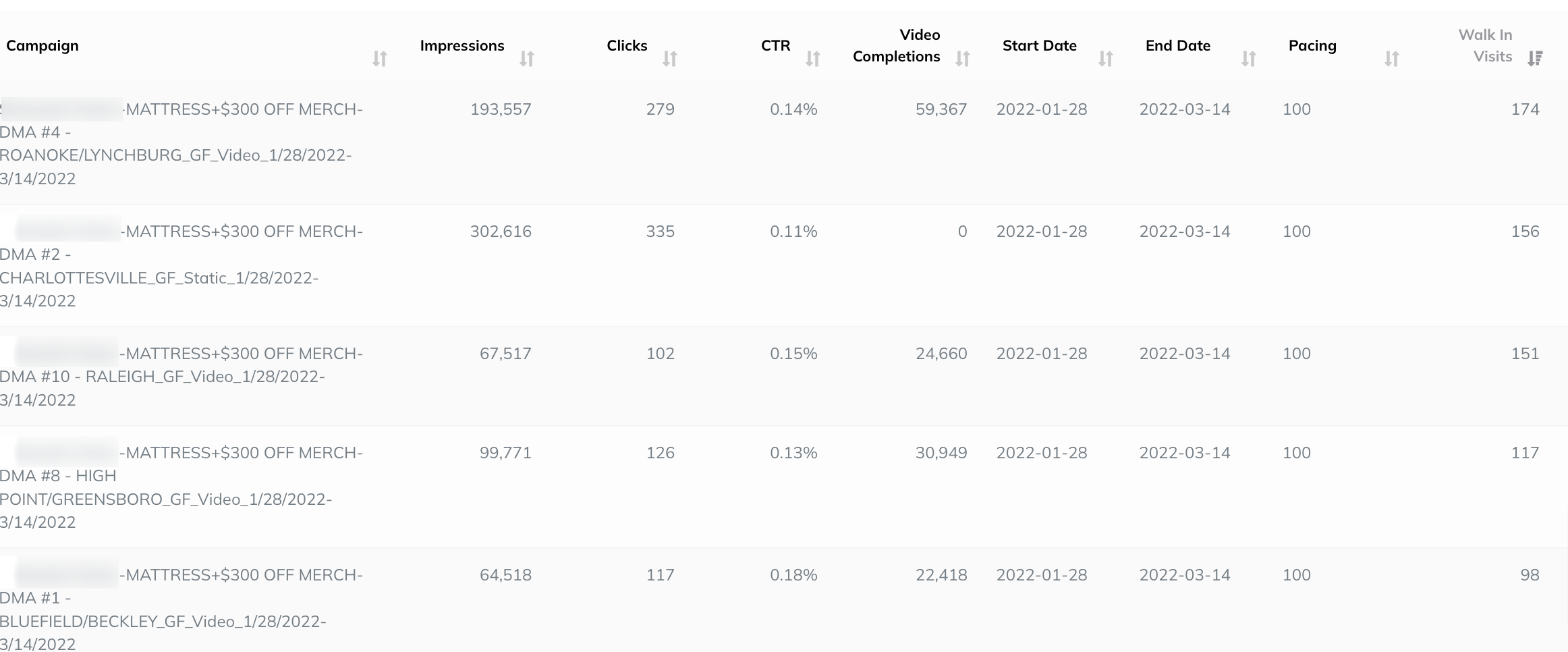
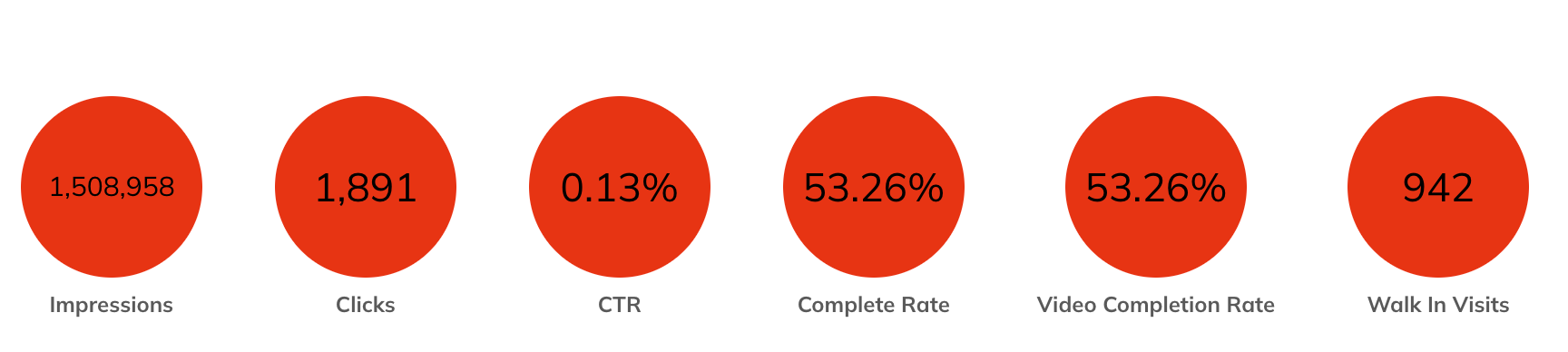
Over A 90 Days Period…The Furniture Store Drove Over 900 Walk-ins To Their Furniture Store

furniture store ott advertisingThis “holistic” strategy allowed us to drive over 900 walk-ins to their furniture store over a 90-day period.  Storage managers were contacting the marketing team about people claiming the coupon codes and noticed the obvious increase in store sales during the advertising period.



The brand has expanded the marketing strategy to more store around the country and has allocated additional marketing dollars to this bucket of digital advertising.

Auto Dealership Uses OTT Advertising To Turnaround A Two Year Slump

The Challenge

A mid-western auto dealership wanted to think “outside the box” of traditional advertising so that they could formulate solutions to the many “pain points” in which the COVID pandemic was changing the landscape of doing business. To further complicate the challenges, the pandemic created inventory/supply chain shortages. Regardless, the dealership still wanted a proactive approach to winning business from the front of the house, with new & used auto sales, to the back of the house bolstering service revenue. Of course, we could jump into all kinds of metrics, numbers, etc. But the most telling number to note is that the dealership has been utilizing our counsel, strategies and platforms for TWO YEARS. They started with a $3,000 per month budget and for the past 21 months, their budget has fluctuated between $10,000 to $20,000 per month. Now, those are numbers we can all understand their meaning…success!

Core Strategy & Solutions We Implemented

COVID changed the landscape in how businesses operate

Although the pandemic has affected so many in so many ways, the “spirit” and “attitudes” of this dealership allow them to “fight and win” versus others who have adopted a “wait and see and hope to survive” attitude. Simply put, do nothing, get nothing!

New car inventory fluctuated from nearly impossible to get cars to sporadic influxes of product

One of the tremendous advantages to utilizing robust, digital strategies is the ability to be nimble. Digital media buys, pivots, tweaks and optimizations or even “wholesale” changes across the board can be implemented with speed, unlike traditional media buying and placements which can lag. The ability to be nimble allows the dealership to respond quickly to the fluctuating inventory from new cars versus used cars versus trucks. 

We were able to target auto buyers accordingly, presenting relevant advertising messaging that would resonate with the audiences that mattered most to the dealership…at that time. We utilized a “multi-pronged” approach finding car buyers or those who have a “high-propensity for being in the market,” coupled with “creditworthiness” and we targeted them at their residences. 

Using Addressable Residential Geofencing allows the dealership to connect with auto buyers during their “research” phase and via their online activities that indicate “intent to buy.” This preemptive strike is crucial due to the fact that 81% of those who show up at a dealership buy a car within 2 weeks.” So, those who think that only targeting or geofencing their competitors is a good strategy are normally sorely mistaken as they are too late to the party and their media spend is wasted.

Our dealership was able to influence the car buyer during their research phase so that OUR dealership was the dealership of choice, first. Again, we would use this strategy mixing new versus used car emphasis according to inventory. 

Additionally, the dealership’s messaging would resonate with those who only wanted to sell their car but not buy one. So, the ability to identify different types of buyers and, in turn, serve advertising in the form of banners, display ads, pre-roll video and OTT/CTV Advertising was impactful. If you “entertain the brain, you turn shoppers into buyers.” Simple!

  • New car shortages put a premium on used cars, yet every dealer was vying to buy up used car inventory and auction prices skyrocketed further squeezing dealership margins

Competition for used cars is brutal. Because dealerships have not had typical 60 to 120 day supplies of new car inventory and, thus, few new cars to sell, they also are not getting the normal flow of trade-ins helping to fill their used car inventory pipelines. As a result, the used car environment became “game-on” and letting the “highest bidder win at sky-rocketing prices” became the reality of the auto auctions. The dealership needed alternatives to securing used cars.

As stated previously, using a mix of strategies and putting the most horsepower on Addressable Residential Geofencing, the dealership is able to fill their used car inventory needs. If they need more cars, we target “car people” vs. “truck people.” 

  • Unique to this dealership, they were located on the “wrong” side of a major river dividing their smaller market from a major metropolitan area. The car buyer’s migration patterns always favor going to the metro area, first, instead of shopping local and the dealership needed to figure out how to slow this trend. Migration patterns NEVER go in the reverse direction.

The primary tactic for this purpose was Addressable Residential Geofencing, again, for the reasons previously mentioned. But, we didn’t stop there in our creative thinking. We deployed programmatic “keyword search retargeting,” targeting those who show intent for the subject matter by their online behavior by which they are using search words/terms relevant to the dealership’s offerings and services. Note, these searches are not “paid search,” like AdWords; rather, these searches occur throughout the rest of the internet on other search engines, subdirectories, etc. We also utilized “keyword contextual retargeting” (Think “research retargeting) in which the content, articles, blogs, other sites that the person is consuming is relevant to our dealerships offering. Of course, we throttled the “location line” to those doing these activities in our dealership’s “back yard.”

  • “Just because you may not have bought your car from us, doesn’t mean we won’t fix it” was a theme used in their advertising in order to gain more service department customers and new people to start a relationship. Getting people to the service department often translates into new or used car sales.

The primary focus here was on the creative. We made sure that in all of our tactical approaches, that the creative / messaging included a plug for “buying your used car, coupled with specific “service” video creative deployed via Programmatic Video (“Pre-roll”). These service advertisements would be targeted to specific audiences and or utilized in a rotation with the other advertising.

  • Obviously, all dealerships calculate their monthly advertising as a “cost per unit sold.” However, in the current environment, that dynamic was somewhat “out the window.” Instead, the dealership maintains a consistent, monthly digital media spend from $10,000 to $20,000.

It’s imperative to note that a single tactic or strategy is not what wins the day. Instead, we develop a more “holistic” or well-rounded approach strategically. That means, many tactics are deployed in a single campaign–Geofencing, Addressable or Residential Geofencing, Keyword Search Retargeting, Keyword Contextual Retargeting, Site Retargeting, etc.

As we and the dealership are huge believers in data, all metrics are ported into a dashboard in which the dealership has access 24/7. Keeping an “eye on the prize” allows us, as a team, to maximize the dealership’s advertising spend in the most efficient manner. Additionally, our team conducts regular campaign reviews with the dealership reviewing the comprehensive data, including “walk-in visits.” Now, we can answer the age-old question:  “Did our advertising get someone in the door?”

Campaign & Client Results

With a well rounded strategy, we were able to deliver 160 walk-ins monthly and measure online conversions from those who saw the ads online and via OTT Advertising, and ultimately visited the website.  We continued to implemented other tactics including Youtube Advertising, which also impacted overall marketing efforts.

Local State University Defies Expectations During Covid 19 At $10 Cost Per Lead

students or teenagers with files and diploma

The Challenge

This local university has a multi-million dollar marketing budget across their undergraduate and graduate programs.  Between the many competitors they have to face including prominent Georgia and Southeast Universities attracting new applicants and students has not been an easy task.  That in addition to the low brand recognition for the university, they have been slowly growing their presence, but needed new innovative tactics to help them reach the student profile that could thrive as students at their school as well as graduates.  That’s when they reached out to Propellant Media for guidance.

The Solution We Implemented

Our original statement of work included OTT/CTV Advertising and Streaming Radio/Spotify campaigns for undergraduate brand.  But as we continued to work together, they soon learned that our passion and partnership mattered just as much as the results.  It showed in our communication, our execution of campaigns, and bringing fresh ideas based on our prior experience with other colleges and universities we worked with.

Nine (9) Months into our client management approach, and supported by strong results, the University was proactively convinced to dramatically increase our SOW to include

  • Geofencing SAT & ACT locations as well as moments when the admissions team is visits certain recruitment events in the southeast
  • Full Funnel Google Ads campaign centered around brand & non brand keywords
  • Paid Social (LinkedIn & Facebook/Instagram) lead generation campaign
  • Focus on retargeting leads with urgency language to get them to convert into true applicants
  • Now handling their marketing plans for the Biz School and Multiple Grad Programs
  • Implementing a Full Funnel attribution model and tying advertising data to applicant and CRM data
  • All vital digital channels Google Adwords, Bing Ads, YouTube, Programmatic Display, lookalike modeling, CRM targeting, OTT/CTV, Pandora/Spotify, Twitch, LinkedIn, Facebook/Instagram

Results Of The Campaign

As we launched and took over the majority of the campaigns, we helped the client lower their cost per student lead which continued to hover at $10 – $20/student for their undergraduate institution.  Our highest peak of lead flow has grown to 2,800 leads per month.

And for the graduate programs, we helped decrease the cost per lead went from $1,100 to $250, thus filling up each department across all the grad programs at the University.  We currently manage over 25 graduate programs each with their own set of strategies.

We have been a partner with the institution for over 3 years and counting.

The University was featured in several publications highlighting the roughly 20% year over year growth despite COVID-19 and the expected increase in competition due to it.

Solar Energy Company Shines With Our Team At $148 Cost Per Conversion

solar panel

Solar Company Challenge

This company was trying to find a partner who could meet a CTR goal of .08% in the alternative energy vertical with minimal success. They needed a geofencing solution, but also reporting that would provide full transparency to overall reporting infrastructure.  They enlisted the help of our team to more precisely target their audience and drive down the CTR they had been seeing from other vendors.

Solution We Implemented

After better understanding the overall campaign challenges, we decided it was vital to implement a full funnel programmatic strategy that included geofencing marketing, site retargeting, and keyword contextual search retargeting.

  • KeyWord Contextual Search Retargeting: We started the campaign with an expanded keyword set due to our expertise with energy campaigns for both search retargeting and keyword contextual. We were then able to quickly optimize at the keyword level for the best performing keywords in the set. Following the keyword optimization, the team used day-parting and domain targeting to improve the performance. The final piece of the puzzle was optimization based on recency.  The recency window was made smaller and the efficiency was greatly improved.
  • Site Retargeting: Knowing the client was already doing google ads and facebook/Instagram advertising, we needed to implemented other forms of site retargeting to provide even more support to their overall advertising efforts.  So we carved out 5% of the budget to make their overall advertising work smarter.
  • Geofencing MarketingOur tried and true geofencing campaign is a bedrock of what we do and why they reached out to us.  We geofenced new constructoin communities that were single family in nature knowing these families and home buyers were open to implementing solar panels in their homes after they were fully and close to constructed.

Result (Improved the Client’s CTR)

Through multiple tactics and optimizations our team was able to achieve a CTR of .25% which more than tripled the company’s goal of .08%.  Over the cost of $4,000/month, we were able to attribute 27 conversions, or $148 cost per conversion.

In addition, the client noted the uptick in leads flow from the site retargeting, which lowered their cost per lead across facebook and google ads campaign because of the full funnel advertising that was implemented.

How We Assisted A Senior Care Living Facility Capture More Patients With Geofencing

nurse helps elderly woman at breakfast

Client Challenge

A regional senior care living facility with a good reputation was struggling to find new ways to gain the proper brand exposure through advertising efforts.  They were already doing Google Ads, SEO, and even TV Advertising in the local communities.  They knew there needed to be a more direct approach to reaching loved ones or senior ready to physically transition into a senior care community.  After learning about geofencing marketing, they requested our team at Propellant Media put together a comprehensive digital game plan that would help them drive walk in foot traffic, inquiries and tours of their facilities.


The Solution We Implemented

From the 4 plus senior care living locations we initially focused on driving foot traffic to, we thought a full funnel programmatic advertising plan was prudent to give all tactic added support:

  • Geofencing Marketing – We created a geofencing campaign targeting ER’s, hospitals, other competitor senior care facilities, and other core locations that became a natural transition point for seniors needing assisted living care.  We targeted over 25 – 30 locations per each individual senior care facility.
  • Keyword Contextual/Search Retargeting – We utilized popular keywords such as senior living, senior care, and senior care near me to reach people across the internet that showed intent.  We even utilized many of the top performing keywords the client furnished from their existing Google Ads campaigns and SEO work to ensure we gave it full coverage.
  • Site Retargeting – The site retargeting included a strategy that was centered on display ads, OTT Advertising and pre roll video.  This full funnel strategy also allowed us to engage senior care audiences knowing they would be more engaged with video in comparison to display ads.
  • Conversion Zone Tracking – In order to measure conversion, we placed a view through conversion pixel on the client’s website in order to measure people who saw the ads and then came to the client’s website or converted on a particular page.  But more importantly, we measured people who saw the ads and came to the client’s physical location.  This is how we’re able to show attribution across Geofencing Marketing campaigns.

ur team was also able to implement our conversion zone tracking, enabling us to measure those who have either clicked or seen the display ads from those who walked inside of our geofencing targets, and measure those who came back to the assisted living facilities.


The Campaign Results

Over the first few months of the campaign, the results have been both powerful and encouraging to our team.  Our team found a minimum of 60 tours/walk-ins attributed to the geofencing marketing campaign we ran in driving brand awareness and walk-in’s to their facilities.  And that was over a 30 day period.  As we continue the campaign for this client, we will naturally see a reduction in cost per visit.

Hotel Property Targets Travelers With Programmatic Display

Depositphotos_26829847_l-2015

The Challenge

A hotel property in a popular tourist destination city was looking to increase awareness among their relevant audience and drive up their programmatic advertising performance. They also wanted to focus on supporting their restaurant and dining locations at their hotel and resort as it was lacking in brand awareness and walk-in traffic due to the competition in the area.  They enlisted the help of our team to precisely target consumers interested in travel to their location.


The Solution We Implemented

Travel is a very unique area.  Given the high competition and number of options available for travelers, we had to implemented a very defined strategy for each tactic because we had 2 objectives: improve brand awareness and target travelers who could show interest in their hotel; and secondly drive restaurant/dining traffic to local travelers.

Our team developed a comprehensive strategy of search retargeting at the keyword level, site retargeting and mobile geo-optimization.

  • Keyword Contextual/Search Retargeting: Instead of targeting an entire country, we focused on keyword contextual and search retargeting based keywords for people looking for hotels in the key city.  So hotels in miami was a sample keyword we leveraged knowing we were getting our ads in front of those individuals expressing interest in hotel properties in miami.
  • Site Retargeting: We decided to tap into multiple DSP’s (not only 1), in order to expand our site retargeting efforts. This gave us even more air cover and further supported their Google Ads, Facebook Ads, and other omnichannel advertising efforts.
  • Geofencing Marketing: We were quick to explain to the client that using this tactic to attract travelers to the hotel would not be wise because there were not great practices in identifying people around the country based on their physical activities that would tell us they are firmly interested in booking travel.  That’s where search and keyword contextual came in.  Instead, we used geofencing to impact their restaurant and dining options that were available.  We geofenced nearby restaurant competitors, other competitors hotels, and local beaches.  We served creative ads that were promotional in nature and got people thinking about other local dining options at the hotel.

With quick learning from the campaign launch, our team and our multivariate algorithms optimized keywords, blacklisted specific domains to more precisely target customers, and adjusted the frequency cap and pacing to maximize budget. We also shifted budget to higher performing areas and swapped creative to keep the advertisements relevant through changing seasons.


The Results

Through multiple tactics and optimizations, our team achieved a CTR of .33%, more than tripling the client’s goal of reaching the industry average CTR of .08 – .1%.  In addition, we leveraged conversion zone tracking to measure those who saw the geofencing marketing ads and then came to the hotel to dine or other reasons.  Over the course of 3 months, we measured over 198 walk-in conversions.  Of that, 11 people clicked on the ads and the rest saw the ads and came to the hotel, letting our team know there was strong influence from the geofencing marketing campaign.

Local College Grows Campus Visits With Geofencing Marketing

education marketing

The Challenge

A local college was use to traditional digital advertising channels including paid search, Facebook advertising, and even some offline marketing including billboard ads.  Lead flow for the college was meager and they wanted to consider solutions that extended beyond typical lower funnel tactics.  After learning about geofencing advertising, the college decided to add it to its marketing mix.

Solution

Propellant Media utilized a list of nearby high schools that we believed were relevant targets based on the college’s existing base of students who attend the college.  Our strategy included:

  • Geofencing Marketing – we targeted SAT & ACT locations with our geofencing marketing solution.  We also geofenced their top 20 feeder high schools around the country.
  • Creative Ads – We also utilized some compelling creative ads we believed would speak to the particular careers that students were most interested in at the college.
  • Omnichannel Site Retargeting – We tapped into multiple DSP’s and channels to retarget users over and over again who expressed an interest in the college.

Results

Over the course of a short period of 1 1/2 weeks while the campaign remains active, the geofencing advertising campaign drove over 30 walk-in visits and overall tours at the college.  The client also saw a reduction in overall cost per conversion for Google Ads and Facebook campaigns due to the site retargeting we implemented for the College.

Apartment Complex Converts With Geofencing

The Challenge

An apartment complex for senior citizens was looking to advertise a rent-free promotion and drive inquiries from potential new residents. They enlisted the help of our team to utilize new geo-fencing technology and several other tactics to more accurately reach their target audience and drive visits to their website and physical location.

The Strategy & What We Implemented

We knew we had an opportunity to reach the target audience with programmatic display solutions.  So we focused on the follow digital tactics:

  • Geofencing Marketing – The advertiser identified the key locations to reach their target audience and our team built geo-fences around those sites.
  • Site Retargeting – The campaign also featured search retargeting at the keyword level and category contextual targeting to reach users interested in senior living.
  • Keyword Contextual/Search Retargeting – We leveraged a number of popular keywords such a 50 plus apartments, senior apartment living, etc.. in order to ensure we reached our target audience.
  • Conversion Zone Tracking – Additionally, the client decided mid-flight to implement a geo-fence conversion zone around the apartment complex in order to measure the number of individuals who were delivered an ad and then visited the complex. Our team and our multivariate algorithms worked to continually optimize the campaign mid-flight by optimizing keywords, category contextual elements and more.

Results

Over the month-long campaign, our team delivered a .41% CTR, more than quadrupling the industry average CTR of .08-.1%. With our team’s Conversion Zone tool, the advertiser was also able to track 109 geo-fence conversions at a CPA of $4.51.

Thanks for contacting us! We will get in touch with you shortly.

Download PDF

Thanks for contacting us! We will get in touch with you shortly.

Download PDF

Thanks for contacting us! We will get in touch with you shortly.

Download PDF

Thanks for contacting us! We will get in touch with you shortly.

Download PDF

Thanks for contacting us! We will get in touch with you shortly.

Download PDF

Thanks for contacting us! We will get in touch with you shortly.

Download PDF

Thanks for contacting us! We will get in touch with you shortly.

Download PDF

Thanks for contacting us! We will get in touch with you shortly.

Download PDF